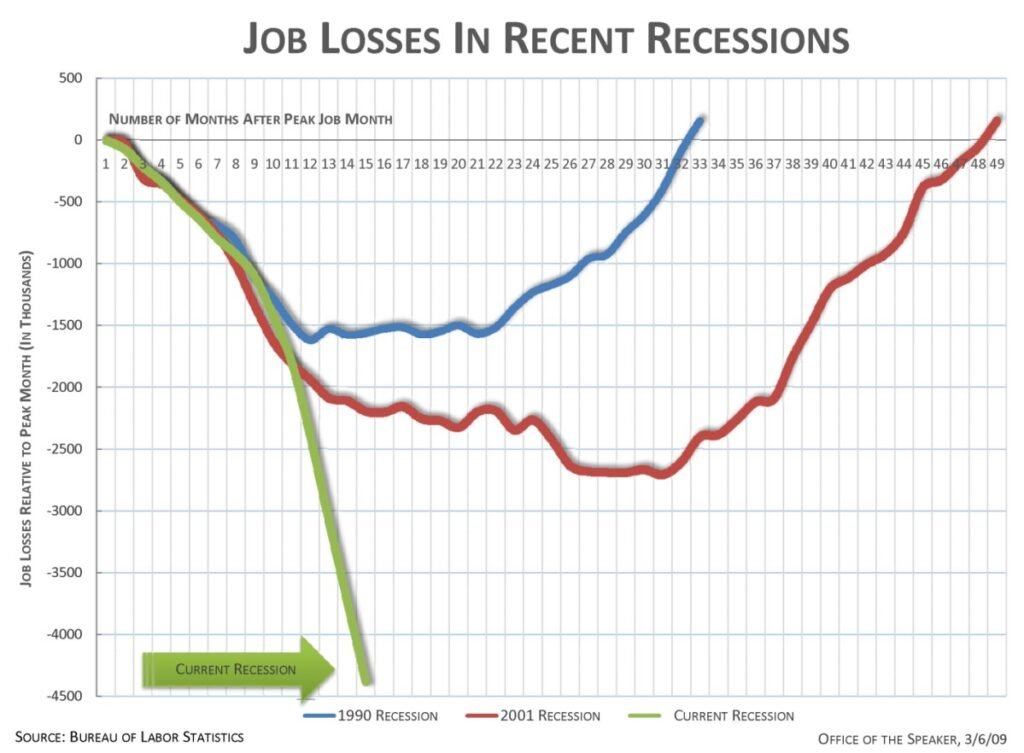
A recession happens when a shock to the economy — a credit crunch, an energy-price spike, trouble in a major trading partner, or the Federal Reserve tightening too hard — knocks a growing economy off course, and the resulting pullback spreads widely enough, deeply enough, and long enough for economists to call it official. There is no single universal trigger; there is a shock, and then a chain reaction of businesses and households pulling back that tends to feed on itself.
Who Actually Decides a Recession Happened
In the United States, that call belongs to the National Bureau of Economic Research (NBER), a private nonprofit economic research organization whose Business Cycle Dating Committee — the small panel of economists tasked with dating the start and end of downturns — defines a recession as “a significant decline in economic activity that is spread across the economy and lasts more than a few months.” That matters because the committee is not just watching one number: it weighs several monthly indicators together, including real personal income, nonfarm payroll employment (the total number of paid U.S. jobs outside farms, private households, and a few other categories), consumer spending, and industrial production, looking for depth, how broadly the decline is spread across the economy, and duration.
It Is Not Really “Two Quarters of Falling GDP”
The popular shorthand — two consecutive quarters of falling gross domestic product (GDP), the total value of everything a country produces — is a useful rule of thumb, but it is not the rule the NBER actually uses. The committee can and has called recessions that do not fit that pattern, because its definition leans on the breadth and depth of the slowdown, not a single GDP threshold. Relying on the two-quarter shortcut alone can mislead: it can miss a sharp, severe, but shorter downturn, and it can also lag well behind what is actually happening on the ground.
Recessions Are Part of a Normal Cycle
Recessions are one phase of what economists call the business cycle, the recurring pattern of expansion, peak, contraction, and trough that market economies move through before expansion resumes. Left alone, an economy tends to keep expanding; a recession happens when something knocks it off that path. As the Federal Reserve Bank of St. Louis puts it, expansions do not simply die of old age — they end because of a shock.
What Kinds of Shocks Trigger One
Those shocks take a handful of recognizable forms. Financial market disruptions, such as a credit freeze or a banking crisis, can suddenly choke off the lending that businesses and households depend on to invest and spend. Sudden spikes in energy prices raise costs across the entire economy at once, squeezing everything from manufacturing to household budgets. International shocks, such as a crisis in a major trading partner, can spill across borders through trade and financial links. And sometimes the trigger is deliberate: when inflation runs too hot, the Federal Reserve raises interest rates to cool spending, and if it tightens too aggressively, that same medicine can tip the economy into contraction.
How One Shock Turns Into a Downturn
Once a shock hits, a fairly consistent chain reaction tends to follow. Businesses pull back on investment, and consumers cut spending on big-ticket items like homes and cars. Sales fall, inventories pile up, and companies respond by cutting production and, eventually, jobs. Rising unemployment then further dampens consumer spending, reinforcing the slowdown rather than stopping it. Eventually, as debt gets paid down and prices adjust to the new reality, the conditions for renewed investment and spending fall back into place, and the cycle turns toward recovery.