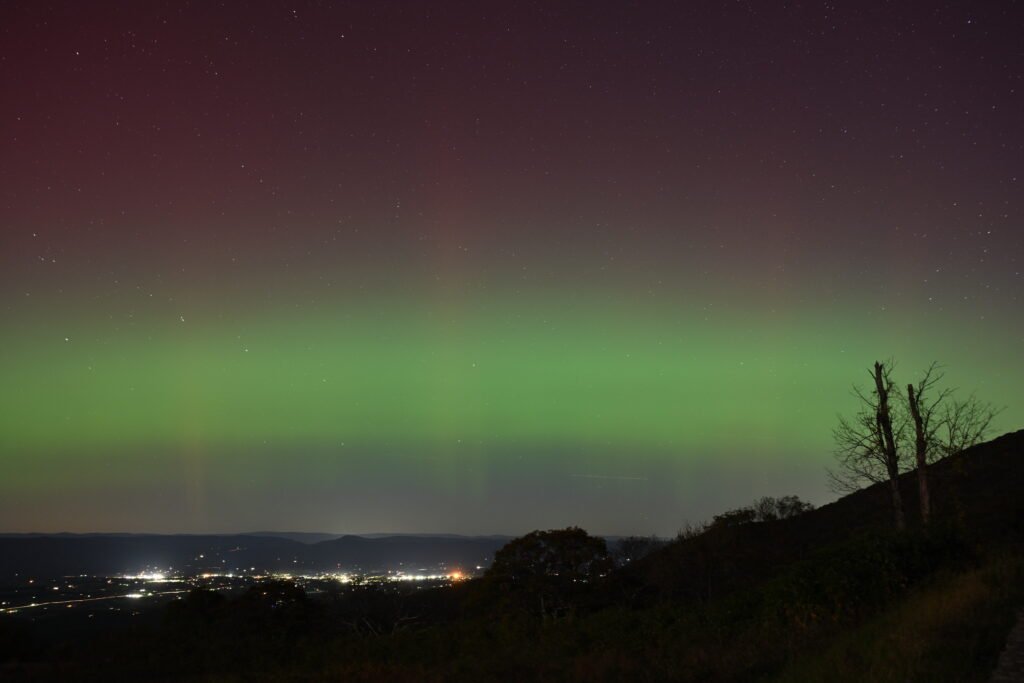
The northern lights happen when charged particles from the sun slam into Earth’s atmosphere and knock its gases into a glow — a chain of events that starts on the surface of the sun, crosses 93 million miles of space, and ends with subatomic particles hitting the sky at a meaningful fraction of the speed of light. On a clear, dark night at high latitude, that chain shows up as ribbons of green, sometimes edged in pink or purple, rippling overhead like a curtain in the wind.
It starts with the sun
The sun is constantly shedding charged particles into space in a stream called the solar wind, and it periodically hurls out bigger bursts through solar flares and coronal mass ejections. According to NASA, when that stream reaches Earth, it interacts with the planet’s protective magnetic field, and energy from the collision builds up in the surrounding magnetosphere — the region of space where Earth’s magnetism, not the sun’s, is in charge. NASA describes the whole system as an intricate dance of particles and magnetism between the sun and Earth known as space weather, and that energy buildup is the fuel the rest of the process runs on.
Why the lights ring the poles instead of showing up everywhere
That stored magnetic energy doesn’t release evenly. NOAA’s Space Weather Prediction Center explains that when the solar wind’s magnetic field tips southward, it links up with Earth’s own field lines, dumping energy into the magnetosphere and accelerating electrons downward along those lines toward the polar regions. That’s why auroras form in rings — called auroral ovals — centered on the magnetic north and south poles, rather than appearing randomly around the globe: the electrons are being funneled there by the geometry of Earth’s own magnetic field.
How fast those particles are actually moving
Those accelerated electrons aren’t moving gently. NOAA’s tutorial puts their speed at roughly 20,000 kilometers per second — about one-tenth the speed of light, or 44 million miles per hour — as they slam into oxygen and nitrogen atoms and molecules more than 60 miles above Earth’s surface. That impact knocks electrons in those atmospheric atoms into a higher-energy state. As the atoms relax back down, they release the extra energy as photons, and a coordinated shower of trillions of those photons is what registers to a person on the ground as a glowing aurora.
Why the color changes across a single display
The color depends on which gas gets hit and how high up the collision happens. NASA and NOAA both point to atomic oxygen as the source of the most common aurora color: a yellow-green glow produced roughly 60 to 120 miles up. Higher-altitude collisions with oxygen, above about 120 miles, tend to produce a rarer red glow, because that particular excited state takes longer to release its energy and needs the thinner air up there to survive long enough to do it. Nitrogen molecules, meanwhile, are responsible for the blue and purple fringes sometimes visible along the lower edges of a display — which is why a single strong aurora can show several colors layered at once, each one marking a different altitude and a different gas.
Why some nights — and some years — are better than others
Aurora activity tracks the sun’s roughly 11-year solar cycle. Near solar maximum, when the sun produces more frequent flares and coronal mass ejections, geomagnetic storms are stronger and more frequent, which pushes the auroral oval further from the poles and makes the northern lights visible at lower latitudes than usual. That’s also why NOAA’s Space Weather Prediction Center issues real-time aurora forecasts: they give skywatchers advance notice of when a strong solar wind stream is likely to paint the sky, rather than leaving it to chance.
- NASA Science, “Auroras.” science.nasa.gov.
- NOAA / NWS Space Weather Prediction Center, “Aurora Tutorial.” spaceweather.gov.
- Photo: G. Edward Johnson, CC BY 4.0, via Wikimedia Commons.