Interest rates affect the economy by changing how expensive it is to borrow money and how much reward there is for saving it — and the Federal Reserve controls that starting point with a single number that ripples outward into mortgages, credit cards, and savings accounts within months.
How one number moves the whole system
The Fed doesn’t set your mortgage rate or your savings account yield directly. What it actually controls is the federal funds rate: the rate banks charge each other for short-term overnight loans. When the Fed’s policy committee raises or lowers that target, the change spreads outward through financial markets — first into other short-term rates, then into the longer-term rates that matter most to households and businesses. Much of that spread happens through what economists call the expectations channel: investors adjust long-term bond yields based on where they think short-term rates are headed next, so markets often move before the Fed even acts.
What it means for anyone borrowing money
Higher benchmark rates translate directly into higher costs for consumer debt. Between July 2021 and recent years, as the Fed raised rates to fight inflation, average credit card rates climbed from about 16.16% to 19.62%, new car loan rates rose from roughly 4.18% to 7.01%, and home equity lines of credit jumped from about 4.24% to 7.44%, according to Bankrate. Mortgages respond too, though indirectly, since they track the 10-year Treasury yield rather than the Fed’s rate itself. Bankrate calculated that financing a $500,000 mortgage cost about $2,089 a month when rates bottomed out near 2.93%, versus roughly $3,079 a month at 6.25% — a 47% jump in the monthly payment for the exact same loan amount. That’s the practical weight of “the Fed raised rates”: the same purchase costs meaningfully more, every month, for as long as the loan lasts.
What it means for anyone saving money
The same tightening cycle that raises borrowing costs tends to reward savers. As benchmark rates climbed, yields on savings accounts and certificates of deposit rose in tandem, with some savings accounts and CDs reaching annual yields above 4% during recent peaks — well above the roughly 0.5% national average that persists at many traditional banks, which tend to be slower to pass higher rates along to depositors. The gap between those two numbers is itself useful information: it’s often worth comparing accounts rather than assuming a bank’s default rate reflects where the market actually is.
Why the Fed does this on purpose
Higher rates aren’t a side effect of Fed policy; they’re the actual goal. By making borrowing more expensive, the Fed deliberately discourages big-ticket purchases like homes, cars, and business equipment. Federal Reserve Governor Philip Jefferson has described this as reducing “the overall demand for goods and services in the economy,” which cools inflation by easing the pressure of demand outpacing supply. Cutting rates works the same lever in reverse — making borrowing cheaper to encourage spending and investment when the economy needs a boost, such as during a slowdown.
One of the trickiest parts of this system is timing. Jefferson has noted that monetary policy affects the economy and inflation with “long, variable, and highly uncertain lags,” meaning a rate change made today might not fully show up in spending, hiring, or inflation data for many months. That lag is a big part of why the Fed tends to move in small, cautious steps and watches incoming data closely rather than swinging rates dramatically in either direction.
- Federal Reserve Governor Philip Jefferson, “Speech on the Implementation and Transmission of Monetary Policy.” Federal Reserve.
- Bankrate, “6 Ways the Fed’s Interest Rate Decisions Impact Your Money.” Article.
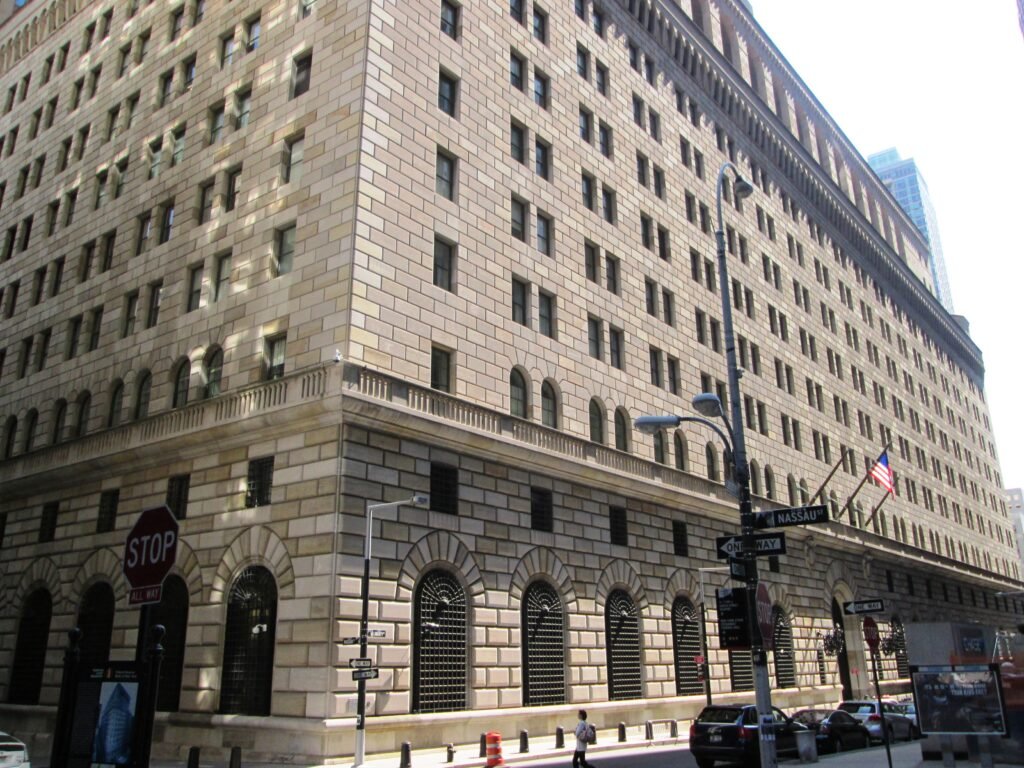
- Photo: Beyond My Ken, CC BY-SA 4.0, via Wikimedia Commons.