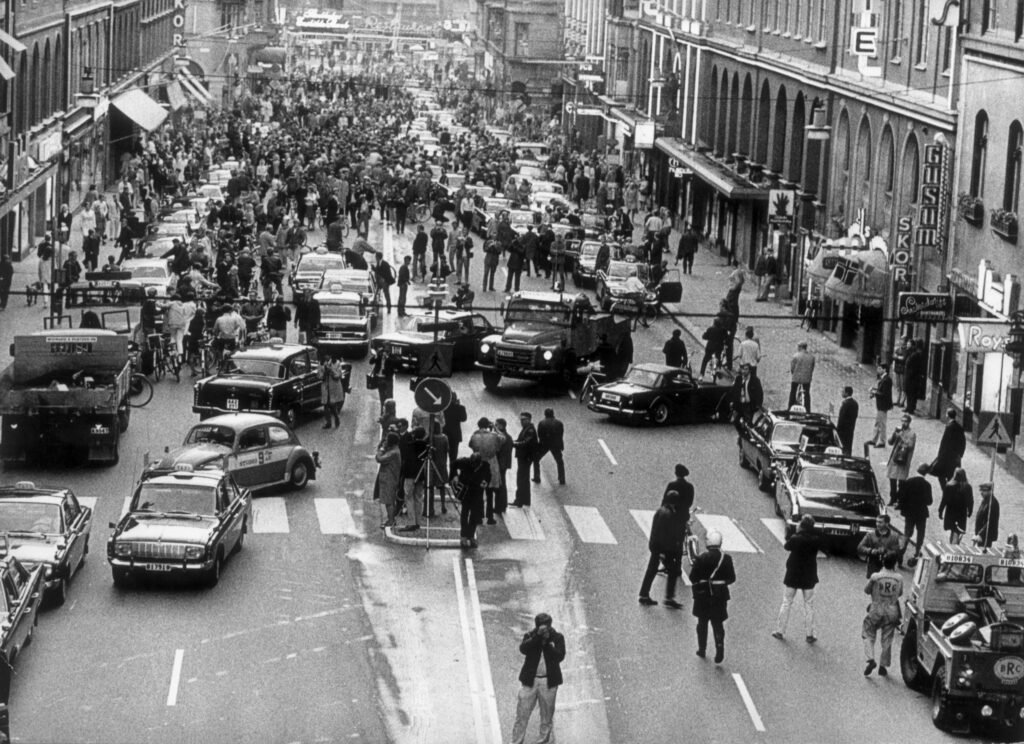
Roughly 65 percent of the world drives on the right and the other 35 percent drives on the left, and the split isn’t an accident of geography — it’s the leftover residue of swords, freight wagons, and one country that flipped its entire traffic pattern in a single morning. That history is also why car manufacturers still build both left-hand-drive and right-hand-drive versions of the same model, and why crossing certain land borders means adjusting to a mirror-image set of road rules.
The Left Side Started With Swords
Long before cars existed, most travelers kept to the left. The leading explanation is practical: most people are right-handed, and a right-handed swordsman on horseback wanted his weapon arm, and his scabbard, angled toward the center of the road, ready to react to an oncoming stranger rather than facing the roadside where it might snag a passerby. Mounting a horse was also easier from the left side while wearing a sword on the left hip, which reinforced the same habit of keeping to the left. That habit hardened into custom well before any government thought to write it into law, which is part of why the “correct” side varied so much once nations later did.
Freight Wagons Flipped It to the Right
The shift toward right-hand travel began not with swords but with cargo. In France and colonial America, teamsters driving large freight wagons typically sat on the rear-left horse so their dominant right arm stayed free to whip the team. Sitting on the left meant they judged road clearance better by keeping their wagon to the right side, and passing oncoming wagons on the right became the more practical convention — a habit that stuck once it caught on, especially in places building new road networks with no older tradition to override.
Napoleon Spread the Right, Britain Spread the Left
The French Revolution turned that convention into a political symbol. Before the Revolution, French aristocrats had traveled on the left, forcing peasants to the roadside on the right — a visible marker of class. As revolutionary sentiment spread, staying to the right became a way for the elite to blend in with everyone else, and Napoleon’s later military campaigns carried right-hand traffic into the territories he conquered or administered across continental Europe. Britain, which Napoleon never conquered, went the other way, formally locking in left-hand traffic with the Highway Act of 1835. As the British Empire expanded, its colonies adopted the same rule, which is why India, Australia, much of southern and eastern Africa, and other former British territories still drive on the left today. Japan is the one notable exception that fits no empire: it settled on left-hand traffic during the Edo period and formalized it in the 1870s while building its railways with British engineering assistance.
Sweden Switched Sides in a Single Morning
Most countries that changed sides did it gradually, over generations. Sweden did it in a few hours. Despite officially driving on the left, Sweden was surrounded by right-hand-traffic Norway and Finland, and by the 1960s more than 90 percent of Swedish cars were already left-hand-drive models built for right-side roads — a mismatch blamed for a rising number of head-on collisions on the country’s narrow two-lane highways. On September 3, 1967, a date Swedes called Dagen H, non-essential traffic was banned from the roads for several hours; drivers stopped at 4:50 a.m., carefully moved their vehicles to the right side of the road, and traffic resumed on the right at exactly 5:00 a.m. The switch was backed by roughly 350,000 replaced road signs and a nationwide publicity campaign, including a contest-winning pop song, to make sure no one forgot.
The result today is less a coherent global system than a patchwork of local decisions made for reasons that had nothing to do with modern traffic — which is exactly why the border between a right-hand-drive and left-hand-drive country can still feel like crossing into a different set of rules, because in a real sense, it is.