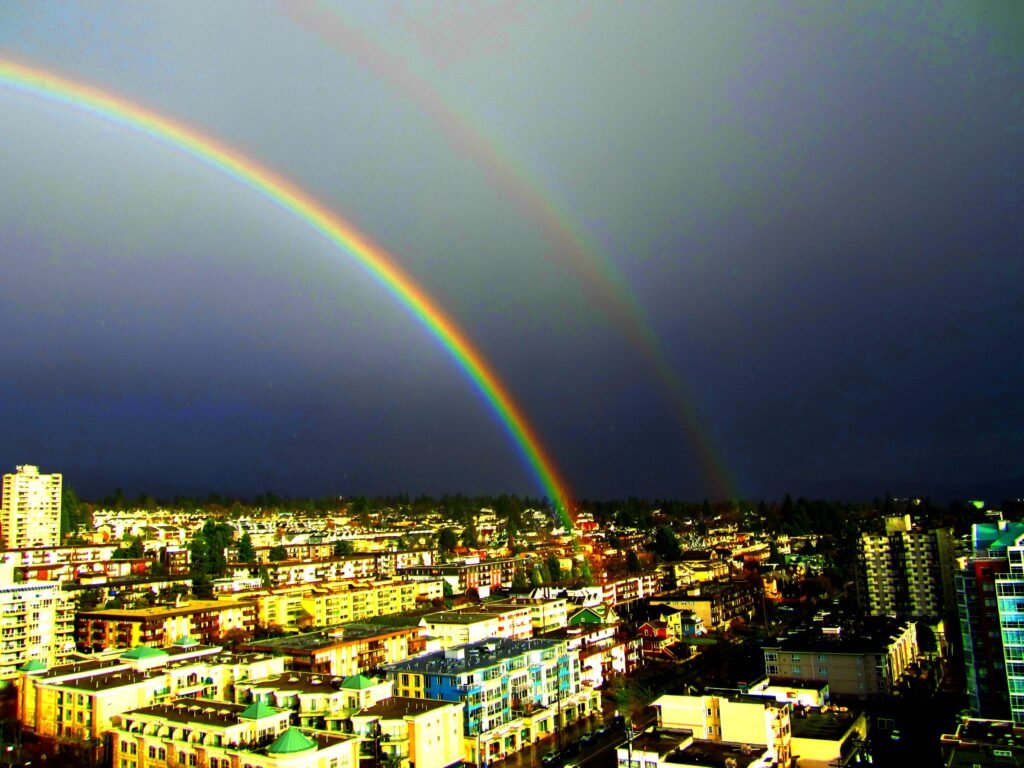
Rainbows are curved because every rainbow is actually a full circle, and the arc people see is only the portion of that circle that sits above the horizon. The shape comes down to simple geometry: sunlight only bounces back to your eyes from raindrops sitting at one specific angle, and that condition traces a circle around a point directly opposite the sun.
How light bends inside a raindrop
A rainbow starts when sunlight hits a raindrop and refracts, or bends, as it passes from air into water. That light then reflects off the inside back wall of the droplet and refracts again on the way back out, splitting into its component colors in the process. This happens inside millions of raindrops at once, all lit by the same sun, which is why the effect appears as a broad band of light rather than a single point.
The 42-degree angle that shapes the arc
The bending and bouncing inside a raindrop sends light back out at a very specific angle, about 42 degrees from the direction the original sunlight came from, according to physicist Robert Greenler of the University of Wisconsin-Milwaukee. Only raindrops sitting at that precise angle relative to your eye and the sun send you rainbow-colored light; every other raindrop just looks like an ordinary drop. Because that 42-degree condition holds true in every direction around you, not just one, it traces out a full circle centered on a spot in the sky called the antisolar point, directly opposite the sun from where you are standing. That circle is the rainbow — the curve is simply what a circle looks like when you are looking at part of it.
Why people see an arc instead of a full circle
The ground gets in the way. The antisolar point sits exactly opposite the sun, which usually puts it below the horizon whenever the sun itself is above it, so the bottom portion of the circle would have to shine up through the earth, according to National Geographic Education. Only the upper part of the circle, arcing above the horizon, is ever visible from the ground. The lower the sun sits in the sky, the higher the antisolar point rises and the more complete the visible arc becomes, which is why rainbows often look biggest and most dramatic in the early morning or late afternoon, when the sun itself is low. From a high enough vantage point, such as an airplane, there is no horizon to cut the circle off, so observers can sometimes see the full ring.
Double rainbows reverse the colors
Sometimes a fainter second arc appears outside the primary rainbow. That secondary rainbow forms when light reflects twice inside the raindrop instead of once, exiting at a wider angle of about 51 degrees. The extra bounce also flips the color order, so red sits on the inside of the primary rainbow but on the outside of the secondary one, a detail that is easy to spot once you know to look for it.
No two people see the same rainbow
Because a rainbow’s position depends entirely on the angle between the sun, the raindrops, and your own eyes, no two people ever see exactly the same one. Step a few feet to the side and the antisolar point moves with you, shifting which raindrops happen to be sending light your way at that moment. It is a small, strange consequence of the geometry involved: the rainbow in any photograph is, in the most literal sense, made only for wherever the camera happened to be standing.