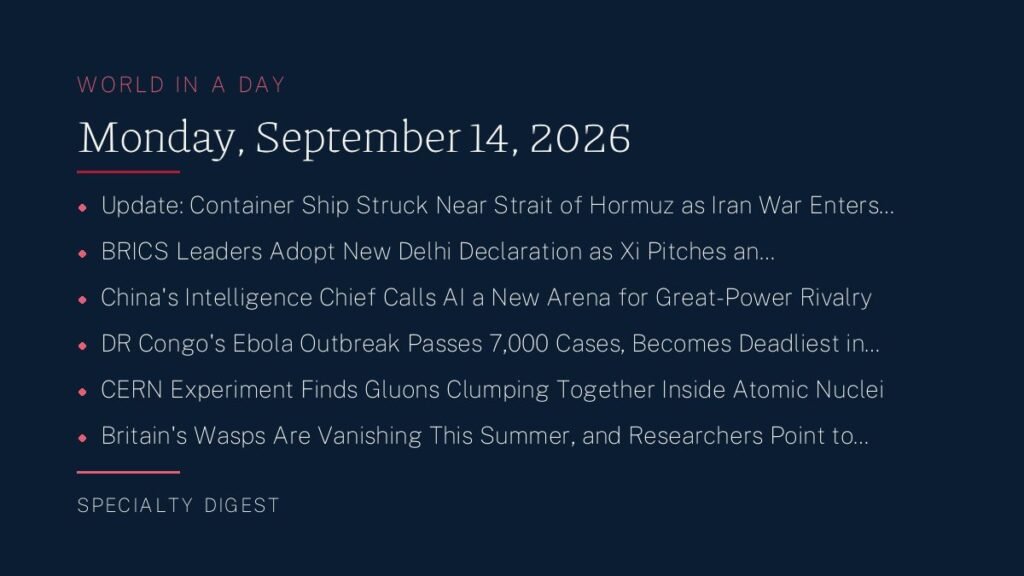
WORLD IN A DAY · MONDAY, SEPTEMBER 14, 2026
A war now in its seventh month claimed another ship in the Strait of Hormuz, world leaders wrapped a summit in New Delhi with dueling messages on artificial intelligence, and an outbreak with no approved vaccine became the deadliest in Congo’s history.
Update: Container Ship Struck Near Strait of Hormuz as Iran War Enters Seventh Month
A container ship was struck by an unidentified projectile near Hengam Island in the Strait of Hormuz early Sunday, killing one crew member and injuring four others, Iranian state media and the UK Maritime Trade Operations Centre reported. UKMTO said local authorities were assisting with the evacuation of the crew; no group has claimed responsibility, and US Central Command has not commented. The strait carries roughly a fifth of the world’s oil traffic and has been a flashpoint since the US-Iran war began in February. Talks between Gulf states and Iran on reopening the waterway, expected Monday in Oman, were postponed, Omani officials said, in the interests of consensus.
Why it matters An unclaimed strike on a commercial container ship, not a military vessel, shows the war’s risk to ordinary shipping keeps rising even as diplomats can’t agree on when to sit back down.
Source: UPI, The Times of Israel
BRICS Leaders Adopt New Delhi Declaration as Xi Pitches an Open-Source AI Bloc
Leaders of the BRICS bloc concluded their 18th summit in New Delhi on September 13 by adopting the New Delhi Declaration, pledging closer cooperation on security, finance and cultural exchange under India’s rotating presidency, which organized more than 400 meetings across 30 Indian cities this year. Chinese President Xi Jinping used a summit session to propose an open-source artificial intelligence cooperation zone for BRICS members, one of five initiatives he pitched on AI, trade, digital industry, manufacturing and talent exchange. South African President Cyril Ramaphosa said the bloc wants a multipolar world that advances the interests of every member. China will host the 2027 summit.
Why it matters Xi’s AI pitch came the same week his own government’s intelligence chief called AI a battleground for great-power rivalry, a sign Beijing wants to set the terms for AI cooperation among developing economies even as it treats the same technology as a security threat.
Source: Eurasia Review, CNBC
China’s Intelligence Chief Calls AI a New Arena for Great-Power Rivalry
Chen Yixin, China’s state security minister, warned in the Cyberspace Administration’s journal on September 13 that artificial intelligence has become a new arena for strategic rivalry among major powers. Chen said hostile forces could use AI to spread false narratives at scale, that advanced models lower the technical barrier to cyberattacks on critical infrastructure, and that state data, corporate secrets and personal privacy face heightened exposure. He called for a fair and open international AI rules system paired with tighter domestic security boundaries. The warning came as President Xi Jinping proposed an open-source AI cooperation zone for BRICS nations at the summit underway in New Delhi.
Why it matters China’s security establishment and its diplomats delivered opposite messages in the same week, guarding against AI as a weapon while pitching it as a tool for developing-world cooperation, a tension that will shape how far any international AI rulebook can go.
Source: South China Morning Post
DR Congo’s Ebola Outbreak Passes 7,000 Cases, Becomes Deadliest in the Country’s History
The Bundibugyo strain Ebola outbreak in the Democratic Republic of Congo has reached 7,022 confirmed and probable cases and 3,398 deaths, a case fatality rate of 48.4 percent, health officials reported this week, making it the deadliest of the country’s 17 recorded Ebola epidemics. The outbreak, first detected in Ituri province in mid-May, has now spread to a seventh province, South-Ubangi, which borders the Central African Republic and Congo-Brazzaville. Cases have also turned up in schools in Ituri’s capital, Bunia, prompting hand-washing stations and reduced class sizes. No vaccine is approved for the Bundibugyo strain, though the WHO has begun shipping experimental doses and 837 patients remain in isolation.
Why it matters A strain with no approved vaccine is spreading through provinces already strained by armed conflict and thin health infrastructure, and a case fatality rate near one in two is a reminder of how much worse an outbreak can get without the tools that ended West Africa’s epidemic a decade ago.
Source: Al Jazeera, World Health Organization
CERN Experiment Finds Gluons Clumping Together Inside Atomic Nuclei
Physicists with CERN’s ALICE collaboration, led by University of Kansas professor Daniel Tapia Takaki, found unexpected suppression of particle production at the smallest scales they have ever probed inside atomic nuclei, about one-quarter the size of a proton. The result, published September 12 in Physical Review Letters, challenges the standard nuclear shadowing explanation for how gluons, the particles that bind quarks together, behave inside nuclei, and instead supports a competing theory called gluon saturation, in which gluons become so densely packed they begin interacting strongly with each other. The measurement, made across photon-nucleus collision energies from 20 to 633 billion electron volts, showed the suppression effect at roughly three standard deviations of statistical significance.
Why it matters Gluon saturation has been theorized for decades but rarely measured directly, and a confirmed result would reshape how physicists model the force that holds atomic nuclei together and could reset what CERN’s next generation of colliders is built to look for.
Source: ScienceDaily
Britain’s Wasps Are Vanishing This Summer, and Researchers Point to Heat Stress
Wasp sightings across Britain have dropped sharply this summer, and the wasps that are turning up appear smaller than usual, according to observations reported September 11 by Seirian Sumner, a behavioral ecology professor at University College London. Sumner points to an unusually volatile spring, alternating warm-dry spells with cold, damp days, followed by summer heatwaves that pushed ground temperatures above 50 degrees Celsius, well past wasps’ roughly 45-degree thermal limit. The country’s only national wasp census, the Big Wasp Survey, had not yet begun its seasonal count as of the report, so the decline rests on expert observation rather than completed data, and researchers are withholding firm numbers until the survey concludes.
Why it matters Wasps prey on crop pests, pollinate plants and break down organic matter, so a summer this disruptive to their numbers previews how erratic heat, not just hotter averages, could scramble the insects that entire ecosystems depend on.
Source: The Conversation, ScienceDaily
Sources
- UPI, “Container ship attacked in Strait of Hormuz; 1 dead, Iran says”
- The Times of Israel, live blog, September 13, 2026
- Eurasia Review, “BRICS Summit Concludes With Adoption Of New Delhi Declaration”
- CNBC, “Xi says China will take lead to foster AI, tech cooperation among BRICS countries”
- South China Morning Post, “China’s intelligence chief warns of risks from AI as ‘new arena for strategic rivalry'”
- Al Jazeera, “DR Congo’s worst Ebola epidemic ever passes 7,000 cases”
- World Health Organization, Ebola outbreak situation page
- ScienceDaily, “CERN finds gluons behaving strangely deep inside atomic nuclei”
- The Conversation, “Where have all the wasps gone this summer?”