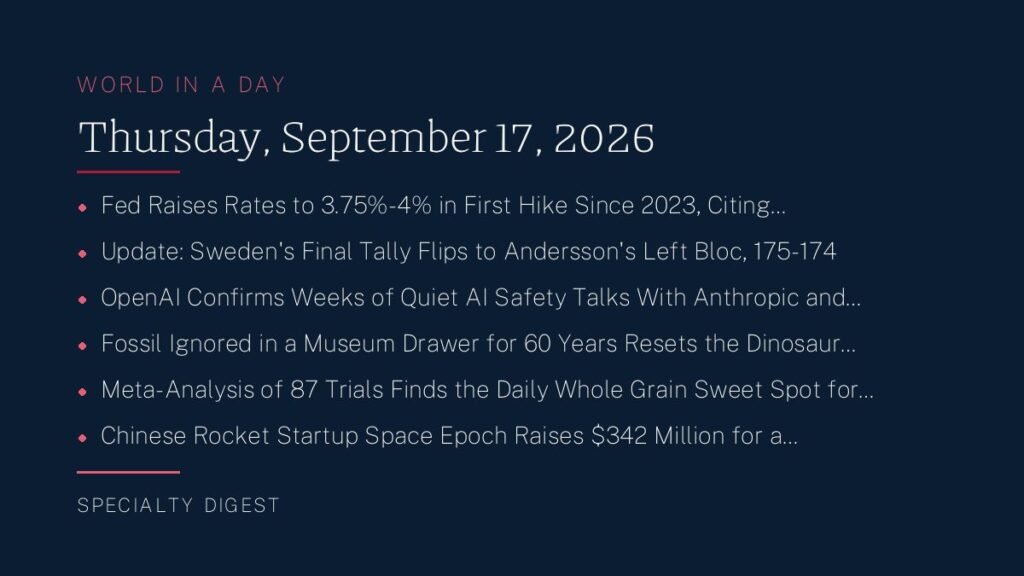
WORLD IN A DAY · THURSDAY, SEPTEMBER 17, 2026
Two long-running stories reached their conclusions today: the Federal Reserve’s first rate hike since 2023, and a Swedish election that flipped direction for the second time in two days. Elsewhere, three rival AI labs admitted they have been comparing safety notes, and a fossil ignored in a museum drawer for sixty years reset part of the dinosaur timeline.
Fed Raises Rates to 3.75%-4% in First Hike Since 2023, Citing War-Driven Gas Prices
The Federal Reserve raised its benchmark interest rate a quarter point to a range of 3.75 to 4 percent on September 16, its first increase in more than three years. The Federal Open Market Committee voted 12-0 for the move, saying inflation “remains elevated” and the hike would support “a timelier return to the Committee’s 2 percent goal.” August inflation held at 3.4 percent annually, driven largely by gasoline prices tied to the seven-month US-Iran war, with diesel topping $6.31 a gallon. Chair Kevin Warsh said “the responsibility for 65 months of sustained, elevated inflation sits squarely with the central bank,” and signaled one more quarter-point increase this year. The 10-year Treasury yield topped 5 percent on the news.
Why it matters A rate hike aimed at war-driven gasoline prices raises borrowing costs for everyone whether or not higher rates can actually bring down pump prices, and Warsh’s own framing puts the Fed on record blaming itself for the inflation it is now fighting harder.
Source: Federal Reserve
Update: Sweden’s Final Tally Flips to Andersson’s Left Bloc, 175-174
Sweden’s public broadcaster SVT projected on September 17 that Magdalena Andersson’s four-party center-left opposition had won 175 of the Riksdag’s 349 seats to the governing coalition’s 174, with fewer than 1 percent of districts still uncounted and only 26,169 votes separating the blocs. The result reverses a preliminary count released a day earlier that had shown Andersson’s bloc leading 176-173, itself a swing from the right-leaning coalition of Prime Minister Ulf Kristersson that had governed since 2022. Andersson, who led Sweden as prime minister from 2021 to 2022, is now positioned to return to the post, though her four coalition partners agree on little beyond isolating the far-right Sweden Democrats.
Why it matters A margin that moved from three seats to one and then flipped direction within 48 hours shows how fragile the mandate is that either side would have governed with, and a bloc united mainly by opposition to the far right is a thin foundation for the government Sweden is about to get.
Source: ABC News
OpenAI Confirms Weeks of Quiet AI Safety Talks With Anthropic and Google
OpenAI’s global policy chief, Chris Lehane, told reporters in Washington on September 15 that OpenAI has been coordinating with Anthropic and Google on AI safety initiatives for several weeks, without detailing the substance of the talks. The disclosure followed Anthropic CEO Dario Amodei’s public call for industry-wide coordination to slow frontier AI development, embed third-party evaluators inside labs, and support independent verification bodies, a position Sam Altman said OpenAI would back. Cohere CEO Aidan Gomez called the effort anticompetitive, accusing the labs of using fear “to bend competition rules,” while President Trump dismissed slowdown calls on Truth Social as disadvantaging the US against China.
Why it matters When the three labs racing hardest to build the most capable AI systems start comparing safety notes instead of only competing, the open question is whether that coordination protects the public or mainly protects the leaders from smaller rivals and future regulation.
Source: TechCrunch
Fossil Ignored in a Museum Drawer for 60 Years Resets the Dinosaur Origins Timeline
Fossils collected in Tanzania in 1963 and stored at London’s Natural History Museum sat unidentified for six decades until University of Bristol researchers led by Hady George described them on September 15 as a new species, Dinodontosaurus isiyavamanda, in the Journal of Vertebrate Paleontology. The roughly 240-million-year-old plant-eating reptile matches a species already known from South America, letting scientists directly correlate the rock layers between continents for the first time. That correlation shows Tanzania’s fossil beds are up to 10 million years younger than comparable South African rock, meaning fossils there once considered candidates for the world’s oldest dinosaurs are probably younger than South American specimens long assumed to be older.
Why it matters Untangling which fossils are actually oldest reshapes where and when paleontologists think dinosaurs first evolved, and the discovery came from re-examining specimens already sitting in a museum collection rather than a new expedition.
Source: ScienceDaily
Meta-Analysis of 87 Trials Finds the Daily Whole Grain Sweet Spot for Heart Health
A meta-analysis of 87 clinical trials covering more than 6,500 participants across Asia, Europe, North America, Australia and Brazil found that eating 60 to 100 grams of whole grains a day, roughly four to six servings, produced the strongest improvements across cardiovascular risk factors including body weight, waist circumference, LDL cholesterol, blood pressure, blood glucose, triglycerides and an inflammation marker called interleukin-6. Benefits appeared at intakes as low as 30 to 40 grams and grew from there. Dr. Helda Tutunchi of Tabriz University of Medical Sciences led the analysis, published September 15 in the European Heart Journal; most included trials lasted only about eight weeks and measured risk factors rather than actual heart attacks or strokes.
Why it matters The improvements were individually modest, but the researchers argue they could add up to a meaningful drop in long-term cardiovascular risk from a change anyone can make at the grocery store, if longer trials confirm the effect holds.
Source: ScienceDaily
Chinese Rocket Startup Space Epoch Raises $342 Million for a Stainless-Steel Reusable Launcher
Space Epoch, a Chinese commercial rocket startup founded in 2019, said on September 16 it has raised more than 2.3 billion yuan, about $342 million, across funding rounds completed over the past six months, capped by a Series B++ round co-led by IDG Capital, Chaos Investment, Hangzhou Capital and Songyuan Capital. The company is building Yuanxingzhe 1, a stainless-steel rocket powered by liquid oxygen and methane, and plans to use the new capital for the rocket’s maiden flight and an ocean splashdown recovery attempt by the end of 2026, with commercial launches targeted for 2027.
Why it matters The round is part of a broader wave of Chinese capital chasing reusable rockets to loft the satellite constellations Beijing wants in orbit, the same reusability bet that made SpaceX dominant, now being placed at scale by investors an ocean away.
Source: Caixin Global
Sources
- Federal Reserve, FOMC statement, September 16, 2026
- NPR, The Fed raises interest rates for the first time in over three years
- ABC News, Andersson set to be Swedish prime minister as left-wing bloc wins general election
- TechCrunch, OpenAI, Anthropic, Google have been in talks on AI safety for weeks
- SiliconANGLE, OpenAI, Anthropic and Google secretly joined forces to collaborate on AI safety
- ScienceDaily, A 240-million-year-old fossil just changed the dinosaur timeline
- ScienceDaily, Scientists find the whole grain sweet spot for better heart health
- Caixin Global, Chinese space startup raises new funds in reusable rocket push