Costa Rica is a small republic in Central America, bordered by Nicaragua to the north, Panama to the southeast, the Pacific Ocean to the west, and the Caribbean Sea to the east. Covering about 51,100 square kilometers and home to just over 5 million people, it is known internationally for two connected facts: it abolished its military in 1948, and it has built its economy and national identity around protecting one of the most biologically diverse landscapes on Earth.
Key Takeaways
- Costa Rica occupies 51,100 square kilometers of the Central American isthmus between Nicaragua and Panama, with coastlines on both the Pacific Ocean and the Caribbean Sea.
- The country abolished its army by decree on December 1, 1948, and made that abolition permanent in Article 12 of its 1949 constitution.
- More than 25% of Costa Rica’s national territory is under formal conservation protection, and four sites are inscribed on the UNESCO World Heritage List.
- The World Bank reported that Costa Rica reached high-income economy status in 2025, and the country has belonged to the OECD since 2021.
- Costa Rica’s government runs on a unicameral Legislative Assembly of 57 members elected to four-year terms, one of the more stable democratic systems in Central America.
Where Costa Rica Is Located
Costa Rica sits on the Central American isthmus, the narrow strip of land connecting North and South America. It borders Nicaragua to the north and Panama to the southeast, giving it coastlines on two oceans: the Pacific to the west and the Caribbean Sea to the east. The country covers about 51,100 square kilometers, according to the Permanent Mission of Costa Rica to the United Nations, an area roughly comparable to the U.S. state of West Virginia.
Mountains, Volcanoes, and Coastlines
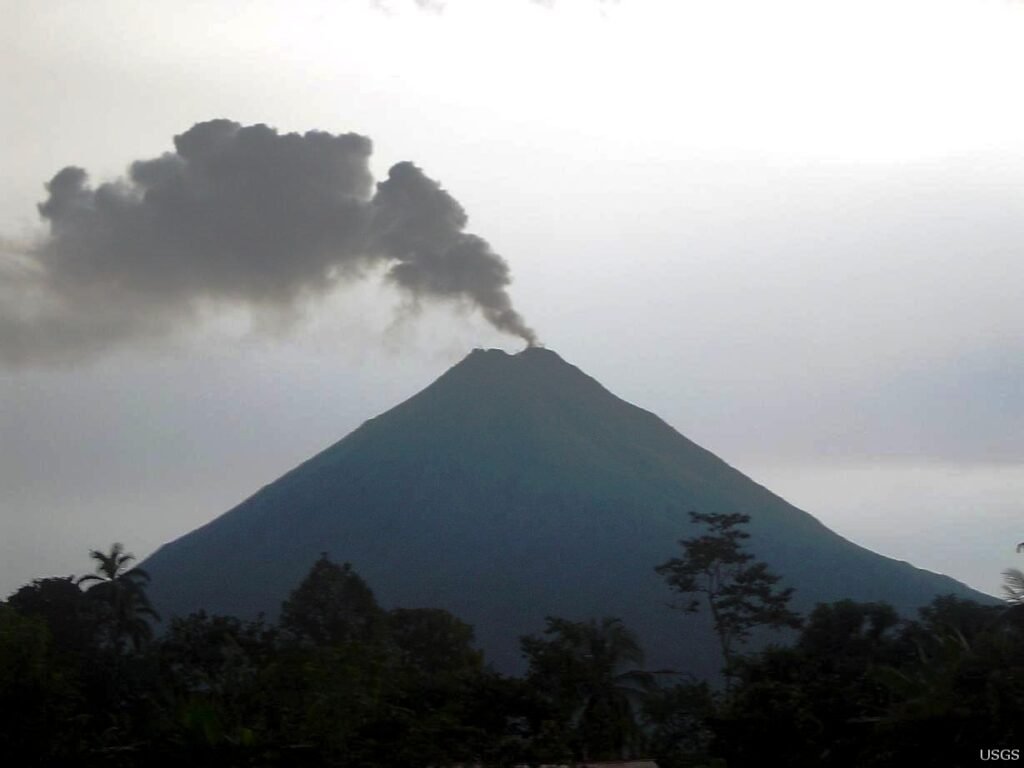
A mountainous spine runs the length of the country, including the Cordillera de Guanacaste, the Cordillera Central, and the Cordillera de Talamanca, whose Chirripo peak is Costa Rica’s highest point. Several of these ranges are volcanic, including Poas, Irazu, and Arenal, according to Encyclopaedia Britannica. Arenal, a 1,670-meter stratovolcano near La Fortuna, is the country’s most recognizable natural landmark. It erupted almost continuously from 1968 to 2010 and has been quiet since, according to the Smithsonian Institution’s Global Volcanism Program, which continues to monitor it as one of the country’s youngest and most closely studied volcanoes. Between the mountain ranges, lowland plains and an extensive coastline support the rain forests, cloud forests, and wetlands for which the country is internationally known.
A Brief History of Costa Rica
Before Spanish contact, the region that is now Costa Rica was home to distinct indigenous chiefdoms, including groups in the Diquis Delta that carved and arranged large stone spheres whose original purpose is still debated by archaeologists. UNESCO inscribed these Precolumbian settlements with stone spheres of the Diquis as a World Heritage Site in 2014. Spain claimed the territory in the 16th century and administered it as a remote, sparsely populated province of the Captaincy General of Guatemala.
Spanish colonial authority in Central America ended in 1821, according to Encyclopaedia Britannica, after which Costa Rica briefly became part of the Mexican Empire before joining the United Provinces of Central America in 1823. Disagreements among the federation’s member states led Costa Rica to withdraw in 1838 and govern itself as a fully independent republic, according to Britannica’s account of Costa Rican independence. Coffee exports, beginning in the mid-19th century, financed much of the country’s early infrastructure and shaped a landowning class that dominated politics for generations afterward.
The 1948 Civil War and Abolition of the Army
Costa Rica’s modern political identity was set by a brief but consequential civil war. After a disputed 1948 presidential election, Jose Figueres Ferrer led an armed uprising that defeated the government within weeks. As head of a transitional junta, Figueres declared the country’s military abolished on December 1, 1948, an event marked by handing over the keys of a military garrison to be converted into a school, according to futurepolicy.org, a policy database maintained by the World Future Council. The following year’s constitution made the decision permanent: Article 12 states that the army as a permanent institution is abolished, reserving only the police forces needed to preserve public order. Costa Rica has had no standing army since.
Government and Economy
Costa Rica is a presidential, democratic republic with three constitutional branches of government, executive, legislative, and judicial, plus an independent electoral tribunal that administers elections, according to the country’s permanent mission to the United Nations. Legislative power rests with a single-chamber Legislative Assembly of 57 deputies, elected by direct popular vote to four-year terms with no immediate re-election, according to the Inter-Parliamentary Union.
The economy has grown quickly in recent years. The World Bank reported that Costa Rica reached high-income economy status in 2025, with growth accelerating to 4.6% that year on the strength of medical device manufacturing and services exports, and that unemployment fell to 6.3% by the fourth quarter of 2025. Costa Rica has been a member of the Organisation for Economic Co-operation and Development since 2021. Despite this growth, the World Bank also reported a national poverty rate of 17.1% and a Gini coefficient of 48.8, pointing to persistent income inequality.
Culture and People
Costa Rica’s population stood at 5,044,197 in the country’s 2022 official population count, with a large share concentrated in the greater San Jose metropolitan area, according to the National Institute of Statistics and Census (INEC). Spanish is the official language and the colon is the national currency. Costa Ricans are commonly called Ticos, and the phrase “pura vida,” literally pure life, functions as an everyday greeting and a shorthand for an unhurried, community-oriented outlook that residents and visitors alike associate with the country.
Spending redirected from the military has gone largely into public education and a universal health care system. By 2009, Costa Rica was allocating roughly 6.3% of GDP to education and about 7% to health care, among the highest shares in Latin America, according to futurepolicy.org.
What Costa Rica Is Best Known For
Internationally, Costa Rica is known first for two connected facts: it has no army, and it has turned environmental protection into national policy. More than 25% of the country’s territory is under some form of conservation protection, according to the Instituto Costarricense de Turismo, the country’s official tourism board. Costa Rica holds four UNESCO World Heritage sites: the Talamanca Range-La Amistad Reserves (inscribed 1983, extended 1990), Cocos Island National Park (1997, extended 2002), the Area de Conservacion Guanacaste (1999, extended 2004), and the Precolumbian stone spheres of the Diquis (2014). Arenal Volcano, though currently dormant, remains the country’s most recognizable natural landmark and a centerpiece of its ecotourism industry.
Why Costa Rica Matters
Costa Rica functions internationally as a working example of two arguments usually made only in the abstract: that a country can secure itself without a standing army, and that conservation and economic development are not automatically in conflict. Its 1948 decision to abolish the military, and to redirect the savings into schools and clinics, is still studied by researchers in peace and security policy as one of the few sustained national experiments in demilitarization. Its record on forest protection, alongside its recent arrival at high-income status, makes it a frequent reference point for the World Bank and other development institutions assessing what small, resource-limited economies can achieve. For a country of just over 5 million people, positioned between two larger neighbors on a narrow isthmus, that combination of influence is unusual.
Sources
- World Bank, “Costa Rica Overview,” 2026, worldbank.org
- UNESCO World Heritage Centre, “Costa Rica: States Parties,” Undated, whc.unesco.org
- Instituto Nacional de Estadistica y Censos (INEC), “Poblacion total de Costa Rica es de 5,044,197 personas,” July 19, 2023, inec.cr
- Permanent Mission of Costa Rica to the United Nations, “Country Facts,” Undated, un.int
- Inter-Parliamentary Union, IPU Parline, “Costa Rica: Legislative Assembly,” 2026, data.ipu.org
- Smithsonian Institution, Global Volcanism Program, “Arenal,” Undated, volcano.si.edu
- World Future Council, “Costa Rica’s Abolition of the Army,” Undated, futurepolicy.org
- Encyclopaedia Britannica, “Costa Rica,” Undated, britannica.com
- Encyclopaedia Britannica, “Costa Rica: Independence,” Undated, britannica.com
- Instituto Costarricense de Turismo (Visit Costa Rica), “National Parks,” Undated, visitcostarica.com
- U.S. Geological Survey, “The Arenal Volcano in Costa Rica” (photograph, image source for this article), Undated, usgs.gov
Key facts
- Costa Rica covers 51,100 square kilometers of the Central American isthmus, bordered by Nicaragua and Panama.4
- Costa Rica abolished its army on December 1, 1948, a decision made permanent by Article 12 of the 1949 constitution.7
- More than 25% of Costa Rica's territory is under formal conservation protection.10
- The World Bank classified Costa Rica as a high-income economy in 2025, following growth of 4.6% that year.1
- Costa Rica's population was 5,044,197 in its 2022 official population count.3
Quick checkWhy is Costa Rica notable for not having a military?Show answer
Costa Rica abolished its army on December 1, 1948, following a brief civil war, and made the abolition permanent in Article 12 of its 1949 constitution. Funds once spent on the military were redirected into education, health care, and later conservation.
Sources
- World Bank. Costa Rica Overview. 2026 (accessed 2026-09-22)
- UNESCO World Heritage Centre. Costa Rica: States Parties. Undated (accessed 2026-09-22)
- Instituto Nacional de Estadistica y Censos (INEC). Poblacion total de Costa Rica es de 5,044,197 personas. 2023-07-19 (accessed 2026-09-22)
- Permanent Mission of Costa Rica to the United Nations. Country Facts. Undated (accessed 2026-09-22)
- Inter-Parliamentary Union (IPU Parline). Costa Rica: Legislative Assembly. 2026 (accessed 2026-09-22)
- Smithsonian Institution, Global Volcanism Program. Arenal. Undated (accessed 2026-09-22)
- World Future Council. Costa Rica's Abolition of the Army. Undated (accessed 2026-09-22)
- Encyclopaedia Britannica. Costa Rica. Undated (accessed 2026-09-22)
- Encyclopaedia Britannica. Costa Rica: Independence. Undated (accessed 2026-09-22)
- Instituto Costarricense de Turismo (Visit Costa Rica). National Parks. Undated (accessed 2026-09-22)
- U.S. Geological Survey. The Arenal Volcano in Costa Rica (photograph, image source). Undated (accessed 2026-09-22)
Editorially reviewed by Specialty Digest Editorial TeamLast reviewed September 22, 2026Researched and drafted with AI assistanceReport an issue