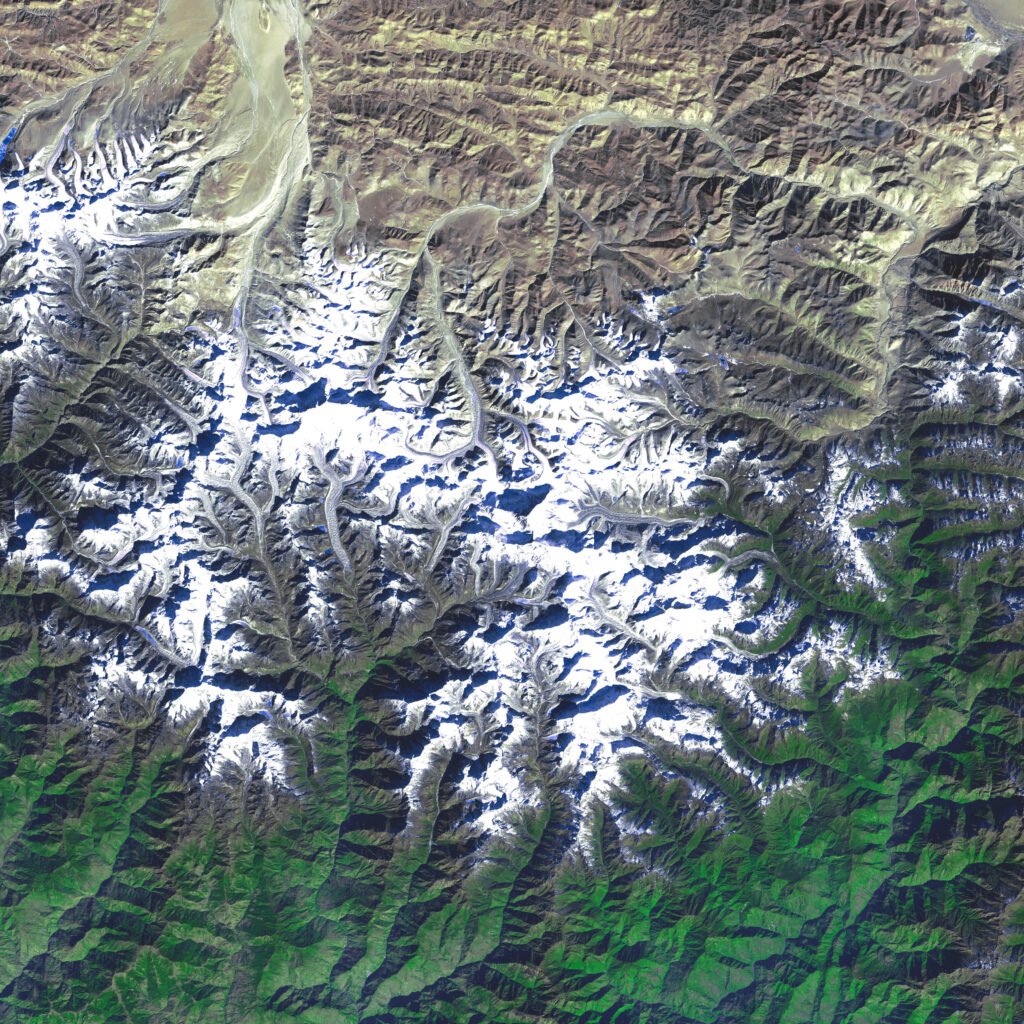
Nepal is a landlocked country in South Asia, wedged between India and China along the southern slope of the Himalayas. It covers about 147,516 square kilometers and is best known globally as home to Mount Everest, the world’s highest peak, and Lumbini, the traditional birthplace of the Buddha. Its capital and largest city is Kathmandu.
Where Is Nepal Located?
Nepal sits in the middle of the Himalayan arc, bordered by China’s Tibet Autonomous Region to the north and by India along its eastern, western, and southern edges. The country has no coastline and no direct border with any other nation besides these two, making it one of the most geographically isolated states in Asia despite lying between two of the world’s most populous countries. Its total area, according to Nepal’s own government tourism authority, is 147,516 square kilometers, roughly comparable in size to the U.S. state of Iowa.
The Geography of Nepal
Few countries pack a wider range of elevation into so narrow a strip of land. Nepal divides into three east-west bands. The Terai, a flat, fertile lowland along the Indian border, sits as low as 60 meters above sea level and makes up about 17 percent of the country. Moving north, the Hill (Pahad) region rises through the Mahabharat range to between 600 and 3,500 meters, holding the country’s two largest valleys, Kathmandu and Pokhara. Beyond that lies the Himalayan region itself, where elevation climbs past 3,000 meters and the country holds eight of the world’s fourteen peaks above 8,000 meters, according to the Nepal Tourism Board.
The highest of those peaks is Mount Everest, called Sagarmatha in Nepali and Chomolungma in Tibetan, which straddles the Nepal-China border at an officially surveyed height of 8,849 meters (29,032 feet), according to Encyclopaedia Britannica. The mountain sits within Sagarmatha National Park, a 124,400-hectare protected area inscribed as a UNESCO World Heritage Site in 1979 both for its geology and glaciers and for the Sherpa communities whose traditional practices have shaped its conservation.
A Brief History of Nepal
The Kathmandu Valley was governed for centuries by the Newar people, first under the Licchavi dynasty from around the 4th and 5th centuries CE and later under the Malla dynasty, which eventually split the valley into the rival city-states of Kathmandu, Patan, and Bhaktapur, according to Britannica. Modern Nepal took shape in 1769, when Prithvi Narayan Shah, the ruler of the small hill kingdom of Gorkha, conquered the valley and unified the surrounding territories, founding the Shah dynasty and setting the country’s approximate present-day borders after further conflicts with Tibet, China, Britain, and the Sikh kingdom.
From 1846 to 1951, real power lay not with the Shah kings but with the Rana family, who ruled as hereditary prime ministers while keeping Nepal formally independent, partly through supplying Gurkha soldiers to the British Indian Army. The Rana regime fell in 1950 to 1951 after a revolution backed by King Tribhuvan and the Nepali Congress party restored authority to the crown. Nepal moved toward constitutional monarchy in 1959 and, after a period of direct royal rule, adopted a multiparty parliamentary system in 1990, per Britannica.
The following decade and a half brought severe upheaval: a Maoist insurgency that began in the 1990s evolved into a civil war against the state, and in 2001 the crown prince killed King Birendra and most of the royal family before killing himself, according to Britannica’s account of the monarchy’s fall. King Gyanendra briefly imposed direct rule in 2005, but a UN-mediated peace process led to elections in April 2008. On May 28, 2008, Nepal’s newly elected constituent assembly voted to abolish the monarchy and declare the country a democratic republic, ending 240 years of royal rule. A new constitution, promulgated on September 20, 2015 after prolonged negotiation, established Nepal as a secular federal republic, though its adoption also triggered unrest among Madhesi communities in the southern plains who said their rights were not adequately protected.
Government and Economy
Nepal’s 2015 constitution defines the country as an “independent, indivisible, sovereign, secular, inclusive, democratic, socialism-oriented, federal democratic republican state,” per the official English text published by Nepal’s Office of the Attorney General. Power is divided across three tiers: the federal government, seven provinces, and local governments. A president serves as head of state, elected by an electoral college of federal and provincial lawmakers, while executive authority rests with a prime minister who leads the Council of Ministers and must command a majority in the House of Representatives. The bicameral federal parliament pairs a 275-member House of Representatives with a 59-member National Assembly, and a Supreme Court heads the judiciary.
Nepal remains one of Asia’s poorer economies by conventional measures, but it has posted one of the sharpest poverty reductions on record: the share of the population living below the international extreme poverty line fell from more than 55 percent in 1995 to an estimated 0.37 percent in 2022, according to the World Bank. Growth, however, leans heavily on remittances sent home by Nepalis working abroad rather than on domestic job creation, and roughly 82 percent of the domestic workforce remains in informal employment. The economy’s main pillars are agriculture, tourism-linked services, and a growing hydropower sector drawing on Nepal’s steep river gradients; the World Bank projected real GDP growth of about 2.3 percent for fiscal year 2026, with a recovery toward an average of 4.4 percent expected in the following two years.
Culture and People of Nepal
Nepal’s 2021 census recorded a total population of 29,164,578, according to the government’s National Statistics Office. Nepali, written in the Devanagari script, is the country’s sole official language at the federal level, though the constitution allows each province to adopt additional official languages from among the many mother tongues spoken across its ethnically and linguistically diverse population, per the government’s own constitutional text.
Religion in Nepal is predominantly Hindu: the 2021 census found 81.2 percent of the population identifying as Hindu, 8.2 percent as Buddhist, 5.1 percent as Muslim, 3.2 percent following the indigenous Kirat tradition, and 1.8 percent Christian, with smaller communities of Jain, Sikh, Bon, and Baha’i adherents, according to the National Statistics Office’s official religion report. In practice, Hindu and Buddhist traditions overlap heavily in everyday life and architecture, nowhere more visibly than in the Kathmandu Valley, where the Newar people built the seven monument zones, including the Hanuman Dhoka, Patan, and Bhaktapur royal squares and the Swayambhu and Bauddhanath stupas, that make up the Kathmandu Valley UNESCO World Heritage Site, inscribed in 1979.
What Is Nepal Known For?
Internationally, Nepal is known above all for two things: Mount Everest and the birthplace of the Buddha. Lumbini, in the southern Terai plains, holds the archaeological remains of the Maya Devi Temple and a pillar erected by the Mauryan emperor Ashoka marking the site; it was inscribed as a UNESCO World Heritage Site in 1997 as one of Buddhism’s holiest places. Mount Everest and the wider Khumbu region draw mountaineers and trekkers from around the world and have made the Sherpa people, who guide and support most Everest expeditions, internationally recognized in their own right.
Nepal is also closely associated with the Gurkhas, soldiers recruited from Nepal into British and, after 1947, Indian military service since the early 19th century. Gurkha units fought in both World Wars and numerous later conflicts and remain known for their combat reputation and loyalty, according to Britain’s National Army Museum.
Why Nepal Matters
Nepal’s significance goes beyond its famous mountain. It sits at a genuine geographic and cultural hinge between South Asia and the Tibetan plateau, and its glaciers and rivers feed into the Ganges basin that hundreds of millions of people downstream in India and Bangladesh depend on. Politically, Nepal is a relatively young case study in the transition from centuries of monarchy to federalism, still working through the practical difficulties of a system adopted only in 2015. Economically, its record on poverty reduction, even amid continued reliance on remittances, has drawn attention from development researchers. And culturally, few countries pack as dense a concentration of globally significant heritage, Hindu, Buddhist, and Himalayan alike, into so compact and difficult a terrain.
Key Takeaways
- Nepal is a landlocked South Asian country of about 147,516 square kilometers, bordered only by India and China.
- Mount Everest (8,849 m), the world’s highest peak, sits on Nepal’s border with China within Sagarmatha National Park, a UNESCO World Heritage Site since 1979.
- Nepal’s population was 29,164,578 at the 2021 census, with Hinduism practiced by about 81.2 percent and Buddhism by about 8.2 percent.
- Modern Nepal was unified in 1769 by Prithvi Narayan Shah; the monarchy was abolished in 2008 and a federal secular republic established by the 2015 constitution.
- Lumbini, in the Terai plains, is the traditional birthplace of the Buddha and a UNESCO World Heritage Site inscribed in 1997.
- Nepal has achieved one of the world’s fastest recorded declines in extreme poverty, though its economy still depends heavily on remittances from workers abroad.
Sources
- Nepal Tourism Board (Government of Nepal), “Geography of Nepal,” undated, https://ntb.gov.np/plan-your-trip/about-nepal/geography
- UNESCO World Heritage Centre, “Sagarmatha National Park,” undated, https://whc.unesco.org/en/list/120
- UNESCO World Heritage Centre, “Kathmandu Valley,” undated, https://whc.unesco.org/en/list/121/
- UNESCO World Heritage Centre, “Lumbini, the Birthplace of the Lord Buddha,” undated, https://whc.unesco.org/en/list/666/
- Encyclopaedia Britannica, “Nepal – History,” undated, https://www.britannica.com/place/Nepal/History
- Encyclopaedia Britannica, “Nepal – Fall of the monarchy,” undated, https://www.britannica.com/place/Nepal/Fall-of-the-monarchy
- Encyclopaedia Britannica, “Nepal – Federal republic,” undated, https://www.britannica.com/place/Nepal/Federal-republic
- Encyclopaedia Britannica, “Nepal summary,” undated, https://www.britannica.com/summary/Nepal
- Encyclopaedia Britannica, “Mount Everest,” undated, https://www.britannica.com/place/Mount-Everest
- Government of Nepal, Office of the Attorney General, “Constitution of Nepal” (official English translation), 2015, https://ag.gov.np/files/Constitution-of-Nepal_2072_Eng_www.moljpa.gov_.npDate-72_11_16.pdf
- National Statistics Office, Government of Nepal, “Religion in Nepal” (2021 Census), 2023, https://censusresults.nsonepal.gov.np/files/result-folder/Religion%20in%20Nepal.pdf
- National Statistics Office, Government of Nepal, “National Population and Housing Census 2021,” 2023, https://microdata.nsonepal.gov.np/index.php/catalog/124
- World Bank, “Nepal Country Overview,” 2026, https://www.worldbank.org/ext/en/country/nepal
- National Army Museum (United Kingdom), “The Gurkhas,” undated, https://www.nam.ac.uk/explore/gurkhas
Key facts
- Nepal's population was 29,164,578 at the 2021 census11
- Nepal covers 147,516 square kilometers between India and China1
- Mount Everest (8,849 m), the world's highest peak, sits on the Nepal-China border within Sagarmatha National Park92
- Nepal became a federal democratic republic in 2008, ending 240 years of monarchy, formalized by the 2015 constitution67
- About 81.2% of Nepal's population practiced Hinduism per the 2021 census10
Quick checkWhat UNESCO World Heritage Site marks the traditional birthplace of the Buddha in Nepal?Show answer
Lumbini
Sources
- Nepal Tourism Board (Government of Nepal). Geography of Nepal. Undated (accessed 2026-09-28)
- UNESCO World Heritage Centre. Sagarmatha National Park. Undated (accessed 2026-09-28)
- UNESCO World Heritage Centre. Kathmandu Valley. Undated (accessed 2026-09-28)
- UNESCO World Heritage Centre. Lumbini, the Birthplace of the Lord Buddha. Undated (accessed 2026-09-28)
- Encyclopaedia Britannica. Nepal - History. Undated (accessed 2026-09-28)
- Encyclopaedia Britannica. Nepal - Fall of the monarchy. Undated (accessed 2026-09-28)
- Encyclopaedia Britannica. Nepal - Federal republic. Undated (accessed 2026-09-28)
- Encyclopaedia Britannica. Nepal summary. Undated (accessed 2026-09-28)
- Encyclopaedia Britannica. Mount Everest. Undated (accessed 2026-09-28)
- Government of Nepal, Office of the Attorney General. Constitution of Nepal. 2015 (accessed 2026-09-28)
- National Statistics Office, Government of Nepal. Religion in Nepal (2021 Census). 2023 (accessed 2026-09-28)
- National Statistics Office, Government of Nepal. National Population and Housing Census 2021. 2023 (accessed 2026-09-28)
- World Bank. Nepal Country Overview. 2026 (accessed 2026-09-28)
- National Army Museum (United Kingdom). The Gurkhas. Undated (accessed 2026-09-28)
- NASA Science / Earth Observatory. Mt. Everest (Landsat 7 satellite image). 2002-01-05 (accessed 2026-09-28)
Editorially reviewed by Specialty Digest Editorial TeamLast reviewed September 28, 2026Researched and drafted with AI assistanceReport an issue