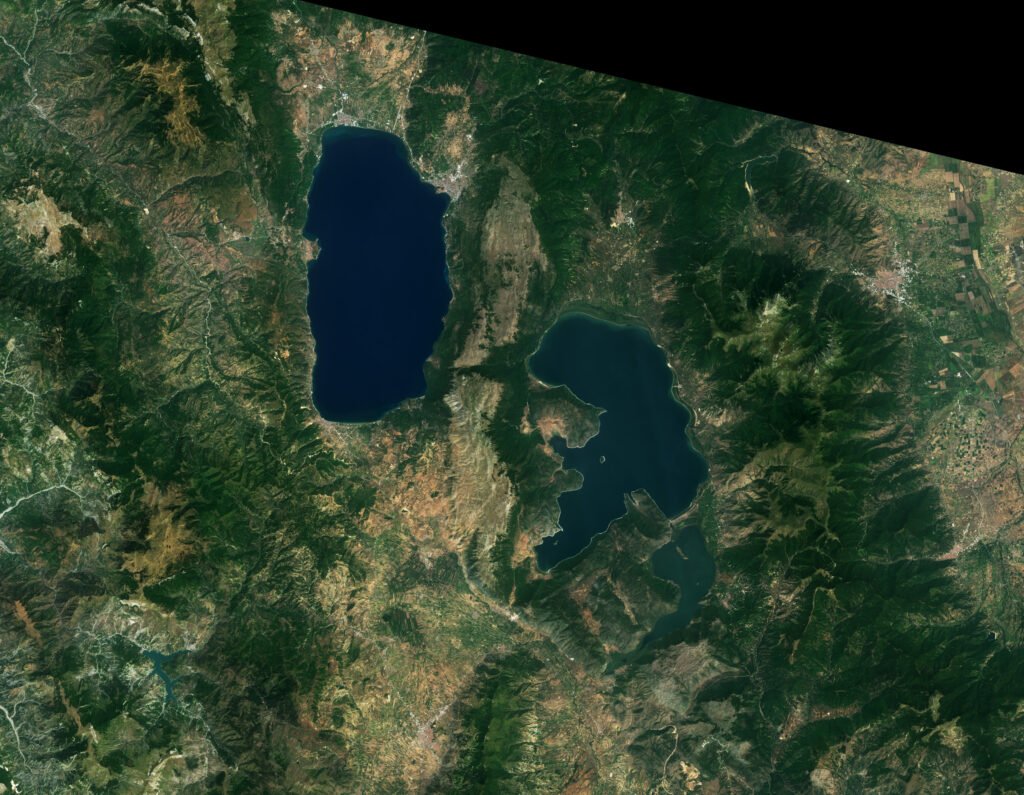
North Macedonia is a small, landlocked country in the western Balkans of southeastern Europe, bordered by Kosovo, Serbia, Bulgaria, Greece, and Albania. Its capital is Skopje, and its best-known feature is Lake Ohrid, one of Europe’s oldest lakes and a dual UNESCO World Heritage site for both nature and culture.
Where Is North Macedonia Located?
North Macedonia sits in the interior of the Balkan Peninsula, with no coastline of its own. It covers about 25,436 square kilometers (9,821 square miles), roughly two-fifths of the broader geographical region historically known as Macedonia, the rest of which lies within Greece and Bulgaria, according to Encyclopaedia Britannica. The country’s position, wedged between the Adriatic and Aegean worlds, has made it a crossing point for trade and migration for millennia.
Geography and Landscape
The terrain is dominated by mountains and river valleys rather than open plains. Major ranges include the Šar, Korab, Osogovo, and Baba mountains, and three national parks, Mavrovo, Galičica, and Pelister, protect much of this high country, per Britannica. The country’s three principal lakes, Ohrid, Prespa, and Dojran, sit along its southern and southwestern borders. Lake Ohrid is the standout: an ancient tectonic lake estimated to be several million years old, home to more than 200 species found nowhere else on Earth, as documented by the UNESCO World Heritage Centre and by NASA Earth Observatory satellite imagery of the Ohrid-Prespa basin.
A Brief History of North Macedonia
Archaeological evidence points to settled Neolithic communities in the region as early as 7000 to 3500 BCE. The area later fell within the orbit of the ancient kingdom of Macedon, whose most famous rulers, Philip II and his son Alexander the Great, built a short-lived but historically pivotal empire in the 4th century BCE, per Britannica’s history of North Macedonia. Historians generally treat that ancient, Greek-speaking kingdom as a distinct entity from the Slavic-speaking population that arrived centuries later; the relationship between the two is precisely what later fueled a modern naming dispute.
Slavic tribes settled the region in the 6th and 7th centuries CE, and it came under Byzantine rule for several centuries. Saints Cyril and Methodius, and their disciples based partly in Ohrid, developed the alphabet that evolved into Cyrillic script, a foundational contribution to Slavic literacy. Medieval control passed between Bulgarian and Serbian rulers, most notably Serbia’s Stefan Dušan, crowned emperor in Skopje in 1346, before the Ottoman Empire absorbed the region within decades of his death and held it for roughly five centuries.
After the Balkan Wars and World War I, the territory became part of the Kingdom of Serbs, Croats and Slovenes, later Yugoslavia, and after World War II it was established as the Socialist Republic of Macedonia within Tito’s federal Yugoslavia. It declared independence in 1991 as the Republic of Macedonia. Greece, which has its own northern region called Macedonia and views the ancient Macedonian legacy as part of Greek heritage, objected to the new state using that name, arguing it implied a territorial or historical claim. The dispute kept the country out of NATO and stalled its EU candidacy for years, forcing it to use the placeholder designation “the former Yugoslav Republic of Macedonia” in international bodies. The two governments resolved the standoff through the Prespa Agreement, signed in June 2018 and taking effect in February 2019, under which the country adopted the name Republic of North Macedonia, a change confirmed by Britannica and reflected in the country’s own Ministry of Foreign Affairs records.
Government and Economy in Brief
North Macedonia is a parliamentary republic. Legislative power rests with the unicameral Assembly (Sobranie), whose 120 members are directly elected for four-year terms under a system with legislated gender quotas, according to the Inter-Parliamentary Union’s Parline database. A directly elected president serves as head of state in a largely ceremonial role, while a prime minister accountable to the Assembly leads the government.
The naming settlement cleared the way for North Macedonia to become NATO’s 30th member on March 27, 2020, per its Ministry of Foreign Affairs. It has held EU candidate status since December 2005 and formally opened accession negotiations in 2020, though membership talks remain ongoing, according to the Council of the European Union. Economically, North Macedonia is one of Europe’s smaller and poorer economies, with a GDP of roughly $19.1 billion and GDP per capita near $10,490 in 2025, alongside an unemployment rate of about 12.3 percent, according to World Bank data. The World Bank frames its ongoing engagement around improving the business climate, strengthening employability and social protection, and supporting greener growth as the country pursues EU alignment.
Culture and People
The 2021 census recorded a resident population of about 1.84 million people. Ethnic Macedonians make up 58.44 percent of residents, and ethnic Albanians are the largest minority at 24.30 percent, followed by smaller Turkish, Roma, Serb, Bosniak, and Vlach communities, according to the State Statistical Office of the Republic of North Macedonia. Macedonian and Albanian are both official languages nationwide, per Britannica. Religious affiliation tracks closely with ethnicity: roughly 46.1 percent of residents identify as Orthodox Christian, mainly through the Macedonian Orthodox Church, and about 32.2 percent as Muslim, according to the U.S. State Department’s 2022 report on international religious freedom, which draws on the same 2021 census.
Skopje is the birthplace of Mother Teresa, born Anjezë Gonxhe Bojaxhiu in the city, then called Uskup under Ottoman rule, on August 26, 1910, according to the Nobel Prize organization’s official biography. The town of Ohrid, meanwhile, is one of Europe’s oldest continuously inhabited settlements and preserves an unusually dense concentration of medieval Byzantine architecture, including some of the earliest Slavic monastic foundations and roughly 800 Byzantine icons dating from the 11th to 14th centuries, per UNESCO.
What Is North Macedonia Known For?
- Lake Ohrid, one of the world’s oldest lakes and a rare UNESCO site recognized for both natural and cultural significance.
- The 2019 name change from Macedonia to North Macedonia, ending a decades-long dispute with Greece and clearing the path to NATO membership.
- A historical connection, and an ongoing political sensitivity, tied to the name of the ancient kingdom of Macedon and Alexander the Great.
- Being the birthplace of Mother Teresa.
- Joining NATO as its 30th member in 2020, after nearly three decades of aspiring to membership.
Why North Macedonia Matters
North Macedonia sits at a strategic junction of the Balkans, linking Central Europe to the Aegean and the wider Mediterranean. Its resolution of the naming dispute with Greece through the Prespa Agreement removed one of the last major sticking points to NATO and EU enlargement in the western Balkans, and the country’s continued push toward EU membership is closely watched as a test case for the broader region’s integration. Ecologically, Lake Ohrid is considered one of the most important freshwater biodiversity sites in Europe, and its preservation has direct bearing on species found nowhere else on the continent.
Key Takeaways
- North Macedonia is a landlocked country in the western Balkans, bordered by Kosovo, Serbia, Bulgaria, Greece, and Albania, with Skopje as its capital.
- The country changed its name from Macedonia to North Macedonia in 2019 under the Prespa Agreement, resolving a long-running dispute with Greece.
- Lake Ohrid, shared with Albania, is a UNESCO World Heritage site valued for both its ancient biodiversity and its Byzantine cultural heritage.
- North Macedonia became NATO’s 30th member in March 2020 and has held EU candidate status since 2005.
- The 2021 census recorded about 1.84 million residents, with ethnic Macedonians (58.44 percent) and ethnic Albanians (24.30 percent) as the two largest groups.
- Mother Teresa was born in Skopje in 1910.
- The economy remains one of Europe’s smaller ones, with GDP per capita around $10,490 in 2025.
Sources
- Encyclopaedia Britannica, “North Macedonia”
- Encyclopaedia Britannica, “North Macedonia: History”
- UNESCO World Heritage Centre, “Natural and Cultural Heritage of the Ohrid region”
- The World Bank, “North Macedonia | Data”
- The World Bank, “North Macedonia and World Bank Group: 30 Years of Partnership”
- State Statistical Office of the Republic of North Macedonia, “Census 2021”
- Ministry of Foreign Affairs of the Republic of North Macedonia, “NATO Membership”
- Council of the European Union, “Republic of North Macedonia”
- U.S. Department of State, “2022 Report on International Religious Freedom: North Macedonia”
- NASA Earth Observatory, “A Pair of Ancient Lakes”
- Inter-Parliamentary Union, IPU Parline: North Macedonia
- The Nobel Prize, “Mother Teresa – Biographical”
Key facts
- Area of approximately 25,436 square kilometers, landlocked in the western Balkans1
- Resident population of about 1.84 million per the 2021 census6
- Renamed from Macedonia to North Macedonia in February 2019 under the Prespa Agreement2
- Became NATO's 30th member on March 27, 20207
- Lake Ohrid is a UNESCO World Heritage site inscribed for both natural and cultural significance3
Quick checkIn what year did the country officially change its name from Macedonia to North Macedonia, and under what agreement?Show answer
February 2019, under the Prespa Agreement with Greece.
Sources
- Encyclopaedia Britannica. North Macedonia. Undated (accessed 2026-09-28)
- Encyclopaedia Britannica. North Macedonia: History. Undated (accessed 2026-09-28)
- UNESCO World Heritage Centre. Natural and Cultural Heritage of the Ohrid region. Undated (accessed 2026-09-28)
- The World Bank. North Macedonia. Data (accessed https://data.worldbank.org/country/north-macedonia)
- The World Bank. North Macedonia and World Bank Group: 30 Years of Partnership. Undated (accessed 2026-09-28)
- State Statistical Office of North Macedonia. Census of Population 2021. 2022 (accessed 2026-09-28)
- Ministry of Foreign Affairs of North Macedonia. NATO Membership. Undated (accessed 2026-09-28)
- Council of the European Union. Republic of North Macedonia. Undated (accessed 2026-09-28)
- U.S. Department of State. 2022 Report on International Religious Freedom: North Macedonia. 2023 (accessed 2026-09-28)
- NASA Earth Observatory. A Pair of Ancient Lakes. 2022-05-17 (accessed 2026-09-28)
- Inter-Parliamentary Union (IPU Parline). North Macedonia: Assembly of the Republic. Undated (accessed 2026-09-28)
- The Nobel Prize. Mother Teresa - Biographical. Undated (accessed 2026-09-28)
Editorially reviewed by Specialty Digest Editorial TeamLast reviewed September 28, 2026Researched and drafted with AI assistanceReport an issue