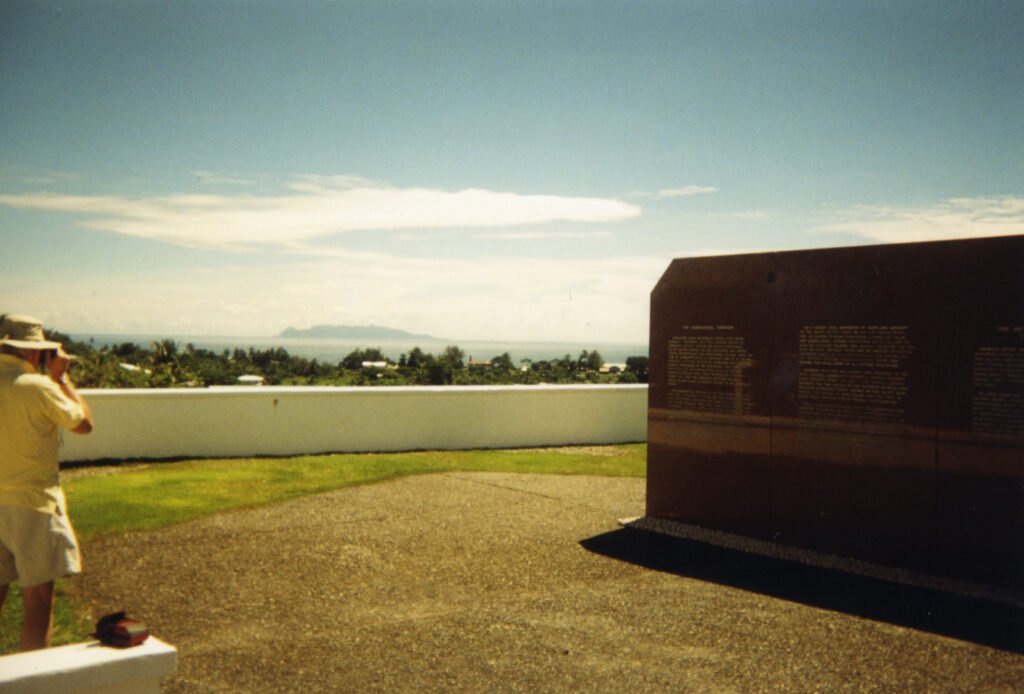
Solomon Islands is a nation of nearly a thousand islands in the South Pacific, best known worldwide as the site of the Battle of Guadalcanal, one of the longest and costliest campaigns of the Second World War.
Where Is Solomon Islands Located?
Solomon Islands lies in the South Pacific, east of Papua New Guinea and northeast of Australia, made up of a double chain of large volcanic islands, including Guadalcanal, Malaita, and New Georgia, along with hundreds of smaller islands and atolls. The capital, Honiara, sits on the north coast of Guadalcanal, the largest island.
Geography and Landscape
Most of the main islands are mountainous and heavily forested, ringed by coral reefs and lagoons, including the Marovo Lagoon, one of the largest lagoon systems in the world. The country sits along the Pacific Ring of Fire and experiences frequent earthquakes and occasional volcanic activity, and its reefs form part of the Coral Triangle, a region recognized for exceptionally high marine biodiversity.
A Brief History
The islands have been inhabited by Melanesian peoples for thousands of years and were named by a Spanish explorer in the sixteenth century, who believed, incorrectly, that he had found a source of King Solomon’s gold. Britain established a protectorate over the southern Solomons in the late nineteenth century, and the islands became the scene of one of the pivotal campaigns of the Pacific War between 1942 and 1943, when Allied and Japanese forces fought for control of Guadalcanal in a grinding land, sea, and air campaign that marked a turning point against Japanese expansion in the Pacific. Solomon Islands gained independence from Britain in 1978.
Government and Economy Today
Solomon Islands is a parliamentary democracy and a Commonwealth realm, with the British monarch represented locally by a governor-general. The World Bank groups it among the eleven Pacific Island countries it supports, noting that these nations combine a population of roughly 2.3 million people spread across an area equivalent to about 15% of the globe’s surface, with substantial natural resources alongside extraordinary linguistic and cultural diversity.[1] The economy relies heavily on logging, fishing, and agriculture, and the World Bank has highlighted opportunities for the country to convert its recent economic recovery into more jobs and higher incomes.[1]
Culture and People
English is the official language, but Solomon Islands Pijin serves as the common language across an extraordinarily fragmented linguistic landscape of more than 70 indigenous languages, among the highest counts per capita of any country in the world. Most of the population is Melanesian and follows a mix of Christian faiths introduced by missionaries alongside enduring customary practices tied to land, kinship, and local chiefs, which still govern much of rural life outside the formal state system.
What Is Solomon Islands Known For?
Internationally, Solomon Islands is known above all for Guadalcanal and the fierce 1942 to 1943 campaign fought there, commemorated today at the Guadalcanal American Memorial on Skyline Ridge above Honiara, which overlooks the city and the waters where much of the naval fighting took place. The country is also known for its reefs and diving sites, its extreme linguistic diversity, and the remnants of wartime wrecks still visible along several of its coastlines.
Why Solomon Islands Matters
As the site of a campaign widely seen as a turning point in the Pacific theater of the Second World War, Solomon Islands holds a place in global military history disproportionate to its small population, and war memorials and wreck sites continue to draw visitors and veterans’ descendants from the United States, Japan, and Australia. As a Pacific Island state, it also figures prominently in regional discussions of climate vulnerability, given its exposure to rising seas and more intense cyclones.
Key Takeaways
- Solomon Islands is a Pacific nation of nearly a thousand islands east of Papua New Guinea.
- Guadalcanal, its largest island, was the site of a pivotal 1942-1943 Second World War campaign.
- The Guadalcanal American Memorial above Honiara commemorates the battle and is the country’s best-known landmark.
- Independent from Britain since 1978, it remains a Commonwealth realm with a parliamentary democracy.
- More than 70 indigenous languages are spoken, among the highest counts per capita in the world.
Sources
Key facts
- Independent from Britain since 1978; a Commonwealth realm
- Site of the 1942-1943 Battle of Guadalcanal, a turning point in the Pacific War
- Pacific Island countries supported by the World Bank total about 2.3 million people1
- More than 70 indigenous languages are spoken across the country
Quick checkWhat WWII battle is Solomon Islands best known for internationally?Show answer
The Battle of Guadalcanal (1942-1943), commemorated at the Guadalcanal American Memorial above Honiara.
Sources
- World Bank. Pacific Island Countries Overview. Undated, continuously updated (accessed 2026-10-04)
Editorially reviewed by Specialty Digest Editorial TeamLast reviewed October 4, 2026Researched and drafted with AI assistanceReport an issue