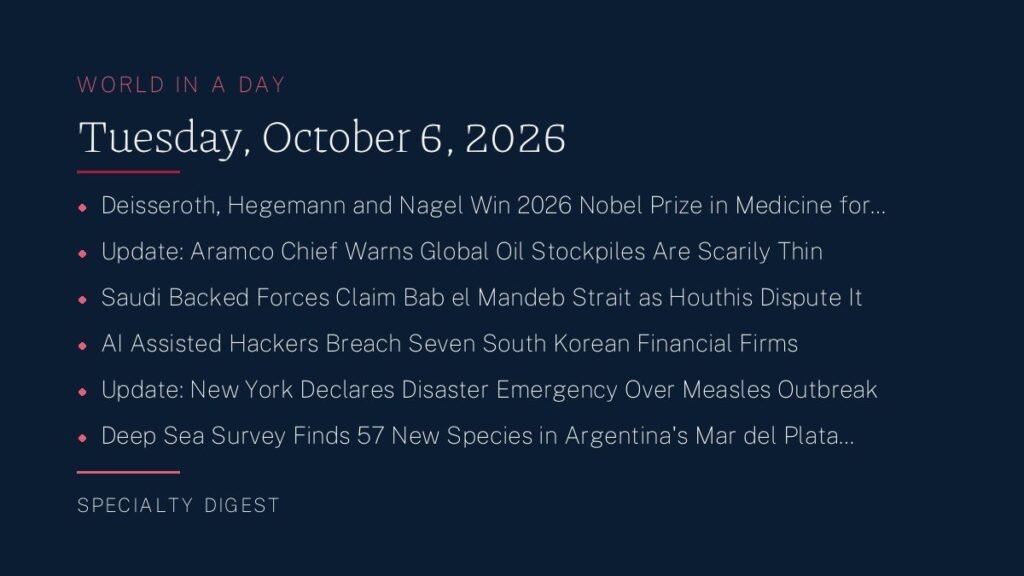
WORLD IN A DAY · TUESDAY, OCTOBER 6, 2026
Energy and war collided today: Saudi Arabia’s oil chief warned the world’s spare fuel supply has grown scarily thin, even as rival forces in Yemen gave conflicting accounts of who now controls one of the planet’s busiest shipping straits. Elsewhere, Stockholm’s Nobel committee honored the scientists who gave neuroscience a light switch.
Deisseroth, Hegemann and Nagel Win 2026 Nobel Prize in Medicine for Optogenetics
The Nobel Assembly at Stockholm’s Karolinska Institute awarded the 2026 Nobel Prize in Physiology or Medicine to Karl Deisseroth of Stanford University, Peter Hegemann of Humboldt University of Berlin, and Georg Nagel of the University of Wurzburg for discovering light gated ion channels and developing optogenetics. Hegemann and Nagel identified channelrhodopsin, a light sensitive protein in algae, in the 1990s. Deisseroth later inserted the protein into neurons, letting scientists switch individual brain cells on or off with a pulse of blue light and millisecond precision. The method now underpins much of modern neuroscience, letting researchers trace which cells drive specific behaviors. The three share a prize of 12 million Swedish kronor, about 1.2 million dollars.
Why it matters Optogenetics turned brain circuits from a black box into something researchers could switch on and off at will, and that single tool has reshaped how depression, Parkinson’s disease and addiction get studied in labs worldwide.
Source: NobelPrize.org
Update: Aramco Chief Warns Global Oil Stockpiles Are Scarily Thin
Saudi Aramco chief executive Amin Nasser told London’s Energy Intelligence Forum that the world’s oil supply cushion has become scarily thin and that the system is already straining, pointing to the Iran conflict that has kept the Strait of Hormuz effectively closed to tanker traffic. United States diesel prices hit a record 6.50 dollars a gallon in September. The G7 has released up to 100 million barrels from emergency reserves, but commercial stockpiles remain below 6 billion barrels, with only about 10 percent readily usable, and analysts say replenishing them could take up to two years even after the fighting ends.
Why it matters A thin global buffer means any new disruption, a seized tanker or a damaged refinery, can send fuel prices spiking with little slack left to absorb the shock, and that squeeze is already reaching gas pumps and shipping bills worldwide.
Source: CNBC
Saudi Backed Forces Claim Bab el Mandeb Strait as Houthis Dispute It
Yemen’s internationally recognized government said its forces, backed by more than 100 Saudi coalition fighter jets, seized full control of the Bab el Mandeb Strait and the town of Dhubab at its narrowest point, driving out Iran aligned Houthi rebels who had captured the waterway last month. The Houthis called the claim completely untrue and said they had instead taken the town of Turbah and were advancing on Taiz, Yemen’s third largest city. The United Nations says roughly 184,000 people have been displaced since fighting resumed. The strait carries about 12 percent of global trade, and the earlier Houthi seizure had already pushed up shipping costs.
Why it matters Competing, unverified claims over a chokepoint this size make it hard for shippers and insurers to judge whether Red Sea routes are actually safer again, and guessing wrong in either direction carries real costs for global trade.
Source: The Washington Post
AI Assisted Hackers Breach Seven South Korean Financial Firms
South Korean regulators said seven financial institutions, including Shinhan Bank, KB Kookmin Bank, Hana Bank and Hyundai Capital, were hit this week by intrusions traced to Artex, a Chinese developed AI penetration testing platform that chooses its next attack method based on the results of the last one. The Shinhan Bank breach exposed loan data, names, phone numbers, incomes and borrowing limits for roughly 25,000 customers, and a savings bank breach hit another 40,000. The same IP address showed up across all seven firms, pointing to a coordinated campaign. The Financial Services Commission ordered every bank to cut non-essential external system access and finish emergency security checks by Thursday.
Why it matters An AI tool that adapts its attack strategy in real time compresses the time defenders have to respond, and a coordinated hit on seven banks at once previews how automated intrusion campaigns against financial infrastructure can scale.
Source: The Korea Herald
Update: New York Declares Disaster Emergency Over Measles Outbreak
Governor Kathy Hochul declared a state disaster emergency running through November 4 after New York recorded 108 measles cases this year, 92 of them since mid July, concentrated in under immunized rural communities across 18 counties. The order lets emergency medical technicians, midwives and pharmacists administer MMR vaccines, allows nurses to order testing, and requires every vaccination to be reported to the state registry within 72 hours. It follows a larger surge next door in Pennsylvania, where cases have reached 977 with five deaths, that state’s largest outbreak in decades. Measles infects roughly 90 percent of non-immune people exposed to it and can cause pneumonia, brain damage or death.
Why it matters A formal disaster declaration, rather than a routine health advisory, signals officials see the vaccination gap as wide enough to need emergency powers, and the regional spread suggests the outbreak is outrunning ordinary public health tools.
Source: Office of Governor Kathy Hochul
Deep Sea Survey Finds 57 New Species in Argentina’s Mar del Plata Canyon
An international team of 20 taxonomists working with the Schmidt Ocean Institute and Ocean Census confirmed 57 new marine species and five new genera from specimens collected in Argentina’s Mar del Plata submarine canyon, a trench more than 3,500 meters deep in the South Atlantic. The haul includes 20 new copepod species, 22 echinoderms and 14 corals and sea pens, among them a sea cucumber nicknamed Loki for its horn like appendages, found at 2,577 meters by the research vessel Falkor (too) and its robotic submersible SuBastian. The specimens were gathered during a 2025 expedition and formally classified at a workshop in Buenos Aires in July.
Why it matters Cataloguing that many new species from one two week workshop shows how much of the deep ocean remains unmapped, and each new entry becomes a baseline for tracking how deep sea ecosystems respond to warming and deep sea mining interest.
Source: Schmidt Ocean Institute
Sources
- NobelPrize.org, 2026 Nobel Prize in Physiology or Medicine press release
- STAT News, on the optogenetics Nobel
- CNBC, on Aramco’s oil stockpile warning
- Business Recorder, on Aramco’s oil stockpile warning
- The Washington Post, on the Bab el Mandeb Strait fighting
- ABC News Australia, on the Bab el Mandeb Strait fighting
- The Korea Herald, on the South Korean bank hacks
- Office of Governor Kathy Hochul, Executive Order No. 65
- CNN, on the New York measles emergency
- Schmidt Ocean Institute, on the Mar del Plata Canyon species