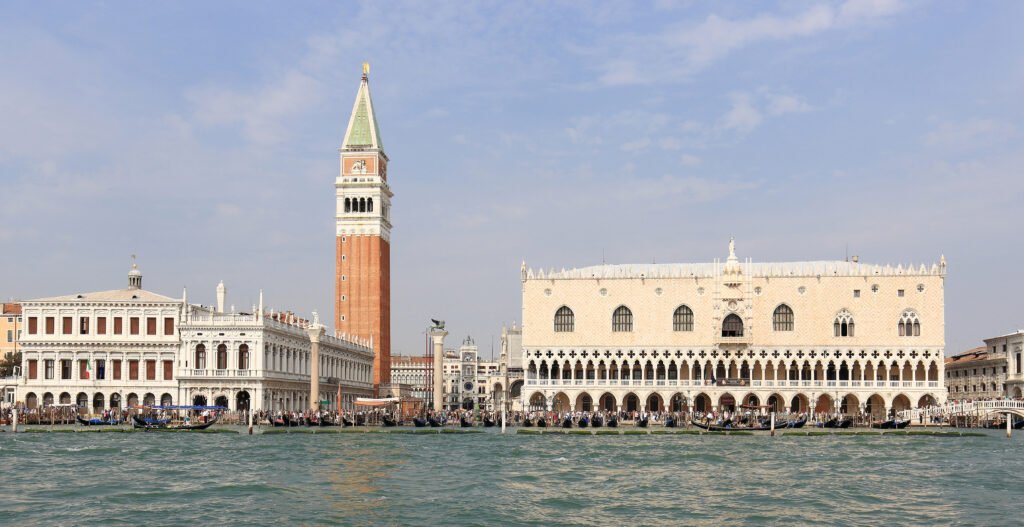
Venice is a city in northeastern Italy built across 118 small islands in a saltwater lagoon on the Adriatic Sea. For more than a thousand years it was the capital of an independent maritime republic, and today it is known worldwide for its canals, its car free streets, and an urban fabric that has survived largely unchanged since the Renaissance.
Where Is Venice Located?
Venice sits in the Veneto region of Italy, inside the Venetian Lagoon, a shallow body of water separated from the Adriatic Sea by a string of barrier islands. The historic city has no roads for cars. Residents and visitors move on foot across more than 400 bridges or by boat along roughly 150 canals, the largest of which, the Grand Canal, winds through the city in a reverse S shape and once served as its main shipping lane.
The Origins and History of Venice
Venice grew out of a scatter of lagoon settlements founded between the fifth and seventh centuries CE, as communities on the Italian mainland sought refuge from waves of invasion following the collapse of the Western Roman Empire. Building on marshy islands meant driving long wooden piles into the clay below the lagoon to support stone construction, a method that still holds up much of the historic city today.
By the ninth century, Venice had become an independent maritime power governed by an elected doge. Over the following centuries the Republic of Venice, often called La Serenissima, built a trading empire that linked Western Europe with the Byzantine world and the eastern Mediterranean, controlling ports and territory across the Adriatic and into Greece and Cyprus. Its merchant fleets carried spices, silk, and glass, and its wealth financed the churches, palaces, and public buildings that still define the city today. The Republic fell in 1797, when Napoleon’s forces ended thirteen centuries of self-government, and the city later became part of unified Italy in 1866.
Government, Trade, and the Decline of the Republic
Venetian government centered on the doge, a head of state elected for life by the city’s aristocratic families, whose power was checked by a series of councils designed to prevent any single family from seizing permanent control. This system kept Venice politically stable for centuries even as its commercial fortunes shifted. Venetian wealth depended heavily on controlling trade routes between Europe and Asia. When Portuguese and later other European explorers opened direct sea routes to India and the Americas in the sixteenth century, Venice’s role as a trade intermediary declined, and the Republic’s influence contracted even as the city itself kept building.
Culture and Daily Life in Venice
Venetian culture grew directly out of the city’s relationship with water and trade. Venetian glassmaking, centered for centuries on the island of Murano after a 1291 decree moved furnaces there over fire safety concerns, remains a recognized craft tradition today. The city’s Carnival, with its elaborate masks, dates back to the medieval Republic and was revived in the twentieth century as a major annual event. Venice also hosts the Venice Biennale, founded in 1895 and now one of the most prominent recurring exhibitions in contemporary art and architecture, and the Venice Film Festival, one of the oldest film festivals in the world. The city’s population lives alongside millions of annual visitors, and management of that flow, including a day-tripper entry fee introduced in the 2020s, has become a defining civic issue.
Venice’s Most Famous Landmarks
Piazza San Marco, the city’s main public square, is anchored by St Mark’s Basilica, a Byzantine-style cathedral consecrated in 1094 and covered inside with gold mosaics, and by its freestanding bell tower, the Campanile. Facing the square is the Doge’s Palace, the former seat of Venetian government, connected to the adjoining prison by the enclosed Bridge of Sighs. The Rialto Bridge, completed in 1591, was for centuries the only crossing over the Grand Canal and remains one of the city’s busiest points. In 1987, UNESCO inscribed Venice and its Lagoon as a World Heritage Site, recognizing the city and its surrounding wetland as a single, continuous work of human construction and maintenance.
What Is Venice Known For?
Venice is known above all for being built on water: a city with canals instead of roads, gondolas and vaporetto boats instead of cars, and a historic center that has kept its medieval and Renaissance street plan intact. It is also known for Carnival, for Murano glass, and for having been, for over a thousand years, one of the most powerful trading states in the Mediterranean world.
Why Venice Matters
Venice matters both as a record of pre-industrial urban engineering and as a case study in the pressures facing historic cities today. Its foundations show how a wealthy, organized society adapted an unlikely site into a functioning capital for more than a millennium. In the twenty-first century, Venice has also become a global reference point for the threat rising sea levels and subsidence pose to low-lying coastal heritage, making decisions made there, including the MOSE flood barrier system completed in the 2020s, closely watched by other at-risk cities.
Key facts
- Built across 118 islands in the Venetian Lagoon, with no roads for cars1
- Capital of the independent Republic of Venice from roughly the ninth century until 17972
- Venice and its Lagoon inscribed as a UNESCO World Heritage Site in 19871
- St Mark's Basilica was consecrated in 10941
- Became part of unified Italy in 18662
Quick checkWhy does Venice have canals instead of roads?Show answer
Venice was built across small islands in a lagoon, so its historic streets are waterways rather than roads for vehicles.
Sources
- UNESCO World Heritage Centre. Venice and its Lagoon. Undated (accessed Accessed 2026-10-06)
- Encyclopaedia Britannica. Venice. Undated (accessed Accessed 2026-10-06)
Editorially reviewed by Specialty Digest Editorial TeamLast reviewed October 6, 2026Researched and drafted with AI assistanceReport an issue