In simple terms
El Nino is the warm phase of a climate pattern in the tropical Pacific Ocean that shifts rainfall and temperature in many parts of the world. Its cold counterpart is La Nina, and the whole cycle is called the El Nino-Southern Oscillation, or ENSO.
Unusually warm surface water in the central and eastern equatorial Pacific changes the atmosphere above it. Because that atmosphere steers storm tracks, the consequences land thousands of kilometers away.
How it works
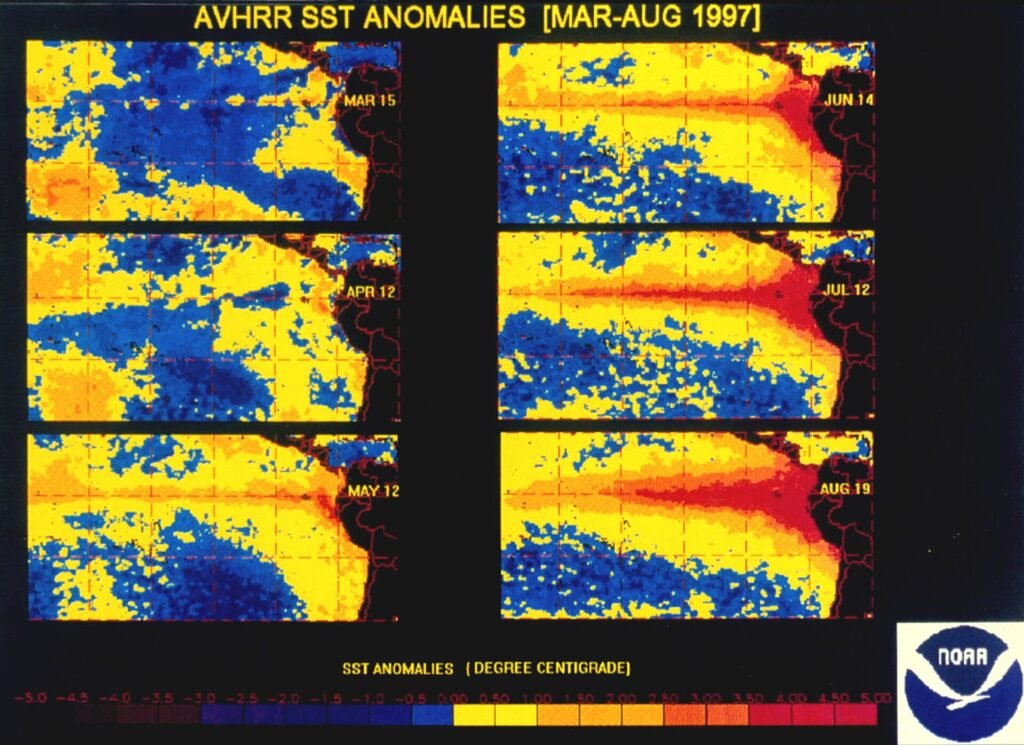
In normal conditions, trade winds blow west along the equator, pushing warm surface water toward Asia while cold water rises from the depths to replace it, a process called upwelling. During El Nino the trade winds weaken, warm water slides back east toward the Americas, and upwelling slows or stops. NOAA reports that the Pacific jet stream then shifts south, leaving the northern United States and Canada warmer and drier while the Gulf Coast and Southeast turn wetter, with increased flooding.
Timing is only loosely predictable. NOAA puts typical episodes at nine to 12 months, occasionally running for years, returning every two to seven years on average with no regular schedule. The World Meteorological Organization says El Nino can last up to 18 months and La Nina up to three years, and that events usually start developing between March and June and peak between November and February. The two agencies describe the same cycle with different thresholds, so duration figures are approximate.
WMO is explicit about the limits: impacts vary with an event’s strength, duration and timing, not all regions are affected, extreme weather still occurs when ENSO is neutral, and it does not use the term Super El Nino. Seasonal models can now project patterns one to six months ahead.
Why it matters
When upwelling weakens, fewer nutrients reach the surface and phytoplankton decline off the Pacific coast, so the fish that eat them and the animals that eat those fish follow. Warmer water also carries tropical species such as yellowtail and albacore tuna into normally cold areas. NOAA records effects on weather, wildfires, ecosystems and economies.
Where you’ll see it
- Seasonal forecasts and official ENSO advisories
- Harvest and water-supply planning
- Fisheries management along the Pacific coast
- Disaster preparedness for floods and drought
Example
South American fishermen noticed unusually warm water in the 1600s and called it El Nino de Navidad, because the warming typically peaked around December.
Often confused with
La Nina, the cold phase, when trade winds strengthen and upwelling increases. El Nino is also not a storm: it is a months-long phase of an ocean and atmosphere pattern rather than an event you can point to on a map.
Key facts
- El Nino and La Nina are the warm and cold phases of the El Nino-Southern Oscillation, with a third ENSO-neutral state between them.2
- During El Nino the equatorial trade winds weaken, warm water moves east toward the Americas, and upwelling of cold nutrient-rich water slows or stops.1
- NOAA reports that episodes typically last nine to 12 months and recur every two to seven years, with no regular schedule.1
- WMO reports that El Nino can last up to 18 months and La Nina up to three years, with events usually developing between March and June and peaking between November and February.2
- WMO states that not all regions are affected, that extreme weather still occurs in ENSO-neutral conditions, and that it does not use the term Super El Nino.2
Related concepts
Quick checkWhat happens to the Pacific trade winds during El Nino?Show answer
They weaken, so warm surface water moves back east toward the Americas and cold upwelling slows or stops.
Sources
- NOAA National Ocean Service. What are El Nino and La Nina?. Undated (accessed Accessed 21 October 2026)
- World Meteorological Organization. El Nino / La Nina Phenomena. Undated (accessed Accessed 21 October 2026)
Editorially reviewed by Specialty Digest Editorial TeamLast reviewed October 21, 2026Researched and drafted with AI assistanceReport an issue