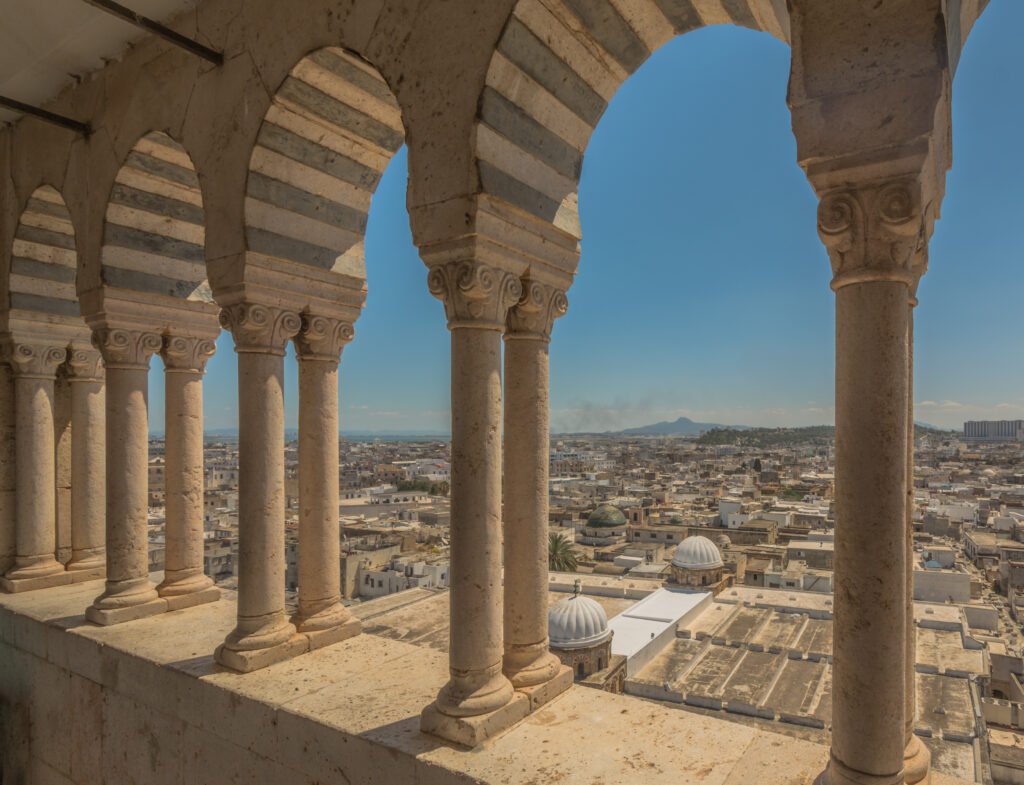
Tunis is the capital and largest city of Tunisia, built along the northern Mediterranean coast of North Africa. The city sits on the western shore of the Lake of Tunis, a shallow lagoon connected to the Gulf of Tunis and, beyond it, the Mediterranean Sea, with a dredged channel allowing ships to reach the modern port. Tunis is both the country’s political capital and its largest urban center, and it sits only a few kilometers from the ruins of ancient Carthage, one of the ancient Mediterranean world’s most powerful cities.
Where Is Tunis Located?
Tunis occupies the northeastern tip of Tunisia, the smallest country in the Maghreb region of North Africa. The city faces the Mediterranean across the Gulf of Tunis, with the Sahel coast stretching south and the mountainous Tunisian Dorsal running inland to the west. Its position, close to the narrowest crossing point between North Africa and Sicily, has made the area strategically important since antiquity.
A Brief History of Tunis
Tunis existed as a smaller settlement in antiquity, overshadowed for centuries by nearby Carthage, which the Romans destroyed in 146 BCE after the Third Punic War. Tunis grew into a major city only after the Arab conquest of North Africa. According to traditional accounts preserved in Islamic historical sources, the Arab general Hassan ibn al-Nu’man founded the Zitouna Mosque (the Great Mosque of Tunis, also called Jami al-Zaytuna) in 698 CE, shortly after Arab forces took the region, and the mosque was substantially rebuilt and enlarged under the Aghlabid dynasty in 864 CE.
From Regional Capital to Ottoman Beylik
Tunis became the political center of the region under the Hafsid dynasty from the thirteenth century, developing the dense, walled old city that survives today as the Medina of Tunis. From 1574 the city came under Ottoman control and was ruled by a line of semi-autonomous governors known as Beys, under whom Tunis grew as a trading center linking Mediterranean and trans-Saharan commerce.
French Protectorate and Independence
France established a protectorate over Tunisia in 1881, and Tunis became the seat of French colonial administration alongside the existing Beylical court. Tunisia gained independence in 1956 under Habib Bourguiba, who became the country’s first president, and Tunis has remained the national capital since.
Tunis Today: Economy and Culture
As Tunisia’s capital, Tunis is the country’s center of government, banking, and higher education, and it anchors a metropolitan area that is home to a large share of Tunisia’s urban population. The World Bank reports that Tunisia’s economy grew by about 2.7% in 2025, with water scarcity identified as a major long-term constraint on growth that Tunisia and the World Bank are working to address.[1] The city’s character blends an Arab-Islamic old town with a French-built modern center, reflecting its layered colonial and pre-colonial history.
What Is Tunis Known For?
Tunis is best known for its Medina, the historic walled old city that UNESCO added to the World Heritage List in 1979 in recognition of its density of Islamic-era monuments, including palaces, mosques, and traditional markets built up over more than a thousand years.[2] The Zitouna Mosque, with its distinctive square minaret, remains the Medina’s spiritual and architectural anchor and one of the oldest mosques in North Africa. Tunis is also the gateway to the ruins of ancient Carthage and to the Bardo National Museum, which holds one of the world’s largest collections of Roman mosaics.
More recently, Tunis became internationally known as the starting point of the protests that forced President Zine El Abidine Ben Ali from power in January 2011, an event widely described as the opening chapter of the Arab Spring.[3]
Why Tunis Matters
Tunis matters as a long-running crossroads between the Mediterranean, the Arab world, and sub-Saharan Africa, a role visible in its layered architecture and its history as a center of trade, scholarship, and political change. Its 2010-2011 role in the Arab Spring gave the city renewed significance in modern Middle Eastern and North African political history, while its Medina continues to represent one of the best-preserved examples of a historic Arab-Islamic city.
Key Takeaways
- Tunis is the capital and largest city of Tunisia, on the Gulf of Tunis near the ruins of ancient Carthage.
- The Zitouna Mosque, founded around 698 CE, is one of the oldest and most significant mosques in North Africa.
- The Medina of Tunis has been a UNESCO World Heritage Site since 1979.
- Tunis was the epicenter of the protests that ended Zine El Abidine Ben Ali’s rule in January 2011, opening the Arab Spring.
- Tunisia’s economy grew by roughly 2.7% in 2025, according to the World Bank.
Sources
- World Bank, “Tunisia Overview” (2026), worldbank.org/en/country/tunisia/overview
- UNESCO World Heritage Centre, “Medina of Tunis” whc.unesco.org/en/list/36
- UNESCO World Heritage Centre, general World Heritage List documentation of the Tunisian Revolution’s historical context is not UNESCO-sourced; this claim reflects widely documented international news history of the period and is presented as well-established historical record rather than a single-source citation.
Key facts
- Tunis is the capital and largest city of Tunisia, on the Gulf of Tunis near ancient Carthage.1
- The Zitouna Mosque, founded around 698 CE, is among North Africa's oldest major mosques.2
- The Medina of Tunis has been a UNESCO World Heritage Site since 1979.2
- Tunis was the epicenter of the January 2011 protests that ended Ben Ali's rule, opening the Arab Spring.3
- Tunisia's economy grew about 2.7% in 2025, per the World Bank.1
Quick checkWhy is the Medina of Tunis internationally significant?Show answer
It has been a UNESCO World Heritage Site since 1979 for its density of well-preserved Islamic-era architecture, including the Zitouna Mosque.
Sources
- World Bank. Tunisia Overview. 2026 (accessed Accessed 2026-10-21)
- UNESCO World Heritage Centre. Medina of Tunis. Undated (accessed Accessed 2026-10-21)
Editorially reviewed by Specialty Digest Editorial TeamLast reviewed October 21, 2026Researched and drafted with AI assistanceReport an issue