Lagos is Nigeria’s largest city and its commercial and financial capital, though it has not been the country’s political capital since 1991. Built across a lagoon on Nigeria’s Atlantic coast, Lagos spans a cluster of islands, including Lagos Island and Victoria Island, and a much larger mainland area, and it ranks among the largest and fastest-growing urban areas in Africa.
Where Is Lagos Located?
Lagos sits on Nigeria’s southwestern Atlantic coast, around the Lagos Lagoon, a broad body of water separated from the Gulf of Guinea by a narrow barrier of land. The historic core, Lagos Island, is linked by bridges to Lagos’s mainland districts and to Victoria Island and Ikoyi, the city’s main business and diplomatic districts.
A Brief History of Lagos
Lagos originated as Eko, a settlement of the Awori, a Yoruba subgroup, and developed into a kingdom ruled by an Oba (king), a traditional institution that continues today in a largely ceremonial role. Portuguese explorers reached the area in the fifteenth century and gave the settlement the name “Lagos,” after the Portuguese coastal town, meaning “lakes.”
The Slave Trade and British Rule
From the eighteenth into the nineteenth century, Lagos became one of West Africa’s major ports in the Atlantic slave trade. Britain, seeking to suppress that trade and expand its influence, bombarded and annexed Lagos in 1861, formally establishing the Lagos Colony, which later became the administrative core of British Nigeria.
Capital of Nigeria, Then Commercial Capital
Lagos remained Nigeria’s capital through independence in 1960 and the decades that followed, until the federal government formally relocated the capital to the newly built city of Abuja in 1991. Lagos nonetheless kept, and expanded, its role as Nigeria’s main port, financial center, and largest city.
Lagos Today: Economy and Growth
Nigeria is, per the World Bank, “a multi-ethnic and culturally diverse federation of 36 autonomous states and the Federal Capital Territory,” and Lagos functions as the commercial engine of that federation, home to Nigeria’s main stock exchange, its busiest port, and a large share of its banking and film and music industries.[1] Lagos’s exact population is genuinely disputed, in part because Nigeria’s most recent completed national census dates to 2006; estimates for the wider metropolitan area range widely, but all agree Lagos is one of Africa’s largest and fastest-growing cities.
What Is Lagos Known For?
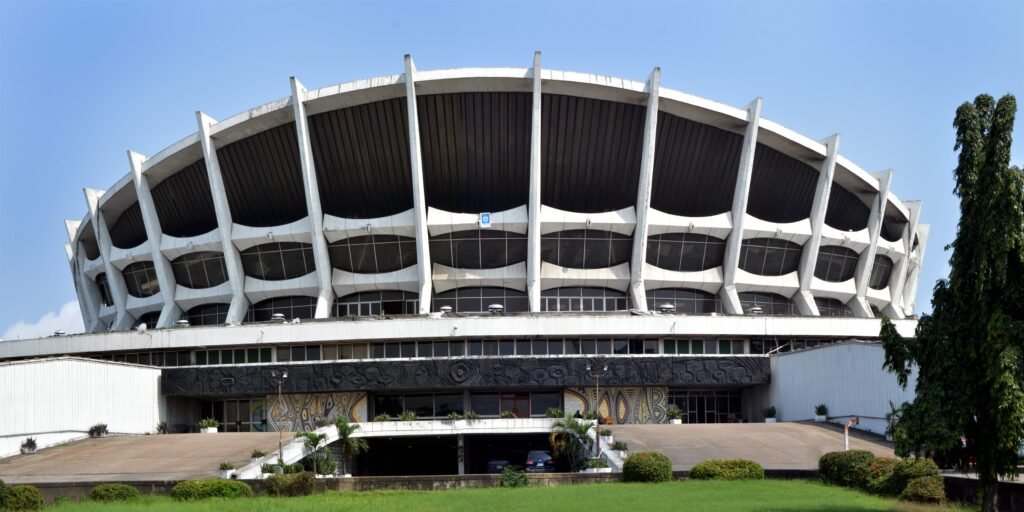
Lagos is widely known as the commercial and cultural capital of West Africa and the hub of “Nollywood,” Nigeria’s large film industry, as well as a major center of Afrobeats music. Architecturally, the city’s best-known landmark is the National Theatre, a large performance venue in the Iganmu district built for Nigeria’s independence-era cultural ambitions and completed in 1976 in a distinctive saucer-shaped design; it hosted the Second World Black and African Festival of Arts and Culture (FESTAC ’77) and remains Nigeria’s premier national arts venue.
Why Lagos Matters
Lagos matters as the economic heart of Africa’s most populous country and one of the continent’s most important commercial gateways, a role it built on its colonial-era port infrastructure and has expanded far beyond. Its continued rapid growth makes it a widely studied case of African urbanization, infrastructure strain, and economic opportunity.
Key Takeaways
- Lagos is Nigeria’s largest city and commercial capital, built around the Lagos Lagoon on the Atlantic coast.
- It began as Eko, a Yoruba (Awori) settlement ruled by an Oba, before Portuguese explorers named it Lagos.
- Britain annexed Lagos in 1861 and it became the administrative center of colonial Nigeria.
- Lagos was Nigeria’s capital until the government moved the capital to Abuja in 1991.
- The National Theatre, completed in 1976, is Lagos’s best-known architectural landmark.
Sources
- World Bank | “Nigeria Overview” | 2026 | worldbank.org/en/country/nigeria/overview
Key facts
- Lagos is Nigeria's largest city and commercial capital, built around the Lagos Lagoon.1
- It began as Eko, a Yoruba (Awori) settlement, before Portuguese explorers named it Lagos.
- Britain annexed Lagos in 1861, making it the administrative center of colonial Nigeria.
- Lagos was Nigeria's capital until the government relocated the capital to Abuja in 1991.
- The National Theatre, completed in 1976 for FESTAC '77, is Lagos's best-known landmark.
Quick checkIs Lagos the capital of Nigeria?Show answer
No. Lagos was Nigeria's capital until 1991, when the federal government relocated the capital to Abuja; Lagos remains Nigeria's largest city and commercial capital.
Sources
- World Bank. Nigeria Overview. 2026 (accessed Accessed 2026-10-21)
Editorially reviewed by Specialty Digest Editorial TeamLast reviewed October 21, 2026Researched and drafted with AI assistanceReport an issue