Accra is the capital and largest city of Ghana, on the Gulf of Guinea coast of West Africa. Built up around a cluster of older Ga fishing settlements and a line of European trading forts, Accra became the capital of the British Gold Coast in 1877 and, after Ghana’s 1957 independence, the capital of the first Sub-Saharan African country to shake off European colonial rule.
Where Is Accra Located?
Accra sits directly on the Atlantic coast of West Africa, on the Gulf of Guinea, in Ghana’s Greater Accra Region. The city grew outward from its original coastal core, where Ga fishing communities and European coastal forts once stood side by side, into a much larger metropolitan area reaching well inland.
A Brief History of Accra
Before European contact, the Accra area was home to several Ga settlements engaged in fishing and regional trade. From the seventeenth century, European trading powers, Portugal, the Netherlands, Denmark, and Britain, built competing coastal forts and castles near these settlements as part of the wider Gold Coast trade network, including the Atlantic slave trade. Britain progressively absorbed the rival forts and in 1877 moved the capital of its Gold Coast colony from Cape Coast to Accra.
Independence and Pan-Africanism
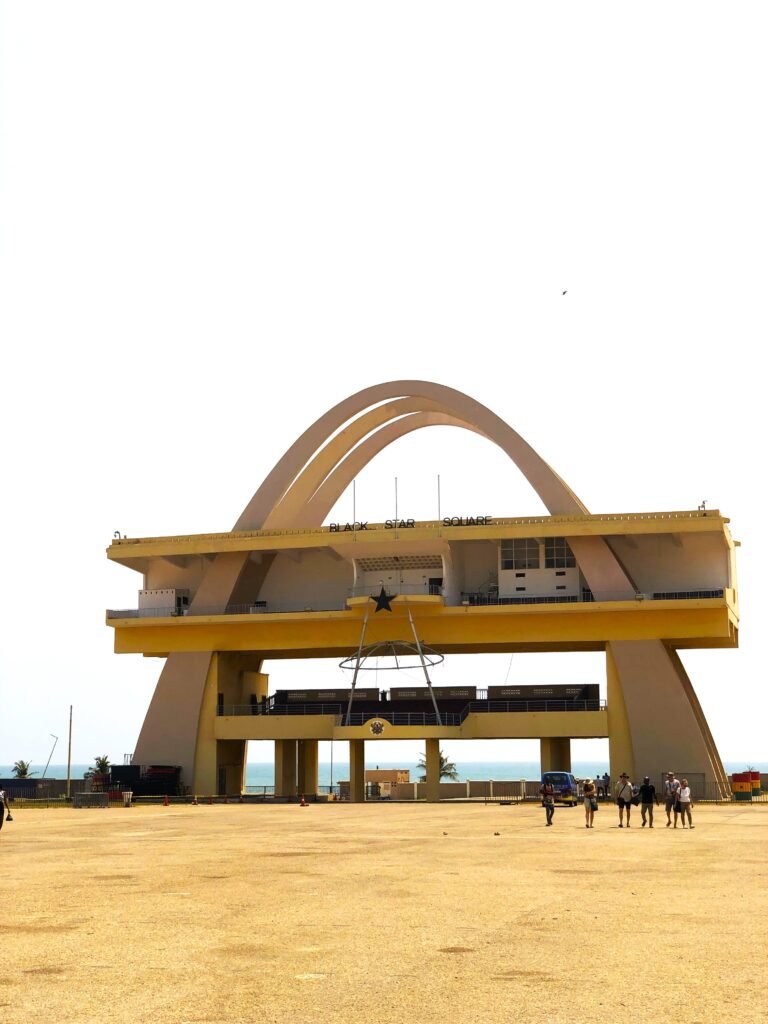
Ghana, led by Kwame Nkrumah, became independent from Britain on 6 March 1957, the first Sub-Saharan African country to do so, and Accra became the capital of the new nation. Nkrumah positioned Accra, and Ghana more broadly, as a center of the wider Pan-African movement, hosting African independence leaders and conferences through the following decade. Independence Square, also called Black Star Square, and its Independence Arch, built in 1961, became the permanent physical monument to that moment and remain the site of Ghana’s annual independence day parades.
Accra Today: Population and Economy
Ghana’s national population reached about 30.8 million according to the 2021 Population and Housing Census conducted by the Ghana Statistical Service, and the Greater Accra Region, anchored by the capital, has become Ghana’s most populous region, overtaking the historically larger Ashanti Region.[1] Accra functions as Ghana’s commercial, administrative, and transportation hub, serving as the country’s main port city alongside nearby Tema.
What Is Accra Known For?
Accra is best known for Independence Square and its Independence Arch, topped with Ghana’s black star, the single most recognizable monument of Ghanaian nationhood and a frequent backdrop for national ceremonies. The city is also known for Jamestown, its historic fishing district built around colonial-era forts and lighthouses, and for its role as an early and enduring center of Pan-African political thought.
Why Accra Matters
Accra matters as the capital of the country that led Sub-Saharan Africa’s wave of independence movements, and its monuments, especially Independence Square, remain touchstones for African nationalism and Pan-Africanism well beyond Ghana’s own borders.
Key Takeaways
- Accra is Ghana’s capital and largest city, on the Gulf of Guinea coast of West Africa.
- It grew from Ga coastal settlements alongside competing European trading forts.
- Accra became the Gold Coast’s colonial capital in 1877, replacing Cape Coast.
- Ghana’s 1957 independence, led by Kwame Nkrumah, made Accra the first Sub-Saharan African capital to achieve it.
- Independence Square and its Independence Arch, built in 1961, are Accra’s defining national monument.
Sources
- Ghana Statistical Service | 2021 Population and Housing Census results, as reported by Xinhua | 2021 | news.cn/english/2021-09/23/c_1310203296.htm
Key facts
- Accra is Ghana's capital and largest city, on the Gulf of Guinea coast.
- It grew from Ga coastal settlements beside competing European trading forts.
- Accra became the Gold Coast colony's capital in 1877, replacing Cape Coast.
- Ghana's 1957 independence made it the first Sub-Saharan African country to achieve it.1
- Independence Square and its 1961 Independence Arch are Accra's defining national monument.
Quick checkWhat does the Black Star atop Accra's Independence Arch symbolize?Show answer
It symbolizes Ghana's independence and African identity, echoing the black star on Ghana's flag and the wider Pan-African movement Ghana helped lead.
Sources
- Ghana Statistical Service (via Xinhua). 2021 Population and Housing Census. 2021 (accessed Accessed 2026-10-21)
Editorially reviewed by Specialty Digest Editorial TeamLast reviewed October 21, 2026Researched and drafted with AI assistanceReport an issue