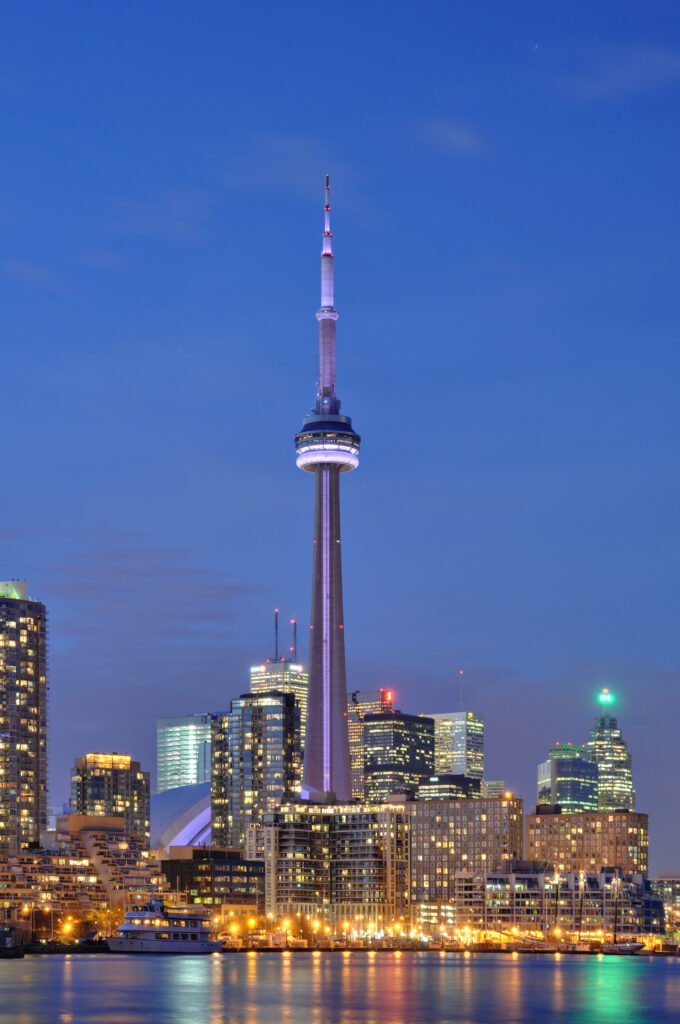
Toronto is the largest city in Canada and the capital of the province of Ontario, built along the northwestern shore of Lake Ontario. It is Canada’s financial and media center and, since a 1998 municipal merger, one of the largest cities in North America by population.
Where Is Toronto Located?
Toronto sits on the northwestern shore of Lake Ontario, the easternmost and smallest of the five Great Lakes, in the Canadian province of Ontario. The city’s waterfront, downtown core, and financial district all face the lake directly, and several rivers and ravines, most notably the Don and Humber valleys, cut through the urban area on their way to it.
A Brief History of Toronto
From York to Toronto
The British Lieutenant Governor of Upper Canada, John Graves Simcoe, founded the settlement as the Town of York in 1793, choosing the site for its defensible harbour. The town was incorporated as a city in 1834 and renamed Toronto, a name drawn from a Mohawk word referring to the area around Lake Simcoe, used earlier for a portage route through the region.
Becoming a Megacity
Toronto grew through the 19th and 20th centuries into Ontario’s largest urban center. In 1998, the provincial government amalgamated the old City of Toronto with five surrounding municipalities, East York, Etobicoke, North York, Scarborough, and York, into a single, enlarged City of Toronto, often referred to afterward as the “megacity.”
What Is Toronto Known For?
Toronto is Canada’s financial capital, home to the Toronto Stock Exchange and the head offices of the country’s largest banks, and one of the most ethnically diverse cities in the world, with a majority of residents born outside Canada according to successive national censuses. Its skyline is dominated by the CN Tower, a 553.3-metre communications and observation tower completed in 1976 by Canadian National Railway. For more than three decades it was recognized as the world’s tallest freestanding structure, a title it held until Dubai’s Burj Khalifa surpassed it in 2007; it remains the tallest freestanding structure in the Western Hemisphere and the defining image of the city’s skyline. Ownership later passed to the Canada Lands Company, a federal Crown corporation.
Culture and Economy
Beyond finance, Toronto anchors Canada’s film and television production industry, hosts the Toronto International Film Festival, and is home to major professional sports franchises across hockey, basketball, baseball, and soccer. Its downtown core combines Victorian-era civic buildings with a dense cluster of modern office and residential towers, reflecting more than two centuries of continuous growth from a small colonial port town.
Why Toronto Matters
As Canada’s largest city and financial hub, Toronto plays an outsized role in the national economy, and its position on Lake Ontario, directly across the water from the United States, has made it a major gateway for trade and immigration since the 19th century. Its growth from a single colonial town into a six-municipality megacity illustrates how Canadian urban governance has adapted to rapid population growth over the past century.
Key Takeaways
- Toronto was founded as the Town of York in 1793 by Lieutenant Governor John Graves Simcoe and renamed Toronto when incorporated as a city in 1834.
- It sits on the northwestern shore of Lake Ontario and is the capital of the province of Ontario and the largest city in Canada.
- The CN Tower, completed in 1976, was the world’s tallest freestanding structure until 2007 and remains Toronto’s most recognizable landmark.
- A 1998 amalgamation merged six separate municipalities into the present, enlarged City of Toronto.
Sources
Key facts
- Founded as the Town of York in 1793 by John Graves Simcoe; renamed Toronto upon incorporation as a city in 1834.
- Capital of the Canadian province of Ontario and the country's largest city by population.
- The CN Tower (1976) was the world's tallest freestanding structure until 2007.1
- A 1998 amalgamation merged Toronto with five neighbouring municipalities into a single enlarged city.
Quick checkWhat was Toronto called before 1834?Show answer
Toronto was founded in 1793 as the Town of York and was renamed Toronto when it was incorporated as a city in 1834.
Sources
- World Bank Group. Canada country overview. Undated, accessed 2026 (accessed 2026-10-21)
Editorially reviewed by Specialty Digest Editorial TeamLast reviewed October 21, 2026Researched and drafted with AI assistanceReport an issue