A keystone species is an organism whose presence has a disproportionately large effect on the structure and stability of its ecological community, relative to how abundant it actually is. Removing a keystone species can set off a chain of changes that reshapes an entire community, even though the species itself may be neither the largest nor the most numerous organism present.
History of the keystone species concept
American zoologist Robert T. Paine introduced the term in 1969, borrowing the image from architecture. A keystone sits at the top of a stone arch and locks the surrounding blocks into place by distributing their weight; remove it, and the arch collapses, even though the keystone itself is only one block among many. Paine developed the idea through field experiments on the rocky intertidal shorelines of the Pacific coast of North America, where he physically removed a predatory sea star from a stretch of shoreline to observe what happened to the community left behind.
Types of keystone species
Ecologists generally group keystone species by the role they play rather than by what kind of organism they are. Keystone predators control the population of a herbivore or competitor that would otherwise dominate a community and crowd out other species. Keystone prey, or keystone resources, work the opposite way: rather than limiting other species, they sustain them. Fig trees (genus Ficus) in tropical American forests are a well-documented example. They fruit nearly year-round, so many birds and mammals come to depend on figs to survive the seasons when other fruit is scarce.
A closely related but technically distinct category is the ecosystem engineer, an organism such as a beaver that physically reshapes its habitat, for example by damming a stream to create a wetland, in ways that open up living space for many other species. Ecosystem engineers often overlap with keystone species in practice, though ecologists generally treat the two labels as separate concepts, since an ecosystem engineer changes the physical environment while a keystone species changes the balance of a food web.
How keystone species work
Paine’s original experiment remains the clearest illustration. The ochre sea star (Pisaster ochraceus) preys on mussels (Mytilus californianus) in the intertidal zones of the northwestern Pacific coast. When Paine removed the sea stars from a test area, the mussels, freed from their main predator, multiplied rapidly and spread across the rock face, crowding out barnacles, algae, and smaller invertebrates and sharply reducing the number of species the area could support. Left alone, the sea star kept the mussel population in check and allowed a far more diverse community to persist. Ecologists call this chain of indirect effects, moving from a predator down through multiple feeding levels, a trophic cascade. The sea star-mussel relationship remains one of the most cited trophic cascades in marine ecology, largely because Paine’s experiment used control plots, which let him rule out other explanations for the change.
The effect is specific to context, though. Pisaster behaves as a keystone predator in some intertidal communities but has little measurable effect in others, depending on which other species are present and how they compete for space. This is one reason ecologists are careful not to assume that every predator automatically qualifies as a keystone species.
Applications and examples of keystone species
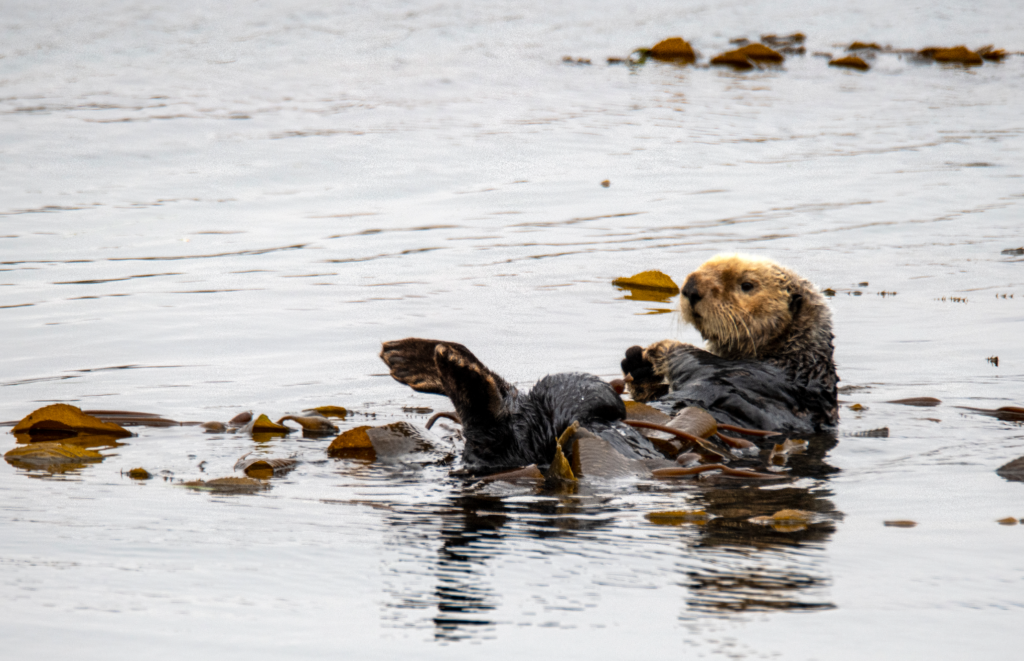
Sea otters (Enhydra lutris) along the North Pacific coast illustrate a similar dynamic in a kelp forest. Otters prey on sea urchins, which graze on kelp, so a healthy otter population generally keeps urchin numbers low enough for kelp forests to thrive. Along the central California coast, a 2013 outbreak of sea star wasting disease killed off sunflower sea stars, another major urchin predator, and a 2014 marine heatwave linked to El Nino conditions further weakened kelp growth. Urchins multiplied and, in places, grazed kelp forests down to bare rock, a condition researchers call an urchin barren. Local otters responded by eating roughly three times as many urchins as before, and otter numbers in the Monterey area grew, but researchers note that otters feed mainly in surviving kelp patches rather than in barrens themselves, where starved urchins offer little nutritional value. Otters alone have not been enough to reverse the barrens, underscoring that a keystone species can soften an ecological collapse without single-handedly undoing it.
Gray wolves in Yellowstone National Park are another frequently cited case, though the National Park Service’s own researchers describe the full picture as unsettled. After wolves were reintroduced in 1995, elk browsing on streamside willow and aspen eased in some areas, and these plants showed signs of recovering. Scientists broadly agree on that pattern, but they still debate why it happened: whether wolves changed elk behavior by making risky areas feel dangerous, whether elk numbers simply fell, whether local water availability set the real limit on plant growth, or whether the return of beavers, themselves tied to willow availability, played an independent role. The Park Service’s position is that the honest answer, as of recent reviews, is that no single explanation yet accounts for everything observed.
The concept is sometimes confused with a flagship species such as the giant panda, whose conservation value lies mainly in its power to attract public attention and funding rather than in any outsized ecological role. A species can be a powerful conservation symbol without functioning as a keystone species in its own ecosystem.
Why keystone species matter
Identifying keystone species gives conservation planners a practical shortcut. Protecting one well-chosen keystone species can indirectly protect dozens of others that depend on it, which is often more achievable than trying to monitor and protect every species in a biodiversity hotspot individually. At the same time, the label has real limits. Because a keystone’s influence depends so heavily on the surrounding community, the same species can be pivotal in one location and marginal in another, which is why ecologists generally test the idea with removal experiments or long-term population data rather than assuming the role from an animal’s size or abundance alone.
FAQs
Is every apex predator a keystone species? No. An apex predator sits at the top of a food chain, but it only counts as a keystone species if removing it measurably changes the structure of the community beneath it. Some apex predators have only a modest effect on their surrounding ecosystem.
Can a plant or a small organism be a keystone species? Yes. The classification depends on ecological effect rather than size or position in a food chain, which is why keystone fig trees and keystone sea stars both count as valid examples despite being very different kinds of organisms.
Key facts
- Term coined by American zoologist Robert T. Paine in 1969, borrowed from the architectural keystone of a stone arch.
- Paine's removal experiments on the ochre sea star (Pisaster ochraceus) in Pacific intertidal zones provided the founding evidence.
- Keystone species can be predators, keystone prey or resources such as fig trees, or ecosystem engineers like beavers.
- Sea otters controlling sea urchin populations in North Pacific kelp forests are a widely cited modern example.
- The role is community-specific: a species can be a keystone in one location and have little measurable effect in another.
Related concepts
Quick checkWhy did sea otters alone fail to reverse California urchin barrens after 2014?Show answer
Because otters feed mainly in surviving kelp patches rather than barrens, where starved urchins offer little food value, so their predation could not clear the barrens on its own.
Sources
- Encyclopaedia Britannica. Keystone species. 2024 (accessed 2026-11-01)
- University of California, Santa Cruz. Sea otters maintain remnants of healthy kelp forest amid sea urchin barrens. 2021-03 (accessed 2026-11-01)
- National Park Service. The Big Scientific Debate: Trophic Cascades. 2024 (accessed 2026-11-01)
Editorially reviewed by Specialty Digest Editorial TeamLast reviewed November 1, 2026Researched and drafted with AI assistanceReport an issue