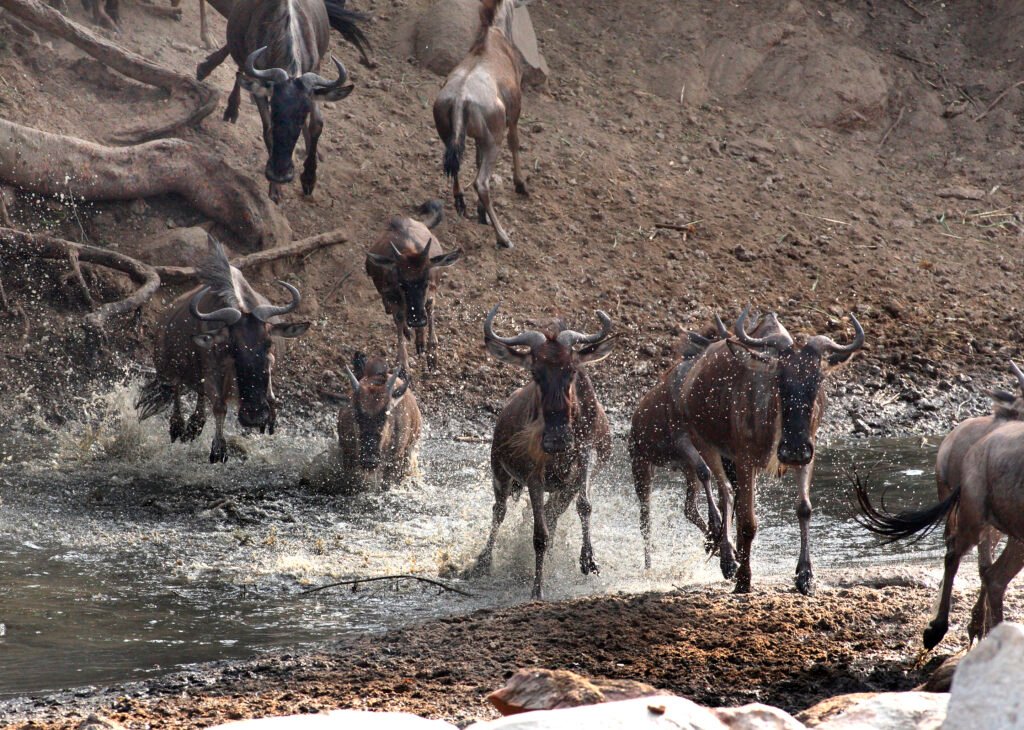
A food web is a map of who eats whom in an ecosystem, showing how energy and nutrients pass from one organism to the next. Unlike a food chain, which traces a single path from a producer to a top predator, a food web links together every food chain in a community, capturing the overlapping, many-to-many feeding relationships that keep a real ecosystem functioning.
History of the food web concept
The idea that organisms are linked in feeding chains is old; some historians trace an early version to the ninth-century scholar Al-Jahiz. The concept took modern scientific shape in 1927, when British ecologist Charles Elton published Animal Ecology. Elton described feeding relationships among animals as chains shaped heavily by the size of available prey, introduced the idea of an ecological niche to describe an animal’s role in its feeding relationships, and proposed representing a community’s structure as a pyramid of numbers across feeding levels. Later ecologists built on Elton’s single-chain framework once they recognized that most real communities do not form one straight line from plant to top predator; instead, the same organism often feeds on and is fed on by several others at once, which is what the word web was eventually used to describe.
How a food web works
Every organism in a food web occupies a trophic level, a position defined by how it gets its energy. Producers, such as plants, algae, and phytoplankton, sit at the base and make their own food, mostly through photosynthesis; some bacteria do the same through chemosynthesis instead. Primary consumers, typically herbivores, eat producers. Secondary consumers eat primary consumers, and tertiary consumers eat secondary consumers. Apex predators sit at the top of a given web with no natural predators of their own besides humans. Decomposers and detritivores, including fungi, bacteria, worms, and scavengers, break down dead organisms and waste at every level and return nutrients to the soil or water, which producers then take up again.
Energy is lost at every step as organisms use it for movement, growth, and metabolism, so considerably less energy reaches each successive trophic level than the one below it. Ecologists commonly estimate that only about 10 percent of the energy available at one trophic level transfers to the next, an approximation first proposed by American ecologist Raymond Lindeman in 1942 and still used as a rough rule of thumb today. This steep drop-off is one reason food webs generally support far fewer large predators than small producers, and why apex predators typically need much larger ranges than herbivores to find enough food.
A food chain and a food web describe the same basic relationships at different scales. A food chain traces one path: a mouse eats seeds, a snake eats the mouse, and an owl eats the snake. A food web shows that the mouse, snake, and owl are each connected to several other organisms too, so losing or adding just one species can ripple through many connected chains rather than just one.
Applications and examples of food webs
Kelp forests illustrate how tightly a food web’s parts depend on each other. Giant kelp is eaten by sea urchins, and sea urchins are preyed on by sea otters, a keystone species whose presence keeps urchin numbers low enough for kelp to thrive; where otters decline, urchins can multiply and strip a kelp forest down to bare rock. Pacific salmon runs show how a food web can move nutrients across an entire landscape: when dams or landslides cut salmon off from spawning rivers, bears that normally feed heavily on salmon rely more on ants and other low-energy food, and the nutrients bears would otherwise spread onto the forest floor in salmon remains decline too, with knock-on effects on plant growth.
Introducing a species that does not belong in a food web can be just as disruptive as removing one. An invasive species that arrives without the predators or competitors that normally limit it can out-compete native organisms for the same food or, in some cases, prey on species that have no natural defense against it, unraveling feeding relationships that took a long time to form. Migratory animals also carry food web connections across continents; the monarch butterfly, for example, depends on milkweed as a primary consumer at one stage of its life cycle and in turn becomes prey for birds and insects at others, linking milkweed patches thousands of miles apart into the same broader web.
Why food webs matter
Because species in a food web are interconnected, a change to one part, whether from climate shifts, pollution, overfishing, or a newly introduced species, rarely stays contained. Ecologists use food web models to anticipate these ripple effects before they happen, for example by estimating how removing a heavily fished predator might allow its prey to multiply unchecked, or how losing producers at the base of a web through habitat loss can eventually starve out everything above them. This interconnected structure is also why conservation efforts increasingly target whole food webs and the relationships within them, rather than focusing on a single species in isolation.
FAQs
Is a food web the same as a food pyramid? Not quite. A food pyramid, closer to Elton’s original pyramid of numbers, shows how the number or biomass of organisms typically shrinks at each higher trophic level. A food web shows the actual feeding connections between species rather than just their relative numbers.
Can one species belong to more than one trophic level? Yes. Many omnivores and scavengers shift levels depending on what they are eating at a given time, which is part of why real food webs are tangled networks rather than simple layered pyramids.
How many trophic levels does a typical food web have? Most food webs have three to five, since so little energy survives the transfer from one level to the next that very few ecosystems can support a sixth. Marine food webs, which often start with especially small, efficient producers like phytoplankton, sometimes support slightly more levels than land-based ones.
Key facts
- Modern scientific roots trace to Charles Elton's 1927 book Animal Ecology, which described feeding chains and a pyramid of numbers.
- Trophic levels run from producers through primary, secondary, and tertiary consumers to apex predators, with decomposers active at every level.
- A food chain traces one feeding path; a food web links together all the overlapping chains in a community.
- Removing or introducing a single species can ripple through a food web, as seen when sea otter declines let urchins strip kelp forests bare.
- Many organisms, especially omnivores and scavengers, occupy more than one trophic level depending on what they are eating.
Related concepts
In the news
Quick checkWhy can losing one species disrupt an entire food web rather than just one feeding relationship?Show answer
Because most species sit at the intersection of several food chains at once, so a change to one connection ripples outward through every other chain that species was part of.
Sources
- NOAA Office of National Marine Sanctuaries. Aquatic food webs. 2024 (accessed 2026-11-01)
- National Geographic Education. Food Web. 2024 (accessed 2026-11-01)
- SciHi Blog. Charles Elton and the Beginning of Modern Animal Ecology. 2021 (accessed 2026-11-01)
Editorially reviewed by Specialty Digest Editorial TeamLast reviewed November 1, 2026Researched and drafted with AI assistanceReport an issue