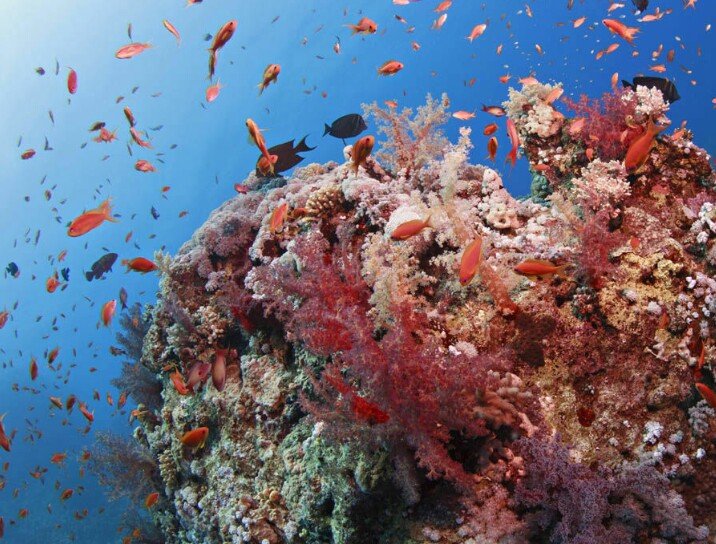
A coral reef is an underwater structure built up over long periods by colonies of hard, reef-building corals that secrete a calcium carbonate skeleton. Although corals are animals, most reef-building species host tiny symbiotic algae called zooxanthellae, which use sunlight to generate energy that the coral shares, which is why healthy reefs are concentrated in shallow, clear, tropical and subtropical waters where enough light can reach them.
History of coral reef science
Charles Darwin proposed the first lasting explanation for how ring-shaped atolls form after observing a reef at Tahiti in 1835 and spending time at the Cocos (Keeling) Islands the following year. He argued that coral grows upward as the Pacific seafloor beneath it slowly subsides, so what starts as a fringing reef around a volcanic island becomes a barrier reef and, eventually, an atoll once the island itself has sunk below the surface. He published the theory in full in The Structure and Distribution of Coral Reefs in 1842, and it challenged the prevailing view at the time that atolls were simply coral growing over the rims of sunken volcanic craters. Darwin’s subsidence theory remained unproven for more than a century until test borings drilled into the Marshall Islands in the 1950s showed that the volcanic rock beneath real atolls had indeed sunk thousands of feet, confirming his account.
Types of coral reefs
Reef scientists recognize three main structural types. Fringing reefs, the most common type, extend directly out from the shore of an island or continent with little or no lagoon separating them from land. Barrier reefs also run parallel to a coastline but sit farther out, separated from land by a lagoon of open, often fairly deep water. Atolls form, by Darwin’s mechanism, when a fringing reef around a volcanic island keeps growing upward even as the island beneath it sinks below sea level, leaving a roughly circular or oval reef enclosing a central lagoon, with sections sometimes rising above the water as low islands.
How coral reefs work
A reef begins when free-swimming coral larvae settle on a submerged rock or other hard surface. As individual coral polyps grow and divide, their skeletons accumulate into the reef’s physical structure, a process slow enough that a single colony may grow only a few centimeters a year and a full barrier reef or atoll can take anywhere from about 100,000 to 30 million years to develop. Only hard, or stony, corals build reefs this way; soft corals, which have a flexible skeleton built around the protein gorgonin, live among reefs but do not construct them. Grazing fish, sea urchins, and snails keep algae from overgrowing the coral, while sea fans, sponges, and the coral skeletons themselves create crevices and surfaces that shelter an unusually dense concentration of marine life relative to the surrounding open water.
Applications and examples of coral reefs
Reef ecosystems provide food, coastal storm protection, tourism revenue, and compounds used in medicine, and they support a share of marine biodiversity far out of proportion to the small fraction of the ocean floor they actually cover. Florida is the only state in the continental United States with extensive shallow coral reef formations, stretching roughly 350 miles from the Dry Tortugas to the St. Lucie Inlet, and the Florida Keys hold North America’s only coral barrier reef along with more than 40 species of reef-building coral. Because reef-building corals need stable warm temperatures, clear and low-nutrient water, and moderate wave action, they are unusually sensitive to changes in their surroundings and cannot relocate when conditions shift against them.
Why coral reefs matter, and the threats they face
Warming ocean temperatures, pollution, disease, and ocean acidification, which makes it harder for corals to build their calcium carbonate skeletons in the first place, all threaten reef ecosystems at the same time, and their combined effect is generally more damaging than any single stress acting alone. Physical damage from storms and boat groundings can also break apart colonies that took decades or centuries to grow. Because reef growth is so slow and recovery depends on a narrow set of environmental conditions holding steady, scientists generally treat coral reefs as one of the ocean habitats most vulnerable to a warming and more acidic ocean, even though the reef-building process Darwin first described continues wherever conditions remain favorable.
The scale of what is at risk is disproportionate to the space reefs occupy. Coral reefs cover less than one percent of the ocean floor, yet they support more than a quarter of all known marine species at some stage of their life cycle, from the fish and invertebrates that live directly on the reef to larger predators that feed nearby. This concentration of life is part of why conservation groups and governments have increasingly turned to active reef restoration, such as growing coral fragments in nurseries before transplanting them onto damaged reefs, as a complement to reducing the warming and pollution that damage reefs in the first place.
FAQs
Are all coral reefs the same color? No. A reef’s color comes largely from its zooxanthellae and the coral’s own pigments; a bleached reef, which has expelled its algae under stress, turns white because the underlying calcium carbonate skeleton becomes visible through the coral’s now-transparent tissue.
Can a bleached coral reef recover? Sometimes. A coral that has bleached is stressed but not yet dead, and it can recover its algae and color if favorable conditions, such as cooler water, return quickly enough; prolonged or repeated bleaching, however, significantly raises the risk that the coral will die.
Key facts
- Charles Darwin proposed his subsidence theory of atoll formation in 1842, after observing reefs at Tahiti and the Cocos Islands.
- Test borings in the Marshall Islands in the 1950s confirmed Darwin's theory by showing the volcanic rock beneath real atolls had sunk thousands of feet.
- The three main reef types are fringing reefs, barrier reefs, and atolls.
- Only hard (stony) corals build reefs; soft corals live on reefs but do not construct them.
- Florida's reef stretches about 350 miles and includes North America's only coral barrier reef, with more than 40 species of reef-building coral.
Related concepts
In the news
Quick checkWhy did it take over a century to confirm Darwin's theory of atoll formation?Show answer
Because proving it required physical evidence of how far the volcanic rock beneath an atoll had sunk, which only became possible once deep test borings were drilled into the Marshall Islands in the 1950s.
Sources
- NOAA National Ocean Service. Corals Tutorial: How Do Coral Reefs Form?. 2024 (accessed 2026-11-01)
- NOAA Florida Keys National Marine Sanctuary. Coral Reefs. 2024 (accessed 2026-11-01)
- Darwin Correspondence Project, University of Cambridge. Darwin & coral reefs. 2024 (accessed 2026-11-01)
- Coral Reef Alliance. Coral Reef Biodiversity: Why Reefs Hold So Much Life. 2024 (accessed 2026-11-01)
Editorially reviewed by Specialty Digest Editorial TeamLast reviewed November 1, 2026Researched and drafted with AI assistanceReport an issue