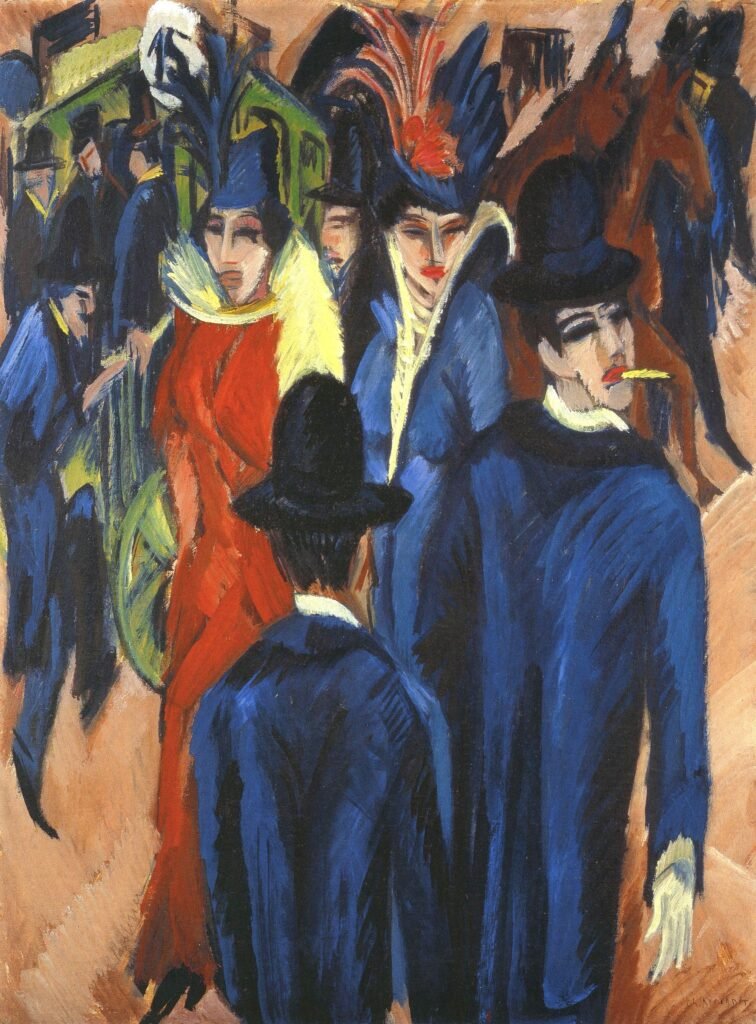
Expressionism is an early twentieth-century art movement, primarily centered in Germany, that emphasized subjective emotional experience over objective visual accuracy, often through distorted forms, simplified shapes, and intense, clashing color. Rather than aiming to depict the world as it objectively appears, Expressionist artists sought to convey how a scene or subject felt emotionally, frequently reflecting anxiety about modern urban life.
n
Die Brucke
n
Die Brucke, meaning ‘the bridge,’ was founded in Dresden in 1905 by four students at the city’s Technical Institute, Ernst Ludwig Kirchner, Fritz Bleyl, Erich Heckel, and Karl Schmidt-Rottluff, with Kirchner generally regarded as the group’s leader. The group is considered the starting point of German Expressionism, producing work marked by intense clashing color, simplified forms, and blunt, angular brushwork, and reviving older German printmaking traditions, especially woodcuts, that had fallen out of fashion. The group moved to Berlin in 1911 and dissolved in 1913 following internal disputes, but mounted more than seventy exhibitions across its roughly eight years of activity.
n
Der Blaue Reiter
n
A second major Expressionist group, Der Blaue Reiter, meaning ‘the Blue Rider,’ formed in Munich in 1911 around artists including Wassily Kandinsky and Franz Marc. Where Die Brucke’s work remained largely figurative, grounded in recognizable scenes and bodies, Der Blaue Reiter pursued a more abstract visual language, with Kandinsky in particular moving toward paintings built almost entirely from color and form rather than depicted subject matter.
n
Expressionism beyond painting
n
Expressionist ideas extended into German cinema during the 1910s and 1920s, most famously in The Cabinet of Dr. Caligari, released in 1920, whose deliberately distorted, nightmarish sets and sharp-angled shadows translated Expressionist painting’s emotional distortion directly into set design and cinematography. The movement also shaped German theatre and literature of the same period, carrying its emphasis on subjective, heightened emotional states across multiple art forms.
n
Themes and social context
n
Expressionist artists frequently depicted the alienation and anxiety of modern urban life, as in Kirchner’s paintings of crowded, unsettling Berlin street scenes, while also contrasting that alienation with an idealized vision of nature and the human body as sources of authenticity. This emotional intensity reflected broader anxieties present in German society both before and after the devastation of World War I, during which several core Expressionist artists served and were deeply affected.
n
Suppression and legacy
n
The Nazi regime labeled Expressionist art ‘degenerate’ during the 1930s, confiscating thousands of works from German museums, destroying some outright, and selling others abroad, forcing many Expressionist artists into exile or silence. The movement was rehabilitated after World War II, and its emphasis on raw emotional intensity and distorted form directly influenced later movements, including Abstract Expressionism in the United States.
n
An earlier precursor: Edvard Munch
n
Norwegian painter Edvard Munch is frequently cited as an important precursor to German Expressionism, particularly through his 1893 painting The Scream, whose swirling, anxious lines and intensely emotional, non-naturalistic color anticipated the movement’s central concern with externalizing inner psychological states years before Die Brucke was formally founded. Munch’s work was well known in German artistic circles by the early 1900s and directly influenced several of the young artists who would go on to found Die Brucke.
n
Austrian Expressionism
n
Expressionism also developed a distinct branch in Austria, particularly in Vienna, where painters Egon Schiele and Oskar Kokoschka produced emotionally raw, often unsettling figurative work, including Schiele’s stark, angular nude portraits and Kokoschka’s psychologically probing portraits, extending Expressionism’s core concerns into a cultural context shaped by Vienna’s own intense early-twentieth-century intellectual ferment, including the city’s close connection to Sigmund Freud’s psychoanalytic theories.
n
Expressionist cinema beyond Caligari
n
German Expressionist filmmaking extended well beyond The Cabinet of Dr. Caligari, including Robert Wiene’s other work and F. W. Murnau’s 1922 vampire film Nosferatu, whose elongated shadows and unsettling lead performance carried Expressionist visual ideas into horror filmmaking. These films proved enormously influential on later American film styles, particularly 1940s film noir, whose directors borrowed Expressionist lighting and composition techniques from German filmmakers who had emigrated to Hollywood.
n
Expressionist woodcuts and prints, revived from older German traditions by Die Brucke, also proved especially well suited to political and social commentary in the years surrounding World War I, since the technique’s bold, simplified contrasts of black and white lent themselves naturally to stark, emotionally direct imagery.
n
Museums and galleries today treat Expressionism as a foundational chapter of modern art history, and major retrospectives of Kirchner, Kandinsky, Munch, Schiele, and other associated artists continue to draw large audiences, reflecting the movement’s lasting hold on the public imagination well beyond the specific historical circumstances that first produced it.
n
Expressionism’s influence also extended into German sculpture and architecture of the same period, where artists applied its emphasis on raw, emotionally charged form to three-dimensional and built work, further demonstrating how thoroughly the movement’s core sensibility spread across different artistic media in early twentieth-century Germany and Austria.
n
Several Expressionist artists who survived the Nazi era into the postwar period, including Schmidt-Rottluff and Kokoschka, continued working for decades afterward, helping personally bridge the movement’s original early-century context with its later institutional rehabilitation and renewed critical appreciation.
n
FAQs
n
Is Expressionism the same as Impressionism? No, despite the similar-sounding names; Impressionism emerged decades earlier in France and focused on capturing fleeting visual effects of light and color from direct observation, while Expressionism prioritized subjective emotional distortion over objective visual accuracy.
n
What was Der Blaue Reiter? A second major German Expressionist group, founded in Munich in 1911 by artists including Wassily Kandinsky and Franz Marc, known for pursuing a more abstract visual style than the more figurative Die Brucke group.
Key facts
- Die Brucke, founded in Dresden in 1905, is considered the starting point of German Expressionism
- Der Blaue Reiter, founded in Munich in 1911, pursued a more abstract style
- The Cabinet of Dr. Caligari (1920) brought Expressionism into German cinema
- The Nazi regime labeled Expressionist art 'degenerate' and confiscated thousands of works in the 1930s
Related concepts
Quick checkWhat group is considered the starting point of German Expressionism?Show answer
Die Brucke, founded in Dresden in 1905 by Ernst Ludwig Kirchner and three fellow students.
Sources
- The Art Story, Die Brucke Movement Overview
- Wikipedia, Die Brucke
- Artincontext, Expressionism Art
Editorially reviewed by Specialty Digest Editorial TeamLast reviewed November 1, 2026Researched and drafted with AI assistanceReport an issue