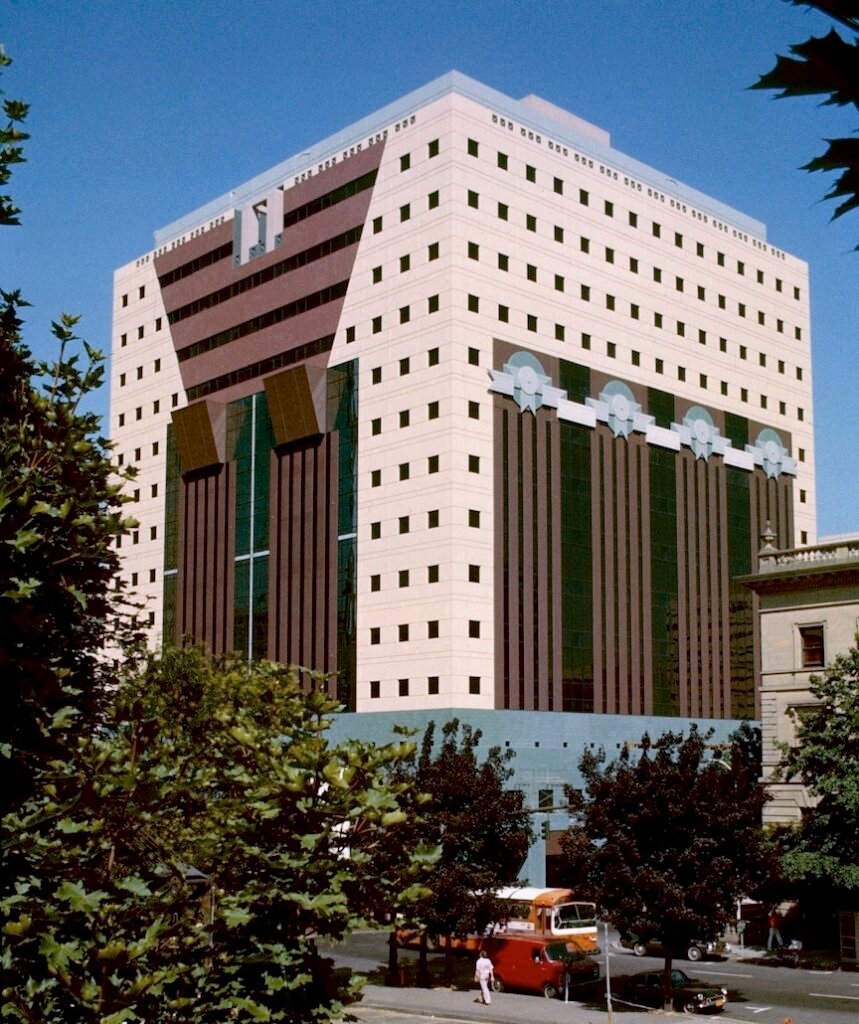
Postmodern architecture is a style and movement that emerged in the 1960s as a direct reaction against modern architecture, especially the austere, ornament-free International Style, reintroducing historical reference, color, humor, and complexity that modernism had deliberately stripped away. It flourished through the 1980s and 1990s before gradually splintering into several successor tendencies by the late 1990s.
Venturi’s challenge to modernism
Architect Robert Venturi formalized the movement’s core argument in his influential 1966 book Complexity and Contradiction in Architecture, directly answering Mies van der Rohe’s modernist maxim ‘less is more’ with his own rejoinder, ‘less is a bore.’ Venturi argued that architecture should embrace complexity and contradiction rather than modernist purity, a position he developed further with Denise Scott Brown in their 1972 book Learning from Las Vegas, which took the city’s commercial strip seriously as a legitimate source of architectural meaning.
Characteristics
Postmodern buildings are typically marked by what critics call double coding, where a building can be read on multiple levels, both as a straightforward structure and as a knowing historical or cultural reference, often blending several past styles within a single facade. The style also favors asymmetry, bright color, sculptural ornament, and a sense of humor or irony largely absent from the serious, minimalist International Style that preceded it, along with a stronger emphasis on contextualism, designing a building to respond visually to its specific surrounding city rather than applying one universal style everywhere.
Landmark buildings
Philip Johnson, who had built his earlier career as a committed modernist, became one of postmodernism’s most visible practitioners with the AT&T Building in New York, completed in 1984, whose decorative broken-pediment top was explicitly inspired by Chippendale furniture. Michael Graves similarly shifted from modernism to postmodernism with his Portland Building, completed in 1982, while Charles Moore’s Piazza d’Italia in New Orleans, completed in 1978, used classical columns and bright color in a deliberately theatrical, almost stage-set-like public plaza.
Jencks and the ‘death’ of modern architecture
Architectural critic Charles Jencks famously declared modern architecture dead in 1977, symbolically dating its demise to the 1972 demolition of the Pruitt-Igoe public housing project in St. Louis, a modernist complex whose failure had already become a widely cited cautionary tale. Jencks’s proclamation helped crystallize postmodernism as a named, self-aware movement rather than simply a loose collection of individual architects’ personal departures from modernist orthodoxy.
Decline and legacy
By the late 1990s, postmodern architecture had fallen out of critical and popular favor, widely seen as overly decorative and increasingly dated, and it splintered into several distinct successor movements, including high-tech architecture, deconstructivism, and a return to strict historical revival sometimes called new classical architecture. Even so, postmodernism’s central insight, that architecture could legitimately quote history, embrace humor, and communicate multiple meanings at once, has continued to influence contemporary design well beyond the style’s own specific visual vocabulary.
Theoretical roots: semiotics and populism
Postmodern architects frequently drew on semiotics, the study of signs and symbols, to argue that buildings communicate meaning the way language does, and that modernism’s abstract glass-and-steel boxes had become an impoverished, meaning-starved vocabulary unable to speak clearly to ordinary people. Venturi and Scott Brown’s study of the Las Vegas Strip treated the city’s garish commercial signage as a legitimate, even admirable, form of popular architectural communication, arguing architects should learn from how ordinary buildings already communicated to the public rather than imposing an elite modernist taste from above. This populist strand of postmodern theory proved controversial, since many critics felt it uncritically celebrated commercial sprawl, but it permanently broadened architectural debate beyond modernism’s narrower focus on abstract form and function alone.
International spread
Postmodernism quickly spread beyond the United States. In Italy, architect Aldo Rossi combined postmodern historical reference with a more severe, rationalist sensibility in buildings such as the Teatro del Mondo, a temporary floating theater built for the 1979 Venice Biennale, while in Japan architects including Arata Isozaki absorbed postmodern ideas within a distinctly Japanese architectural tradition. In Britain, James Stirling’s No. 1 Poultry in London, completed in 1997, applied postmodern historical quotation and bold color to a prominent City of London site, standing as one of the style’s last major landmark commissions before critical fashion moved decisively elsewhere. Robert A. M. Stern became one of the style’s most prolific American practitioners, designing numerous postmodern houses, academic buildings, and corporate headquarters throughout the 1980s.
Criticism
Critics of postmodern architecture, including many committed modernists, argued the style was fundamentally superficial, applying historical ornament as a decorative skin bolted onto conventional building structures rather than rethinking architecture at a deeper level, and accused postmodern buildings of aging particularly poorly compared to the more austere modernist towers they had replaced. Architectural historians today generally take a more measured view, treating postmodernism as an important, if sometimes uneven, corrective to modernism’s own excesses rather than dismissing it outright as a stylistic dead end, and several once-maligned postmodern buildings have since gained historic landmark protection.
FAQs
Is postmodern architecture the same as modern architecture? No; postmodern architecture emerged specifically as a reaction against modernist architecture’s rejection of ornament and historical reference, deliberately reintroducing both, even though postmodern architects often began their careers working in the modernist style they later rejected.
Why is the AT&T Building considered a landmark of postmodernism? Because its architect, Philip Johnson, a committed modernist earlier in his career, topped an otherwise fairly conventional skyscraper with an unmistakably decorative, historically referential crown, a gesture that would have been unthinkable under strict modernist design principles.
Key facts
- Robert Venturi's 1966 book formalized the movement with 'less is a bore'
- Philip Johnson's AT&T Building (1984) added a Chippendale-inspired crown
- Charles Jencks declared modern architecture 'dead' in 1977
- Splintered into high-tech, deconstructivist and new classical tendencies by the late 1990s
Related concepts
Quick checkWhat phrase did Robert Venturi use to answer Mies van der Rohe's 'less is more'?Show answer
'Less is a bore,' from his 1966 book Complexity and Contradiction in Architecture.
Sources
- Wikipedia, Postmodern architecture
- MasterClass, Postmodern Architecture
- ArchDaily, The Legacy of Postmodernist Architecture
Editorially reviewed by Specialty Digest Editorial TeamLast reviewed November 1, 2026Researched and drafted with AI assistanceReport an issue