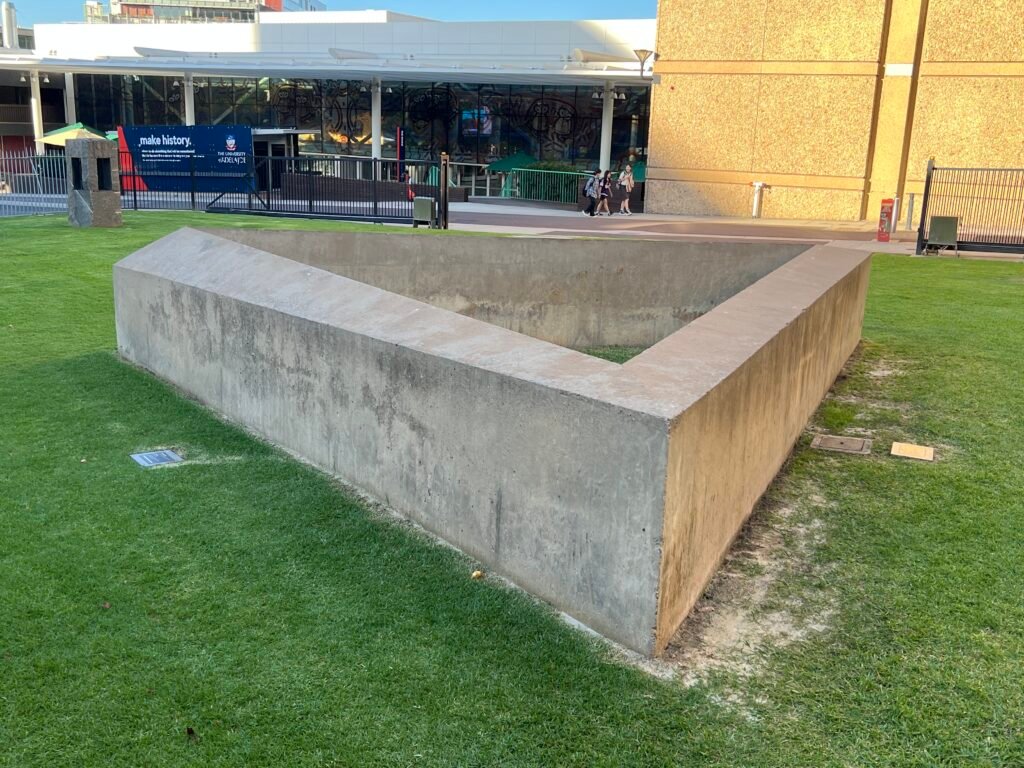
Minimalism is an art and design movement that emphasizes reducing a work to its essential elements, simple geometric forms, industrial materials, and a deliberate absence of personal expression or symbolism, shifting attention toward the physical object itself and the viewer’s direct experience of it. It took shape in New York in the early 1960s, partly as a reaction against the emotionally expressive, highly personal gestures of Abstract Expressionist painting that had dominated the previous decade.
Reaction against Abstract Expressionism
Where Abstract Expressionist painters emphasized visible brushwork, emotional intensity, and the artist’s individual gesture, Minimalist artists deliberately pursued the opposite: cool, impersonal, industrially fabricated objects that made no claim to express the artist’s inner feelings. This shift was also sometimes called ‘literalist’ or ‘ABC art,’ terms that captured the movement’s insistence on taking an object at face value rather than reading deeper symbolic or emotional meaning into it.
Donald Judd and specific objects
Donald Judd became one of Minimalism’s most influential figures, showing his geometric boxes and stacked forms, made from industrial materials such as metal, concrete, and fiberglass and often left raw or painted a single solid color, at Manhattan’s Green Gallery in 1964. In his influential essay ‘Specific Objects,’ Judd argued that these works belonged to neither painting nor sculpture but to a new category of three-dimensional object defined on its own terms, a position that became foundational to how critics discussed Minimalist work.
Dan Flavin and other key figures
Dan Flavin exhibited his first sculptures made from ordinary commercial fluorescent light tubes at the same Green Gallery in 1964, using standardized, store-bought lighting fixtures as his sculptural material. Other central figures included Carl Andre, known for arranging simple industrial units directly on the gallery floor; Agnes Martin, whose faint, hand-drawn grid paintings pursued Minimalist reduction within two-dimensional painting; and critic Michael Fried, who used the term ‘literalist’ pejoratively in his influential 1967 essay ‘Art and Objecthood’ to criticize what he saw as the movement’s overly literal relationship to real, physical space.
Roots and spread beyond visual art
Minimalism’s visual roots trace back to several earlier twentieth-century movements, including the Bauhaus, Russian Constructivism, the Dutch De Stijl movement, and the geometric abstraction of Kazimir Malevich and Piet Mondrian, all of which had already explored stripped-down, geometric visual languages decades earlier. The underlying idea of radical reduction spread well beyond painting and sculpture into minimalist music, architecture and product design, and literature, demonstrating how broadly the basic impulse toward simplicity and essential form could travel across completely different creative disciplines.
Minimalism in music
The same impulse toward radical reduction and repetition that shaped visual Minimalism also produced a parallel movement in music during the 1960s and 1970s, led by composers including Steve Reich, Philip Glass, and Terry Riley, who built extended compositions from steadily repeating rhythmic and melodic patterns that shifted only gradually over long stretches of time. Like their visual-art counterparts, minimalist composers deliberately avoided the dense emotional development and complex structure of earlier twentieth-century classical music, favoring instead a hypnotic, process-driven clarity.
Minimalism in architecture and design
Architects and product designers later adapted Minimalist principles into a widely recognized design sensibility emphasizing clean lines, open uncluttered space, neutral color, and an absence of decorative ornament, visible in the work of architects such as Tadao Ando and in the broader late-twentieth-century taste for pared-down interiors and furniture. This architectural and design strand of Minimalism shares the art movement’s basic preference for reduction and restraint, though it developed its own distinct vocabulary suited to livable, functional spaces rather than gallery objects.
Influence today
Minimalism’s insistence on direct, unornamented physical presence continues to shape how contemporary artists, architects, and designers think about materials, scale, and the viewer’s bodily experience of an object or space, and major museums regularly mount retrospectives of Judd, Flavin, and their contemporaries, confirming the movement’s lasting place within the broader history of twentieth-century art.
Minimalism and feminist critique
Some art historians and feminist critics have noted that Minimalism’s canonical figures were overwhelmingly male, and have highlighted women artists working in related reductive styles, including Anne Truitt and Agnes Martin herself, whose contributions were sometimes less immediately recognized within the movement’s early critical reception than those of their male contemporaries such as Judd and Flavin.
Materials and fabrication
Minimalist artists frequently had their geometric forms fabricated industrially rather than handcrafted personally in the studio, commissioning precisely machined metal, plywood, or fiberglass components from commercial manufacturers, a practice that reinforced the movement’s rejection of visible individual artistic touch in favor of an impersonal, industrially produced final object.
Exhibiting Minimalist work
Minimalist installations often depend heavily on the specific gallery space surrounding them, with artists such as Judd and Flavin carefully considering how a work’s scale and placement interact with a room’s architecture, lighting, and the viewer’s physical path through it, making the exhibition space itself an active part of how a Minimalist work is experienced rather than a neutral backdrop.
FAQs
Is art-world Minimalism the same as the modern ‘minimalist lifestyle’ trend? They share an underlying emphasis on simplicity and reduction, but the 1960s art movement specifically concerns gallery objects and critical theory about perception and literal physical presence, while the contemporary lifestyle trend is a broader, more informal popular idea about owning fewer possessions.
Why did Donald Judd call his works ‘specific objects’ rather than sculpture? He argued his geometric, industrially fabricated works did not fit the traditional categories of either painting or sculpture, and needed to be understood instead as a new kind of three-dimensional object defined on its own terms.
Key facts
- Emerged in New York in the early 1960s as a reaction against Abstract Expressionism
- Donald Judd and Dan Flavin both showed key works at the Green Gallery in 1964
- Critic Michael Fried criticized the movement as 'literalist' in his 1967 essay Art and Objecthood
- Roots trace to the Bauhaus, Russian Constructivism, De Stijl, Malevich and Mondrian
Related concepts
Quick checkWhat earlier art movement was Minimalism largely reacting against?Show answer
Abstract Expressionism, with its emphasis on visible brushwork and the artist's emotional, personal gesture.
Sources
- Wikipedia, Minimalism
- The Art Story, Minimalism Movement Overview
- Whitney Museum, Donald Judd
Editorially reviewed by Specialty Digest Editorial TeamLast reviewed November 1, 2026Researched and drafted with AI assistanceReport an issue