World War II was a global military conflict fought between 1939 and 1945, pitting the Allied powers, principally Britain, the Soviet Union, the United States, and China, against the Axis powers, principally Germany, Italy, and Japan. It remains the deadliest conflict in human history, drawing in more than thirty countries and touching nearly every inhabited region, and it reshaped the political map, international institutions, and balance of power for the rest of the twentieth century.
The war in Europe began on September 1, 1939, when Germany invaded Poland, prompting Britain and France to declare war days later. Germany, under Adolf Hitler, had already annexed Austria and dismantled Czechoslovakia through a combination of diplomatic pressure and threatened force, and the invasion of Poland marked the point at which other powers concluded that further concessions would not contain German expansion. In the Pacific, long-simmering Japanese expansion into China escalated into a separate but ultimately connected conflict, which merged fully into the global war after Japan’s attack on the American naval base at Pearl Harbor on December 7, 1941, bringing the United States into the fighting on both fronts.
Turning Points
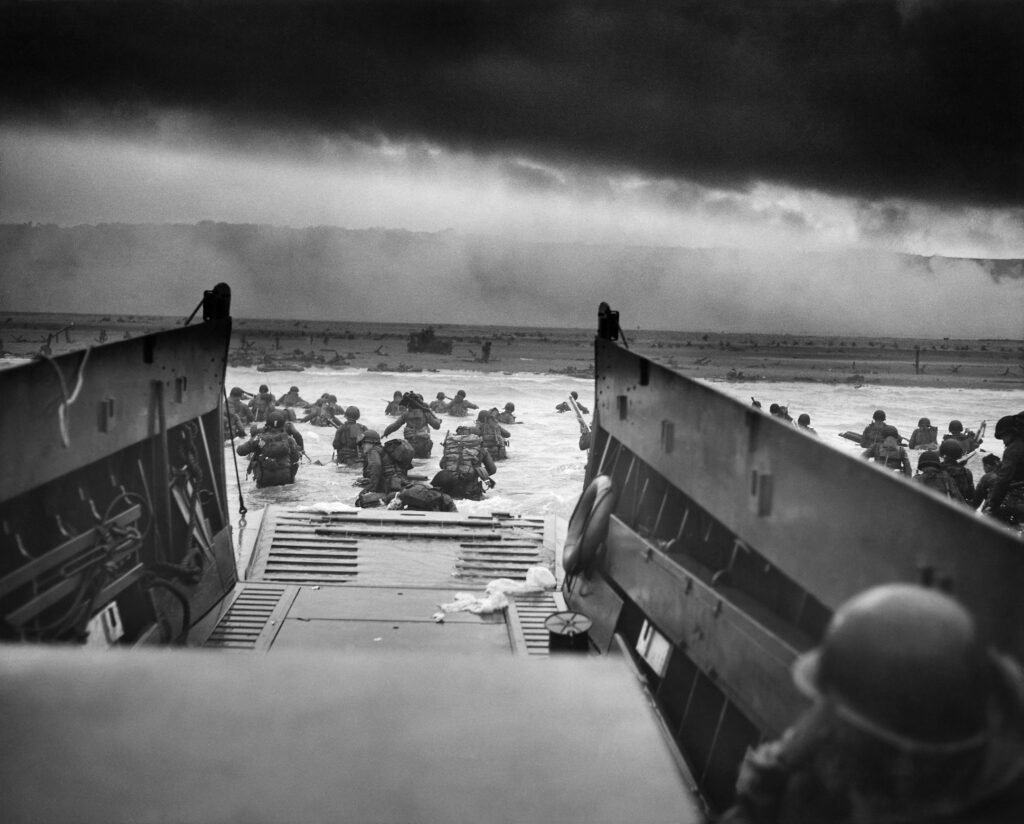
Several campaigns are widely treated as turning points. On the Eastern Front, the Battle of Stalingrad, fought from mid-1942 into early 1943, ended in a catastrophic German defeat and marked the start of a sustained Soviet advance westward that would eventually reach Berlin. In the Pacific, the Battle of Midway in June 1942 destroyed a large portion of Japan’s carrier fleet and shifted naval initiative decisively to the United States. In Western Europe, the D-Day landings in Normandy on June 6, 1944, opened a second major front against Germany, forcing it to fight a two-front war against Allied forces advancing from both the west and the east simultaneously.
The war also produced the Holocaust, the systematic genocide carried out by Nazi Germany and its collaborators that killed approximately six million Jews, along with millions of Roma, disabled people, political prisoners, and other targeted groups, in ghettos, mass shootings, and purpose-built extermination camps across German-occupied Europe. The scale and deliberate organization of this genocide profoundly shaped postwar international law, including the development of the legal concept of genocide itself and the Nuremberg trials that prosecuted Nazi leadership for crimes against humanity.
The War’s End and Its Aftermath
Germany surrendered on May 8, 1945, now commemorated as Victory in Europe Day, after Soviet forces captured Berlin and Hitler died by suicide in the final days of the battle. The war in the Pacific continued for several more months until the United States dropped atomic bombs on Hiroshima and Nagasaki in August 1945, the only use of nuclear weapons in warfare to date, after which Japan surrendered on September 2, 1945, bringing the global conflict to a close.
Estimates of total deaths from the war, combining combatants and civilians across all theaters, range from roughly seventy to eighty-five million people, making it, by a wide margin, the deadliest conflict in recorded human history. Its end reshaped the world order: European colonial empires, already weakened by the war’s cost, began a rapid process of decolonization across Asia and Africa over the following decades; the United States and the Soviet Union emerged as the two dominant global powers, setting the stage for the decades-long geopolitical rivalry known as the Cold War; and the United Nations was founded in 1945 specifically to prevent a comparable catastrophe from happening again, with the war’s atrocities also informing the Universal Declaration of Human Rights adopted a few years later.
A Total War
World War II is often described as a “total war” because it mobilized entire societies, not just armies, toward the war effort. Civilian industries converted to produce tanks, aircraft, and munitions at a scale no previous conflict had required; women entered factory and agricultural labor in large numbers across combatant nations as men were drafted into military service; and rationing of food, fuel, and consumer goods became a routine part of daily life for civilians on both sides. Cities became direct military targets in a way earlier wars had rarely seen, as strategic bombing campaigns targeted industrial centers and, controversially, sometimes civilian populations directly, from the Blitz on British cities to the firebombing of German and Japanese cities later in the war.
The war also accelerated technological change at a remarkable pace. Radar, jet aircraft, and the first operational ballistic missiles all emerged from wartime research programs, while the Manhattan Project’s development of nuclear weapons represented the most consequential technological outcome of the entire conflict, one whose implications for international security have persisted ever since. Codebreaking efforts, including the Allied effort to break German Enigma-encrypted communications, also drove early advances in computing that would shape postwar technology well beyond their original military purpose.
FAQs
What event is considered the start of World War II in Europe?
Germany’s invasion of Poland on September 1, 1939, after which Britain and France declared war on Germany.
When did World War II end?
The war ended in Europe on May 8, 1945, and in the Pacific on September 2, 1945, following Japan’s surrender after the atomic bombings of Hiroshima and Nagasaki.
What brought the United States into the war?
Japan’s attack on the American naval base at Pearl Harbor on December 7, 1941, after which the United States declared war on Japan and, days later, on Germany and Italy as well.
What international institution was created directly in response to the war?
The United Nations, founded in 1945 to provide a forum for resolving international disputes and prevent another war on the same scale.
In the news
Quick checkWhat event triggered the start of World War II in Europe?Show answer
Germany's invasion of Poland on September 1, 1939, after which Britain and France declared war on Germany.
Editorially reviewed by Specialty Digest Editorial TeamLast reviewed November 2, 2026Researched and drafted with AI assistanceReport an issue