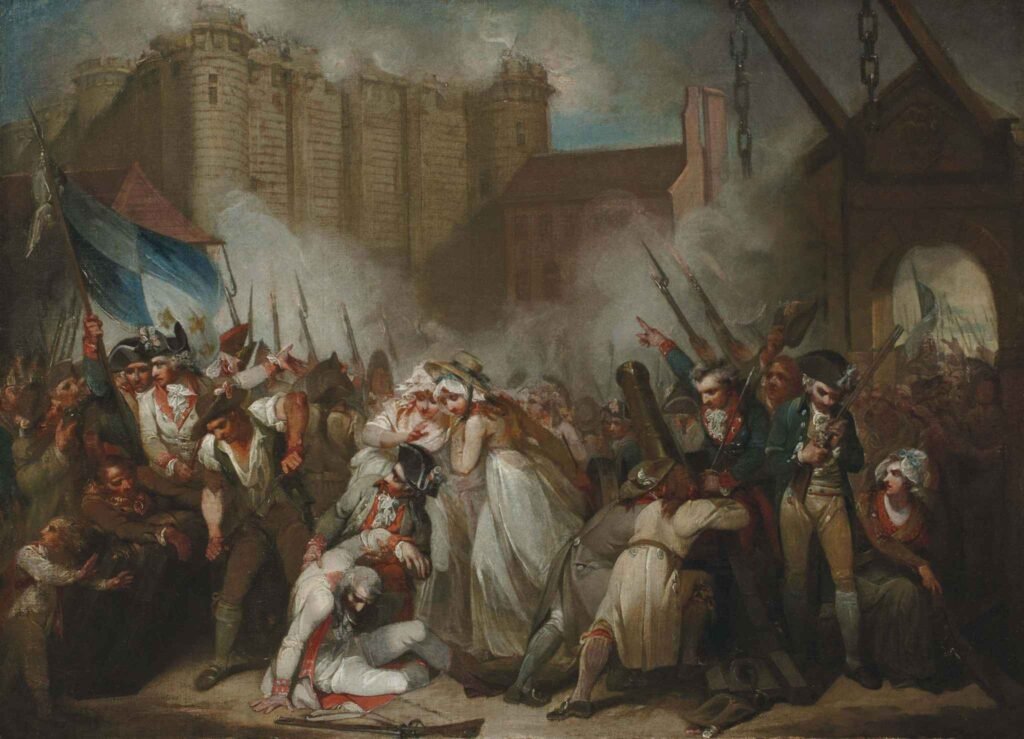
The French Revolution was a period of radical political and social upheaval in France between 1789 and 1799 that overthrew the absolute monarchy, dismantled the legal privileges of the aristocracy and clergy, and introduced ideas of popular sovereignty and citizenship that reshaped politics far beyond France itself. It is traditionally dated from the storming of the Bastille, a royal fortress and prison in Paris, on July 14, 1789, through Napoleon Bonaparte’s seizure of power in a coup in November 1799.
The revolution emerged from a combination of pressures that had been building for decades. France’s monarchy faced a severe fiscal crisis, worsened by the cost of wars and lavish royal spending, while a rigid social structure divided the population into three estates: the clergy, the nobility, and the commoners, who bore most of the tax burden despite having the least political power. Poor harvests in the 1780s drove up bread prices and widespread hunger, and Enlightenment ideas questioning the legitimacy of absolute monarchy and hereditary privilege had spread widely among the educated middle class, creating a combustible mix of economic desperation and ideological challenge to the existing order.
From Estates-General to Revolution
King Louis XVI summoned the Estates-General, a representative assembly of the three estates that had not met in over a century, in 1789 to address the fiscal crisis. Disputes over voting procedures quickly escalated, and representatives of the commoners declared themselves a National Assembly with the authority to write a new constitution. When popular unrest in Paris culminated in the storming of the Bastille on July 14, 1789, the event became a symbol of the people’s capacity to resist royal authority by force, and it is still commemorated annually as France’s national day.
In August 1789, the National Assembly adopted the Declaration of the Rights of Man and of the Citizen, proclaiming liberty, equality, and popular sovereignty as foundational political principles and abolishing feudal privileges. Over the following years, the monarchy’s power steadily eroded as the revolution radicalized, driven partly by fear of foreign invasion from monarchies hostile to the revolution and partly by internal political struggles between competing revolutionary factions.
The Reign of Terror
France was declared a republic in September 1792, and King Louis XVI was tried and executed by guillotine in January 1793, a decisive break with any possibility of restoring the old monarchy. The following period, known as the Reign of Terror and lasting from 1793 into 1794, saw the Committee of Public Safety, dominated by Maximilien Robespierre, use emergency powers and revolutionary tribunals to execute thousands of people accused of counter-revolutionary activity, often on thin or politically motivated evidence. The Terror ended when Robespierre himself was arrested and executed in July 1794, in an episode known as the Thermidorian Reaction, after which more moderate leadership sought to stabilize the republic.
From Republic to Napoleon
The years following the Terror were marked by continued political instability, economic difficulty, and ongoing wars against a coalition of European monarchies alarmed by the revolution. A government known as the Directory governed France through the mid-1790s but struggled to maintain consistent authority or address the country’s economic problems. This instability created an opening for Napoleon Bonaparte, a successful general who had built a strong public following through military victories, to seize power in a coup on 18 Brumaire, by the revolutionary calendar, or November 9, 1799, by the conventional one. His rise marked the formal end of the revolutionary period and the beginning of a new phase of French and European history under his rule.
Lasting Influence
The French Revolution’s influence extended well beyond France’s borders and beyond its own decade. It inspired nationalist and democratic movements across nineteenth-century Europe and Latin America, popularized the modern vocabulary of rights, citizenship, and popular sovereignty, and demonstrated that an entrenched absolute monarchy could be overthrown by organized political action. At the same time, the Terror’s excesses became a cautionary example frequently invoked in later debates about revolutionary violence, the risks of concentrated emergency power, and the tension between radical change and political stability.
Women and Everyday Life
The revolution reshaped daily life well beyond the political chambers of Paris. Women participated actively from the earliest days, most famously in the Women’s March on Versailles in October 1789, when thousands of Parisian women marched to the royal palace to demand bread and ultimately forced the royal family to relocate to Paris under closer public watch. Revolutionary clubs and pamphlets debated women’s political rights directly, most notably Olympe de Gouges’s 1791 Declaration of the Rights of Woman and the Female Citizen, though the revolutionary governments ultimately did not extend formal political rights to women, and later restricted women’s political organizing as the revolution progressed.
The revolution also touched religion, measurement, and even the calendar itself. The Catholic Church lost its privileged legal status and much of its property, clergy were required to swear loyalty to the state, and a new, secular civic religion was briefly promoted in its place. The metric system was introduced during this period, intended as a rational, universal alternative to the patchwork of local weights and measures previously in use, and a new revolutionary calendar replaced the Gregorian calendar for a time, renaming months and restructuring weeks in an attempt to break symbolically with the religious and royal past. Many of these changes, including the metric system, outlasted the revolution itself and spread well beyond France in the centuries that followed.
FAQs
What event is traditionally marked as the start of the French Revolution?
The storming of the Bastille, a royal fortress and prison in Paris, on July 14, 1789.
What happened to King Louis XVI?
He was tried by the revolutionary government and executed by guillotine in January 1793, after France had already been declared a republic.
What was the Reign of Terror?
A period from 1793 to 1794 when the Committee of Public Safety, led by Maximilien Robespierre, used emergency powers to execute thousands of people accused of counter-revolutionary activity.
How did the revolutionary period end?
With Napoleon Bonaparte’s coup in November 1799, which replaced the unstable revolutionary government and began a new phase of French history under his rule.
In the news
Quick checkWhat event is traditionally marked as the start of the French Revolution?Show answer
The storming of the Bastille, a royal fortress and prison in Paris, on July 14, 1789.
Editorially reviewed by Specialty Digest Editorial TeamLast reviewed November 2, 2026Researched and drafted with AI assistanceReport an issue