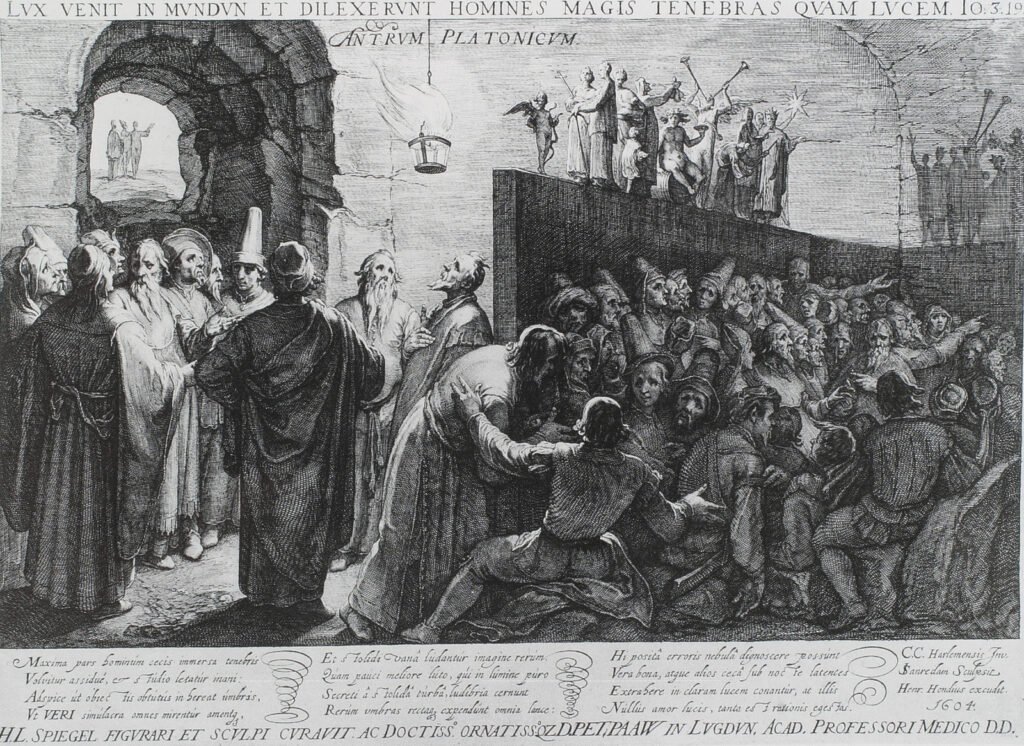
An allegory is a narrative, whether a story, poem, or image, in which characters, events, or settings systematically represent abstract ideas, moral qualities, or real-world situations beyond their literal meaning. Unlike a simple metaphor, which compares two things within a single phrase or sentence, an allegory sustains its symbolic correspondence across an entire work, so that the story functions coherently on two levels at once: a literal narrative and a parallel symbolic meaning running underneath it.
Allegory appears across a wide range of cultures and historical periods, often serving purposes beyond simple storytelling. Religious traditions have used allegory extensively to convey spiritual or moral teachings in memorable narrative form, political writers have used it to critique powerful institutions indirectly, and philosophers have used it to illustrate abstract arguments through concrete, imaginable scenarios.
Classic Literary Examples
John Bunyan’s The Pilgrim’s Progress, published in 1678, is one of the most influential Christian allegories in English literature, following a character named Christian as he journeys from the “City of Destruction” toward the “Celestial City,” encountering characters and places with names like the Slough of Despond or Vanity Fair that directly represent spiritual temptations and obstacles along the path toward salvation. The novel‘s structure makes its allegorical intent explicit through this kind of direct symbolic naming, guiding readers toward the intended parallel meaning rather than leaving it purely open to interpretation.
George Orwell’s Animal Farm, published in 1945, offers a very different but equally sustained allegory, using a farm taken over by its animals to represent the Russian Revolution and the early Soviet Union. Specific animal characters correspond to real historical figures and factions, and the farm’s descent from its idealistic founding principles into a new form of oppression under the pigs mirrors Orwell’s critique of how the Soviet state betrayed its own revolutionary ideals. Because the correspondence between the story’s events and real history is so consistent and deliberate, the work functions as allegory rather than simply as a story that invites loose comparison to real events.
Philosophical Allegory
Allegory is not confined to literature written for entertainment. Plato’s Allegory of the Cave, presented in his dialogue The Republic, describes prisoners chained inside a cave who can see only shadows cast on a wall, mistaking those shadows for the whole of reality. Plato uses this scenario to represent his theory of knowledge and reality, where ordinary sensory experience is compared to the limited shadows, and genuine philosophical understanding is compared to stepping out of the cave into true sunlight. The allegory lets Plato convey a complex and abstract epistemological argument through a vivid, concrete scenario that remains widely taught and discussed well outside specialized philosophy.
Allegory, Fable, and Censorship
Allegory overlaps with related forms like the fable, a short story, often featuring animals, that conveys a specific moral lesson, as in the traditional tales attributed to Aesop. The key distinction is typically one of scale and systematic correspondence: a fable usually teaches a single, fairly direct moral point, while a full allegory sustains a more extensive and detailed set of correspondences across an entire narrative.
Throughout history, allegory has also served as a tool for addressing politically or religiously sensitive subjects indirectly, letting writers critique powerful figures or institutions under the cover of an ostensibly unrelated story. This indirection has sometimes allowed allegorical works to circulate in societies where direct criticism would have been dangerous or forbidden, since censors or authorities could, at least in principle, choose to read the work only at its literal level.
Reading an Allegory on Two Levels
Part of what makes allegory distinctive as a literary technique is that it rewards, and sometimes requires, two simultaneous modes of reading. On a purely literal level, The Pilgrim’s Progress can be read simply as an adventure story about a man traveling toward a distant city, and Animal Farm can be read simply as a story about animals rebelling against a farmer, each perfectly coherent without any reference to the symbolic meaning underneath. A reader unaware of the intended allegorical correspondence can still follow and enjoy the surface narrative, even while missing the deeper layer of meaning the author built into it.
This dual structure is also why allegory can lose some of its force over time or across cultural distance, as audiences less familiar with the specific historical events, religious doctrines, or political circumstances an allegory was built to represent may read the surface story without recognizing the intended parallel meaning at all. Scholars and teachers often need to supply this missing context explicitly, which is part of why allegorical works are so frequently taught alongside detailed historical or religious background rather than left to speak entirely for themselves.
FAQs
What makes Orwell’s Animal Farm an allegory?
Its animal characters and farm events systematically represent real historical figures and events from the Russian Revolution and early Soviet Union, with a consistent correspondence maintained throughout the work.
How does allegory differ from a simple metaphor?
A metaphor compares two things within a single phrase or sentence, while an allegory sustains a systematic symbolic correspondence across an entire narrative, functioning on two levels at once.
What does Plato’s Allegory of the Cave represent?
Plato’s theory of knowledge and reality, comparing ordinary sensory experience to shadows on a cave wall and genuine philosophical understanding to stepping into true sunlight outside the cave.
Why have writers used allegory to address sensitive topics?
Because its indirection allows criticism of powerful figures or institutions to be conveyed through an ostensibly unrelated story, sometimes letting such works circulate where direct criticism would have been dangerous.
Quick checkWhat makes Orwell's Animal Farm an allegory?Show answer
Its animal characters and farm events systematically represent real historical figures and events from the Russian Revolution and early Soviet Union.
Editorially reviewed by Specialty Digest Editorial TeamLast reviewed November 2, 2026Researched and drafted with AI assistanceReport an issue