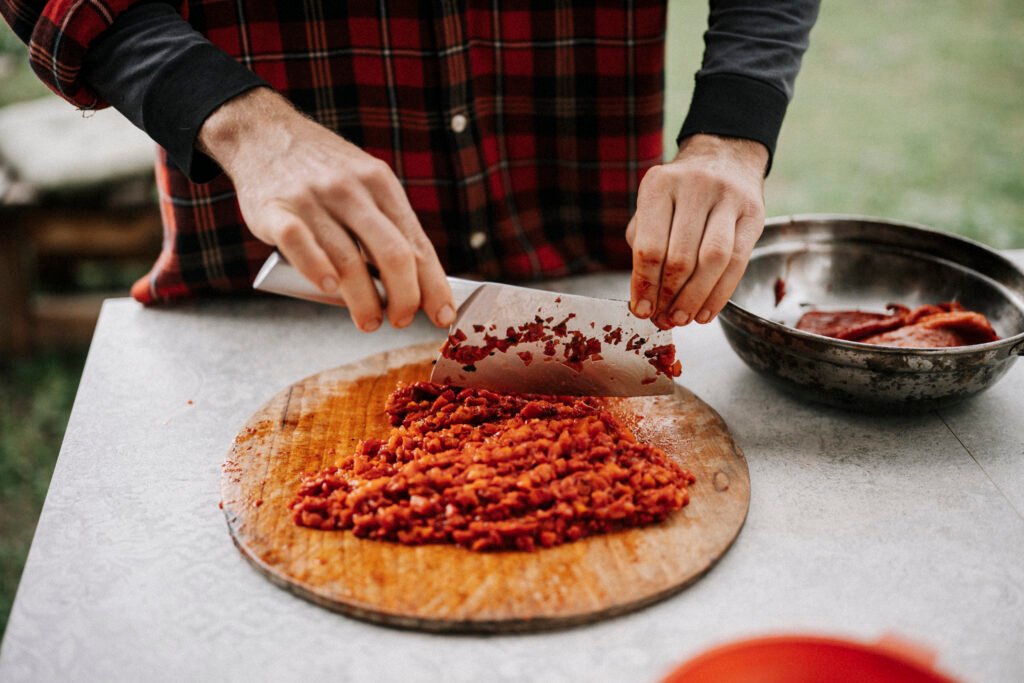
Knife skills are the set of grip, cutting, and safety techniques cooks use to turn whole ingredients into precise, consistent pieces. The discipline covers how a cook holds a knife, how the guiding hand controls the food, and the cuts named for their resulting shape, from a fine brunoise to a rough chop.
Grip and Safety
Two grips dominate professional kitchens. The pinch grip wraps the thumb and index finger around the blade just above the handle, giving control and reducing wrist fatigue over long prep sessions. The handle grip, closing all fingers around the handle, offers less precision but more power for heavy work like splitting squash. The guiding hand uses a claw position, curling fingertips under so knuckles, not fingertips, face the blade. A cutting board is anchored with a damp towel or a rubber mat so it cannot slide. Knives are kept sharp deliberately, since a dull blade requires more force and is more likely to slip; a sharp edge is maintained with a honing steel between uses and restored periodically with a whetstone or professional sharpening service.
Named Cuts
Classical French technique names cuts by their final dimensions. Julienne produces thin matchsticks roughly 1/8 inch square and two to three inches long; batonnet is a slightly thicker version. Brunoise dices julienne into tiny 1/8-inch cubes, prized for garnishes and fine sauces. Macedoine and large dice scale the same logic up to a quarter inch and a half inch respectively. Chiffonade shreds leafy herbs or greens into thin ribbons by rolling leaves tightly before slicing across the roll. Mincing reduces an ingredient, often garlic or shallot, to the smallest practical pieces without a formal shape requirement. Rough chop and mirepoix style cutting trade precision for speed when a dish will be strained or pureed later.
Why Technique Matters
Uniform cuts cook at the same rate, which is the practical reason restaurant kitchens train knife skills so rigorously. A pan of unevenly cut vegetables finishes with some pieces raw and others overcooked, while consistent pieces reach doneness together. Cut size also changes texture and presentation; a fine brunoise releases more surface area to a sauce than a large dice, intensifying flavor transfer. Speed matters commercially, since prep cooks are often measured by how quickly they can turn a case of onions into usable product without sacrificing consistency, and culinary schools use timed cutting tests as a baseline skill assessment.
Knife Types and Maintenance
A chef knife, typically eight inches, handles the bulk of general cutting, while a paring knife manages small or delicate work and a boning knife separates meat from bone with a thin, flexible blade. Serrated bread knives use a sawing motion rather than a straight push cut. Beyond sharpening, proper storage in a block, on a magnetic strip, or in blade guards prevents edge damage, and hand washing immediately after use protects both the edge and the user, since knives left in a sink of water are a common cause of accidental cuts.
Training and Assessment
Culinary schools formalize knife skills training through timed cutting tests, where students must produce a set quantity of a named cut within strict time limits while meeting uniformity standards judged by size and shape consistency. The classic onion or carrot test, requiring dozens of uniform brunoise or julienne pieces in a few minutes, remains a common benchmark across professional programs worldwide. Beyond speed, instructors assess hand position, posture, and board hygiene, since poor habits that go uncorrected early tend to persist throughout a cook’s career and increase injury risk over years of repetitive work.
Ergonomics and Injury Prevention
Repetitive strain injuries are common among prep cooks who spend hours cutting daily, making posture and grip efficiency a long-term health concern rather than just a speed issue. Standing at a comfortable board height, keeping the cutting motion close to the body, and alternating tasks to avoid prolonged repetitive strain all reduce cumulative wrist and shoulder stress. Cut-resistant gloves are used by some cooks for high-risk tasks like breaking down whole fish or butchering, though many chefs avoid gloves for fine knife work since they reduce tactile feedback. First-aid readiness, including knowing how to treat a knife cut immediately, is considered a basic kitchen safety requirement in most professional environments, and many commercial kitchens require new hires to complete a basic safety orientation before handling knives unsupervised.
Global Variation
While French technique dominates Western culinary education, other traditions have their own distinct cutting vocabularies. Japanese cuisine emphasizes precise single-pull slicing motions for raw fish, using specialized single-bevel blades like the yanagiba, where the cutting philosophy prioritizes a clean single stroke over the push-and-rock motion common in Western knife work. Chinese cuisine centers much of its prep around a single multipurpose cleaver capable of slicing, chopping, and even crushing garlic with the flat side of the blade, reflecting a different approach to tool specialization than the multi-knife Western roll. These regional differences show that knife skills are not a single universal standard but a family of related techniques shaped by each cuisine’s ingredients and cooking methods.
Standardized Knife Rolls
Professional cooks typically carry a personal knife roll containing a curated set of blades rather than relying on communal kitchen knives, since a familiar, personally maintained knife performs more predictably than an unfamiliar one of uncertain sharpness. A typical roll includes a chef knife, paring knife, boning or fillet knife, and sometimes a honing steel, with cooks often spending considerable money over a career upgrading to higher-quality steel as their skills and earnings grow. This personal investment reflects how central knife skills are to professional identity in the kitchen, with a cook’s blade choice and maintenance habits often read by colleagues as a marker of seriousness and experience.
Key facts
- Pinch grip is standard for control; claw position protects the guiding hand.nJulienne, brunoise, and batonnet are classical French named cuts by size.nUniform cuts cook at the same rate, improving consistency.nA sharp knife is safer than a dull one because it requires less force.
Quick checkWhat is the claw grip used for in knife skills?Show answer
The claw grip curls the guiding hand's fingertips under so knuckles face the blade, protecting fingers while holding food steady for cutting.
Sources
- Culinary Institute of America, The Professional Chef
Editorially reviewed by Specialty Digest Editorial TeamLast reviewed November 3, 2026Researched and drafted with AI assistanceReport an issue