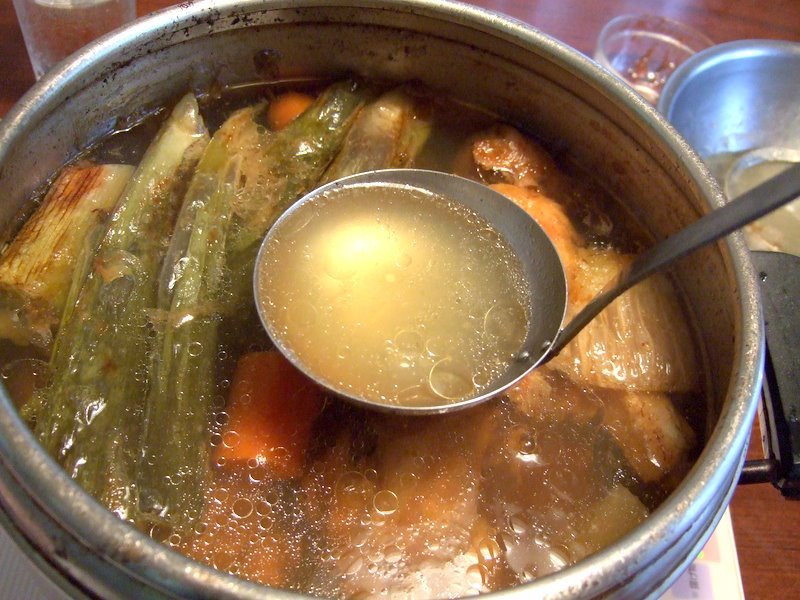
Culinary stock is a flavorful liquid made by simmering bones, meat, vegetables, or seafood in water, forming the foundation for soups, sauces, and braises across most professional kitchens. Unlike broth, which is typically seasoned and served as is, stock is left unseasoned so it can be reduced or combined freely without concentrating excess salt.
Types of Stock
White stock is made from raw bones, often veal or chicken, simmered gently to produce a clear, pale liquid used in delicate sauces. Brown stock roasts the bones first, caramelizing surface proteins and sugars to add color and deeper flavor, forming the base for rich sauces like demi-glace. Fish stock, or fumet, uses lean fish bones and cooks for a much shorter time, since fish collagen breaks down quickly and prolonged cooking turns the liquid cloudy and bitter. Vegetable stock skips animal products entirely, relying on aromatics like onion, carrot, and celery, known together as mirepoix, for body and flavor.
Technique
Stock is started in cold water, which helps draw out proteins gradually and keeps the liquid clear; starting with hot water shocks proteins into clumping, producing cloudiness. It is simmered, never boiled, since a hard boil emulsifies fat into the liquid and breaks collagen apart too violently, again clouding the stock. Impurities that rise to the surface, called scum, are skimmed off periodically. Aromatics are added partway through cooking rather than at the start, since delicate vegetables like celery can turn bitter if simmered for the full cooking time of a long bone stock.
Role in the Kitchen
Stock reduces into glace when cooked down until thick and syrupy, concentrating flavor into a small volume used to finish sauces with body and shine. It forms the liquid base of classical sauces built on the French mother sauce system, and stands in for water in risottos, braises, and pan sauces to add depth that water cannot. Many kitchens keep a perpetual stock pot, continuously replenished with scraps and bones, as a low-cost way to extract maximum value from kitchen trim that would otherwise be discarded.
Clarifying Stock
A consomme is a stock clarified to perfect transparency using a raft, a mixture of egg white, ground meat, and vegetables that is brought slowly to a simmer, where it coagulates into a floating mass that traps impurities and fat as it rises. The clarified liquid is then carefully ladled or strained from beneath the raft without disturbing it, producing a consomme prized in classical French service for its clarity and concentrated flavor. This technique demonstrates how far stock can be refined beyond its everyday role as a cooking base, becoming a standalone dish in formal dining.
Storage and Food Safety
Stock is a highly perishable product because its long, slow cooking extracts proteins and nutrients that also make an excellent growth medium for bacteria once cooled improperly. Professional kitchens cool large batches quickly using ice baths or shallow pans rather than letting a full pot cool slowly at room temperature, since the extended time spent in the bacterial danger zone between roughly 40 and 140 degrees Fahrenheit is the primary food safety risk. Properly cooled stock can be refrigerated for several days or frozen for months, often portioned into ice cube trays or containers sized for common recipe quantities, letting cooks thaw only what a given dish requires.
Stock Beyond French Tradition
Nearly every global cuisine has an equivalent to French stock, even where the term itself is not used. Japanese dashi, made from kombu seaweed and dried bonito flakes, serves the same foundational role in miso soup and simmered dishes that European stock plays in Western sauces, though it is made through an entirely different, much faster extraction process. Southeast Asian and Chinese kitchens often maintain long-simmered bone broths similar in method to French stock but seasoned and used differently, reflecting independent culinary development toward a similar solution: that a well-built savory liquid base improves nearly everything cooked with it.
Stock as a Business Cost Center
In commercial kitchens, stock production is also a cost and labor consideration, since simmering bones for many hours consumes energy and stovetop or oven space that could otherwise be used for active cooking during service. Many restaurants schedule stock production for overnight or off-peak hours specifically to avoid competing with dinner service for burner space, and some smaller operations purchase commercial base or concentrate instead of making stock from scratch, a tradeoff between labor cost and flavor quality that chefs weigh differently depending on their kitchen’s size and budget.
Vegetarian and Vegan Stock Trends
Growing demand for plant-based cooking has pushed many kitchens to develop more sophisticated vegetable and mushroom stocks that rival meat-based versions in depth, often incorporating roasted vegetable trim, dried mushrooms, and seaweed-based umami sources to compensate for the gelatin and collagen that animal stocks naturally provide.
Bone broth, marketed as a health product distinct from culinary stock despite being prepared almost identically, surged in popularity during the 2010s, driven by claims about gut health and collagen benefits that pushed long-simmered animal stocks into mainstream grocery store shelves for the first time.
Despite the marketing distinction, the techniques are essentially continuous with traditional stock-making, suggesting the renewed popularity reflects a broader rediscovery of long-standing culinary practice rather than a genuinely new culinary category.
Industrial production, which values predictable timing far more than any individual kitchen does, has pushed toward stock bases that behave consistently across enormous batch sizes, which is part of why many large-scale food operations rely on dehydrated or concentrated bases rather than fresh stock made daily from scratch.
Key facts
- White stock uses raw bones; brown stock uses roasted bones for deeper color and flavor.nStock starts in cold water to stay clear.nSimmering, not boiling, prevents cloudiness and emulsified fat.nReduced stock becomes glace, a concentrated flavor base.
Quick checkWhy does stock start in cold water rather than hot?Show answer
Starting in cold water lets proteins release gradually, keeping the stock clear, while hot water shocks proteins into clumping and clouds the liquid.
Sources
- Culinary Institute of America, Larousse Gastronomique
Editorially reviewed by Specialty Digest Editorial TeamLast reviewed November 3, 2026Researched and drafted with AI assistanceReport an issue