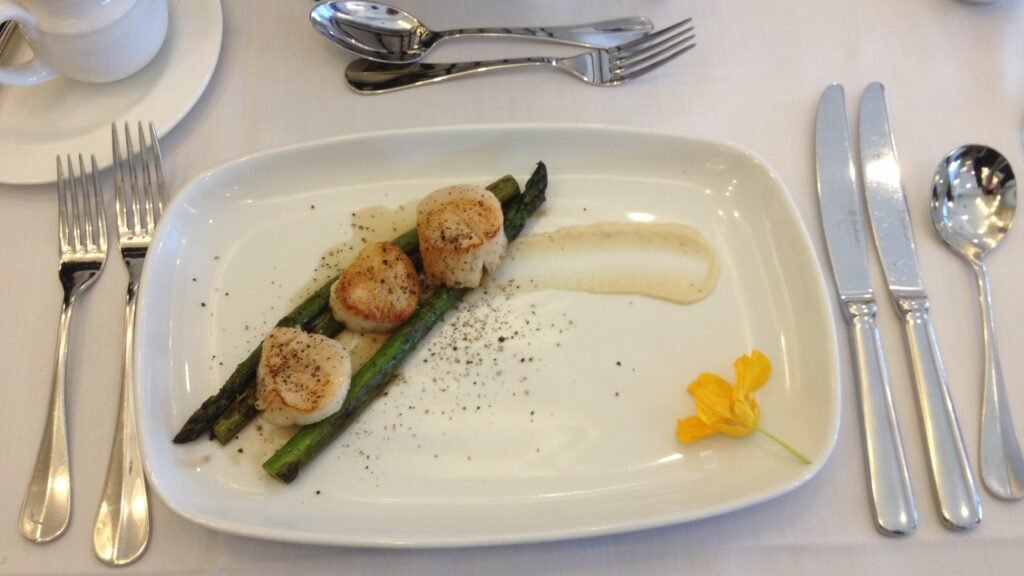
Plating is the art and technique of arranging food on a plate before it reaches a diner, balancing visual appeal with practical concerns like temperature, portion control, and ease of eating. Professional kitchens treat plating as the final stage of cooking, since even a technically perfect dish can underperform if it looks careless or confusing on the plate.
Principles of Composition
Classical plating favors a clock-face layout, placing protein, starch, and vegetable components at consistent positions so diners can navigate the plate intuitively, often with the protein toward the front. Modern plating borrows from visual art, using odd numbers of elements, negative space, and height to create movement and focus. Color contrast draws the eye, pairing a vivid sauce against a neutral protein, while texture contrast, such as a crisp garnish atop a soft puree, signals variety before the first bite. Sauce placement matters functionally as well as visually; a pool beneath food keeps a crisp exterior from becoming soggy, while a drizzle across the top adds flavor without drowning texture.
Tools and Techniques
Squeeze bottles and offset spatulas give cooks fine control for sauce lines and smears. Ring molds shape rice, pureed vegetables, or layered components into clean geometric forms. Tweezers place delicate garnishes like microgreens or edible flowers with precision impossible by hand. Warming plates before service keeps hot food hot longer, while chilled plates serve the same purpose for cold courses. Many kitchens photograph a finished plate as a reference standard, so every cook on the line reproduces the same composition throughout service.
Cultural and Historical Shifts
French haute cuisine historically plated at the table or from a trolley, with elaborate garnish built around a whole roasted item. The nouvelle cuisine movement of the 1960s and 1970s, led by chefs like Paul Bocuse, shifted plating toward individual portions arranged directly by the kitchen, emphasizing lighter sauces and simpler compositions. Minimalist plating gained prominence in the 2000s, influenced by Scandinavian and Japanese aesthetics that favor restraint, natural materials, and asymmetry over the dense, symmetrical plates of earlier eras, a shift widely visible across fine dining menus since.
Plating Education and Team Consistency
Culinary schools now teach plating as a distinct skill alongside cooking technique, since a dish that tastes excellent but looks disorganized still underperforms commercially. Students practice working within a template, such as a specific sauce placement or garnish count, before experimenting with their own compositions, mirroring how knife skills are taught through structured repetition before creative freedom. In a professional kitchen, a plate-up guide, often an annotated photograph posted on the line, ensures every cook on every shift reproduces a dish identically, since inconsistency between plates served on the same night damages a restaurant’s perceived quality even if each individual plate tastes fine.
Technology and Photography
The rise of food photography and social media has changed plating priorities in many restaurants, pushing chefs to consider how a dish will look in a photograph taken from directly above, an angle very different from the diner’s own eye-level view. Height on the plate, once prized in the ornate towers of 1990s fine dining, has become less fashionable as flatter, wide compositions photograph more clearly for social sharing. Some chefs resist designing specifically for photography, arguing it distorts culinary priorities toward visual novelty rather than flavor, while others treat photogenic plating as simply a modern extension of the same presentation instincts chefs have always had.
Cultural Approaches Beyond France
Japanese kaiseki cuisine has long treated plating as inseparable from the meal’s meaning, choosing dishware, color, and arrangement to reflect the season and even the specific month, a philosophy distinct from and arguably older than French plating tradition. Middle Eastern and South Asian family-style service, by contrast, often favors abundant, communal platters over individually composed plates, reflecting different cultural values around hospitality and sharing rather than individual presentation. These varied traditions show that plating reflects not just technique but the social and cultural meaning a cuisine assigns to the act of serving food.
Dietary and Dietary-Restriction Considerations
Plating decisions increasingly account for dietary restrictions and allergen separation, with kitchens using distinct plates, utensils, or marked positioning to signal a gluten-free or allergen-modified dish to serving staff at a glance. Portion visualization also plays a quiet functional role, since careful plating can make a calorie-conscious or smaller portion appear generous through height, negative space, and color balance, a technique fine dining has used for decades independent of any particular health trend.
Training the Eye
Chefs often describe developing an eye for plating the same way painters develop a sense of composition, through repeated practice and critical feedback rather than a fixed formula applied mechanically every time. Many kitchens hold regular tastings where new dishes are plated multiple ways side by side before settling on a final version, treating plating decisions with the same deliberate iteration given to seasoning or technique, rather than leaving it as an afterthought once the cooking itself is finished.
Plating in Casual and Fast-Casual Dining
Outside fine dining, casual and fast-casual restaurants have adopted simplified plating principles too, recognizing that even a quick-service bowl or sandwich benefits from deliberate color contrast and neat assembly rather than haphazard construction, since customers increasingly photograph meals at every price point, not only in expensive restaurants.
Chain restaurants, in particular, now train staff with standardized plating diagrams much like fine dining kitchens do, ensuring a burger or salad looks identical whether it is assembled in one location or another across hundreds of stores.
Key facts
- Classical plating uses a clock-face layout for protein, starch, and vegetable.nOdd numbers and negative space are common modern composition tools.nSauce placement affects both flavor delivery and texture preservation.nNouvelle cuisine shifted plating toward individual, kitchen-arranged portions.
Quick checkWhy do many modern plates use odd numbers of elements?Show answer
Odd numbers of elements tend to read as more dynamic and visually interesting than even, symmetrical arrangements, a principle borrowed from visual art.
Sources
- Culinary Institute of America, On Food and Cooking by Harold McGee
Editorially reviewed by Specialty Digest Editorial TeamLast reviewed November 3, 2026Researched and drafted with AI assistanceReport an issue