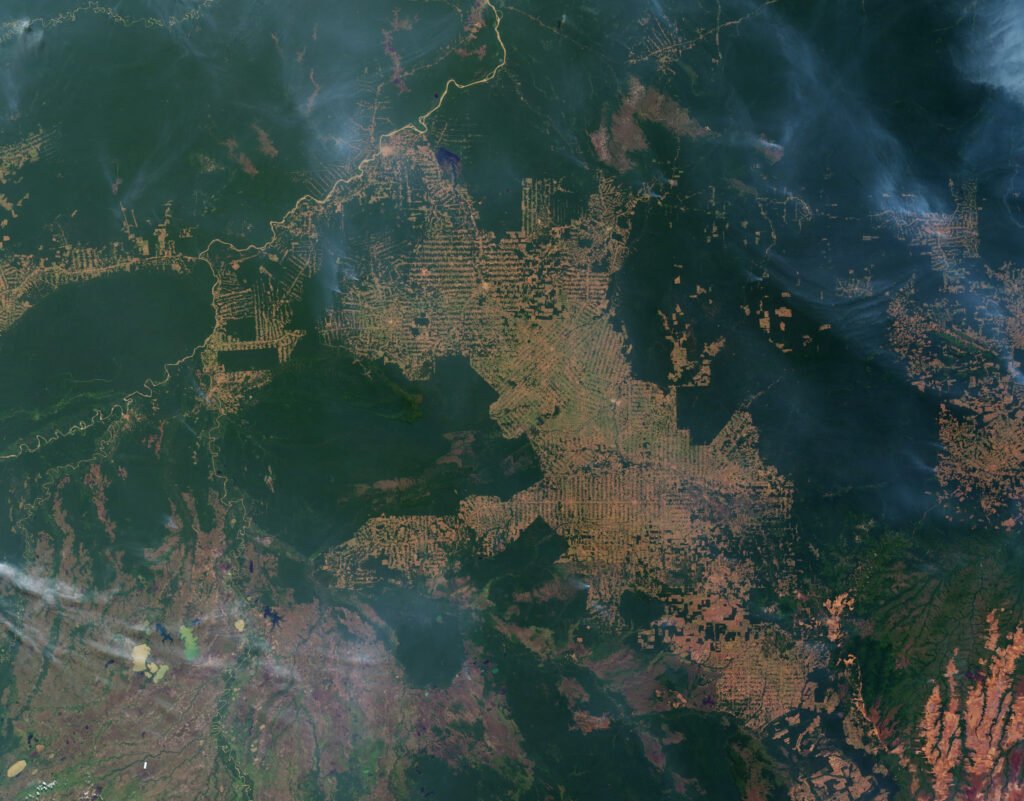
Forest fragmentation is the breaking up of large, continuous forest areas into smaller, isolated patches, typically caused by roads, agriculture, urban development, or logging, with significant consequences for the species and ecological processes that depend on intact forest.
Causes of Fragmentation
Agricultural expansion, road construction, and urban and suburban development are the leading drivers of forest fragmentation worldwide, each carving continuous forest into progressively smaller and more isolated patches surrounded by non-forest land uses. Even relatively narrow infrastructure like roads and pipelines can fragment forest ecologically despite occupying a small total land area, since they create edge effects and barriers to animal movement that extend well beyond their physical footprint.
Edge Effects
Fragmentation increases the proportion of forest located near an edge, where conditions differ substantially from deep forest interior through increased wind exposure, temperature swings, and light penetration, changes that favor some species while disadvantaging others that require stable interior forest conditions. Edge effects can extend tens to hundreds of meters into a forest patch depending on patch size and surrounding land use, meaning small fragments can become almost entirely edge-affected with little true interior habitat remaining.
Consequences for Wildlife
Species requiring large contiguous territories or specific interior forest conditions, including many large mammals and certain forest-interior bird species, decline or disappear from fragmented landscapes even when total remaining forest area seems substantial, since isolated patches often cannot support viable populations independently. Fragmentation also disrupts gene flow between populations by limiting animal movement between patches, reducing genetic diversity and long-term population resilience in affected species.
Connectivity and Corridors
Conservation planners increasingly prioritize maintaining or restoring habitat corridors that connect fragmented patches, allowing wildlife to move between them for feeding, breeding, and seasonal migration, an approach that can substantially mitigate fragmentation’s ecological costs even without reversing the fragmentation itself. Landscape-scale conservation planning now routinely incorporates connectivity modeling to identify priority corridors before development decisions are finalized.
Mitigating Fragmentation in Planning
Land use planning tools, including conservation easements, zoning that clusters development rather than spreading it across a landscape, and wildlife crossing structures built into major roads, all aim to reduce the ecological cost of continued human development while still accommodating economic growth in forested regions.
Preventing Fragmentation Through Policy
Beyond corridors and easements, some jurisdictions have adopted forest retention policies that require developers to preserve a minimum percentage of existing forest cover on a parcel, or transferable development rights programs that let landowners sell development rights for forested land to developers seeking to build at higher density elsewhere, concentrating development away from ecologically sensitive forest areas without necessarily halting overall growth. These policy tools attempt to reconcile continued economic development with meaningful limits on further forest fragmentation.
Fragmentation Effects on Forest Carbon
Fragmented forest edges lose carbon more readily than intact forest interior due to increased tree mortality and altered microclimate near edges, meaning fragmentation carries a carbon cost in addition to its biodiversity impacts, a factor increasingly incorporated into climate policy discussions about the full value of maintaining large, unfragmented forest blocks rather than smaller scattered patches totaling the same area.
Fragmentation Metrics in Research
Landscape ecologists use quantitative fragmentation metrics, including patch size, shape, and distance between patches, to compare fragmentation levels across regions and time periods, providing an objective basis for prioritizing conservation and restoration investment.
Fragmentation in Tropical Versus Temperate Forests
Tropical forest fragmentation tends to produce particularly severe biodiversity consequences given the exceptionally high species richness and specialized ecological relationships found in tropical forest ecosystems, where even modest fragmentation can disproportionately threaten species with narrow habitat requirements or limited dispersal ability compared with the generally more resilient wildlife communities found in temperate fragmented landscapes.
Urban Forest Fragmentation
Fragmentation within and around expanding urban areas presents distinct management challenges, since remaining urban forest patches often must simultaneously serve recreational, stormwater management, and biodiversity conservation functions despite their small size and heavy surrounding development pressure, requiring urban planners to maximize the ecological value of limited remaining forest area.
As development pressure continues worldwide, the tools available for managing fragmentation’s consequences, from corridors to policy incentives, will likely remain central to reconciling continued human land use with meaningful forest conservation.
Fragmentation Awareness in Public Policy
Growing public and scientific awareness of fragmentation’s ecological costs has gradually shifted land use planning norms in many regions toward greater consideration of forest connectivity, even where full prevention of further fragmentation remains politically or economically unrealistic.
That gradual shift in planning norms, while incomplete, represents meaningful progress toward reconciling continued development with the ecological value of connected, unfragmented forest landscapes.
Ultimately, addressing fragmentation requires coordinated action across private landowners, developers, and government agencies, since no single actor working alone can reverse a problem driven by thousands of independent land use decisions made over decades.
Every acre kept whole today is one less acre that future conservationists will need to painstakingly reconnect tomorrow.
That simple arithmetic is why connectivity, not just total area, has become the measure that matters most in modern forest conservation.
Measured this way, the fight against fragmentation is really a fight to keep forests talking to each other across the landscape.
Keeping that conversation open, acre by connected acre, remains the clearest practical goal available to anyone working against fragmentation today.
It is, in the end, a quiet but essential form of landscape repair.
It deserves to be treated as such.
No forest, however large, is truly safe while it remains cut off from its neighbors.
Reconnecting it is worth every bit of effort that takes.
Key facts
- Driven mainly by agriculture, roads, and development;Creates edge effects that alter conditions near patch boundaries;Mitigated through habitat corridors and connectivity planning
Quick checkWhy can small, isolated forest patches fail to support species that seem common in the region?Show answer
Isolated patches often cannot sustain viable populations independently, especially for species needing large territories or stable interior conditions
Sources
- Landscape ecology research on fragmentation and connectivity
Editorially reviewed by Specialty Digest Editorial TeamLast reviewed November 3, 2026Researched and drafted with AI assistanceReport an issue