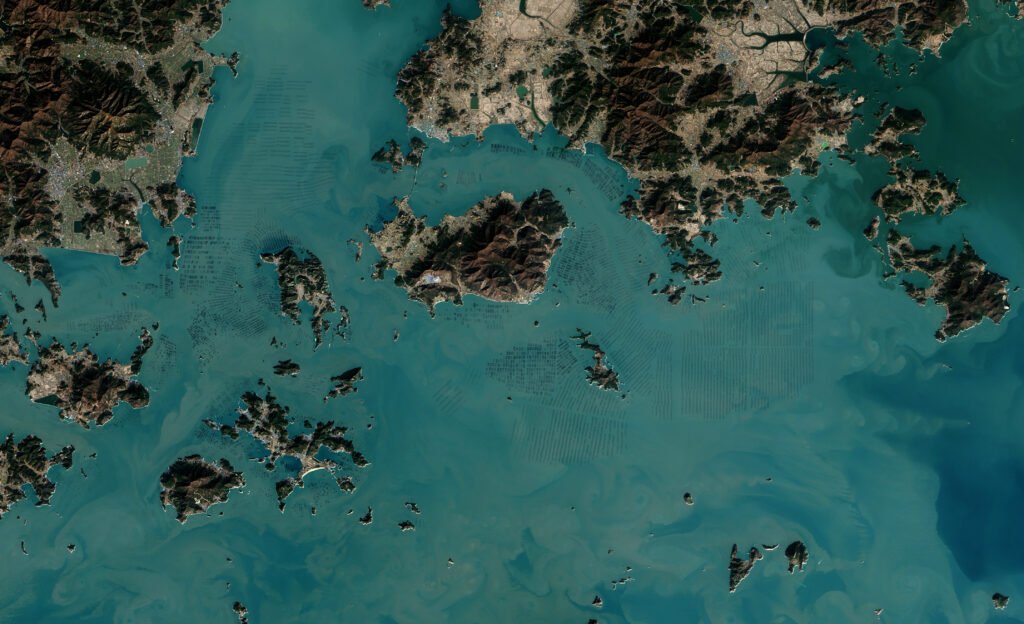
Seaweed farming is the cultivation of marine algae in coastal or offshore waters for food, animal feed, fertilizer, and increasingly, industrial and biotechnology applications. It is one of the fastest-growing segments of global aquaculture, requiring no feed, fresh water, or arable land, since seaweed draws its nutrients directly from the surrounding seawater and sunlight.
Common Cultivation Methods
Most seaweed farming uses simple rope or line systems, where young seaweed fragments or spores are attached to horizontal lines suspended in the water column at a depth suited to the species being grown. Some operations use floating rafts or nets instead, particularly in sheltered bays, while more capital-intensive offshore systems are being developed to expand production into deeper, more exposed waters.
Major Farmed Species
Kelp species are widely farmed in temperate waters including parts of China, Korea, Japan, and increasingly North America and Europe, while red seaweeds such as nori and certain carrageenan-producing species dominate production in warmer tropical and subtropical waters. China produces the largest volume of farmed seaweed globally by a wide margin, supplying both food markets and industrial processing.
Uses and Products
A large share of farmed seaweed is processed into food products, from nori sheets used in sushi to various seaweed-based snacks and ingredients, while another major use is extracting hydrocolloids such as agar, carrageenan, and alginate, which serve as thickening and stabilizing agents in food, cosmetics, and pharmaceutical products. Seaweed is also increasingly used as a feed additive for livestock, where certain species have shown promise in reducing methane emissions from cattle.
Environmental Benefits
Growing seaweed absorbs carbon dioxide and nutrients like nitrogen and phosphorus directly from seawater, which can help counteract local nutrient pollution and has generated interest in seaweed farming as a tool for coastal water quality improvement and even potential carbon sequestration. Seaweed farms can also provide habitat and shelter for various marine organisms, adding a degree of ecological value beyond their direct commercial output.
Growth and Future Potential
Global seaweed farming has expanded rapidly over the past two decades, and organizations researching ocean-based climate and food solutions increasingly point to seaweed as a scalable option with a comparatively light environmental footprint. Significant growth is anticipated in regions outside East Asia, including parts of Africa, the Americas, and Europe, as new markets and processing infrastructure for seaweed products continue to develop.
Processing Infrastructure
Freshly harvested seaweed is typically dried quickly to prevent spoilage, either through traditional sun-drying on racks or mats, or using mechanical dryers in more industrialized operations, before further processing into food products or industrial extracts. Building adequate drying and processing infrastructure near farming sites remains an important factor limiting how quickly seaweed farming can expand in some newer growing regions.
Challenges Facing Growth
Disease and pest outbreaks, including ice-ice disease affecting certain tropical seaweed species, can cause significant crop losses, while warming ocean temperatures are shifting which species grow well in which locations. Competition for coastal space with other uses, along with the need to develop new processing and market infrastructure, also shapes how quickly seaweed farming can expand into new regions beyond its traditional East Asian strongholds.
Carbon Sequestration Research
Some researchers and companies have explored sinking farmed seaweed to the deep ocean floor as a potential method of long-term carbon storage, since carbon absorbed by growing seaweed could theoretically remain locked away if the biomass reaches sufficient depth. This application remains scientifically and commercially unproven at meaningful scale, and significant questions about measurement, permanence, and ecological effects remain under active study.
Looking Ahead
Seaweed farming sits at an unusual crossroads of food production, carbon policy, and coastal planning. As governments explore ocean-based climate mitigation and blue carbon credits, seaweed cultivation is drawing interest well beyond its traditional markets in food and hydrocolloids. Breeding programs aimed at higher-yield, disease-resistant strains are expanding the range of species grown commercially, while mechanized seeding and harvesting equipment is gradually lowering labor costs on larger farms. At the same time, nearshore space is getting more contested, and farms increasingly have to coexist with shipping lanes, fisheries, and recreational use, which is pushing some operators toward offshore or multi-use platform designs. How quickly seaweed farming scales beyond its current niche will depend heavily on whether reliable, affordable processing and market access develop alongside the farms themselves.
Related Specialties
Seaweed farming connects closely to mariculture and other forms of nearshore aquaculture, since many seaweed farms occupy the same coastal waters used for shellfish or finfish production and sometimes combine several species on one lease. It also overlaps with integrated multi-trophic aquaculture, where seaweed is grown specifically to absorb nutrients released by fish or shrimp farms nearby. Coastal and marine spatial planning professionals weigh seaweed leases against shipping, tourism, and conservation interests, while food scientists and biochemists work on turning raw seaweed biomass into stable ingredients for food, cosmetics, and industrial applications.
Economic Considerations
Seaweed farming benefits from comparatively low input costs, since most cultivated species require no feed and relatively simple growing infrastructure such as ropes, lines, or nets anchored in coastal waters. Labor, however, can be a significant expense, particularly during planting and harvest periods when work is often done by hand or with basic tools from small boats. Processing adds considerable value but also cost, since raw seaweed typically needs drying, extraction, or other treatment before it becomes a stable, sellable product, and access to reliable processing facilities can be a major constraint for smaller farms. Market demand has grown steadily across food, cosmetics, and emerging biomaterial applications, though prices for different seaweed species and grades can vary widely depending on regional supply and buyer specifications.
Key facts
- Requires no feed, fresh water, or arable land.|Commonly grown on suspended ropes or floating rafts.|Kelp dominates temperate production, nori and carrageenan species dominate tropical.|Can absorb excess nutrients and help improve local water quality.
Quick checkWhy doesn't seaweed farming require feed like fish farming does?Show answer
Seaweed draws its nutrients directly from seawater and uses sunlight for energy through photosynthesis, so farmers do not need to provide any manufactured feed.
Sources
- FAO Fisheries and Aquaculture Department
Editorially reviewed by Specialty Digest Editorial TeamLast reviewed November 3, 2026Researched and drafted with AI assistanceReport an issue