Overview
An anterior cruciate ligament injury involves damage to one of the key ligaments stabilizing the knee joint, most often occurring during sports that involve sudden changes of direction, rapid deceleration, or awkward landings from a jump, rather than through direct contact with another player.
Diagnosis and Treatment Pathways
Diagnosis typically combines physical examination with imaging such as an MRI, and treatment decisions depend heavily on an athlete activity level and goals, with many competitive athletes choosing surgical reconstruction followed by many months of structured rehabilitation before returning to full competition.
Risk and Prevention Research
Research has identified several risk factors for this injury, including certain movement patterns during landing and cutting, and has led to the development of specific neuromuscular training programs designed to reduce injury risk, particularly in sports and populations shown to experience higher injury rates.
Mechanisms of Injury
Most anterior cruciate ligament tears occur without any contact from another player. Non-contact mechanisms account for the majority of cases and typically involve a sudden deceleration, a change of direction, or an awkward landing from a jump. The classic scenario involves the knee moving into a combination of valgus collapse, where the knee caves inward, along with internal or external rotation of the tibia relative to the femur, while the foot remains planted on the ground. Sports that involve frequent cutting, pivoting, and jumping, such as soccer, basketball, and team handball, see disproportionately high rates of this injury because these movement patterns place repeated strain on the ligament.
Contact mechanisms, while less common, tend to involve a direct blow to the outside of the knee that forces it into valgus, or a tackle that hyperextends the joint. Female athletes are injured at notably higher rates than male athletes in comparable sports, a disparity that researchers attribute to a combination of anatomical differences such as a narrower intercondylar notch, hormonal influences on ligament laxity across the menstrual cycle, and differences in neuromuscular control and landing mechanics. Fatigue is another contributing factor, since tears cluster later in matches and practice sessions when muscular support around the joint has diminished and reaction time has slowed, leaving the ligament to absorb forces it would otherwise be shielded from by active muscle control.
Diagnosis and Imaging
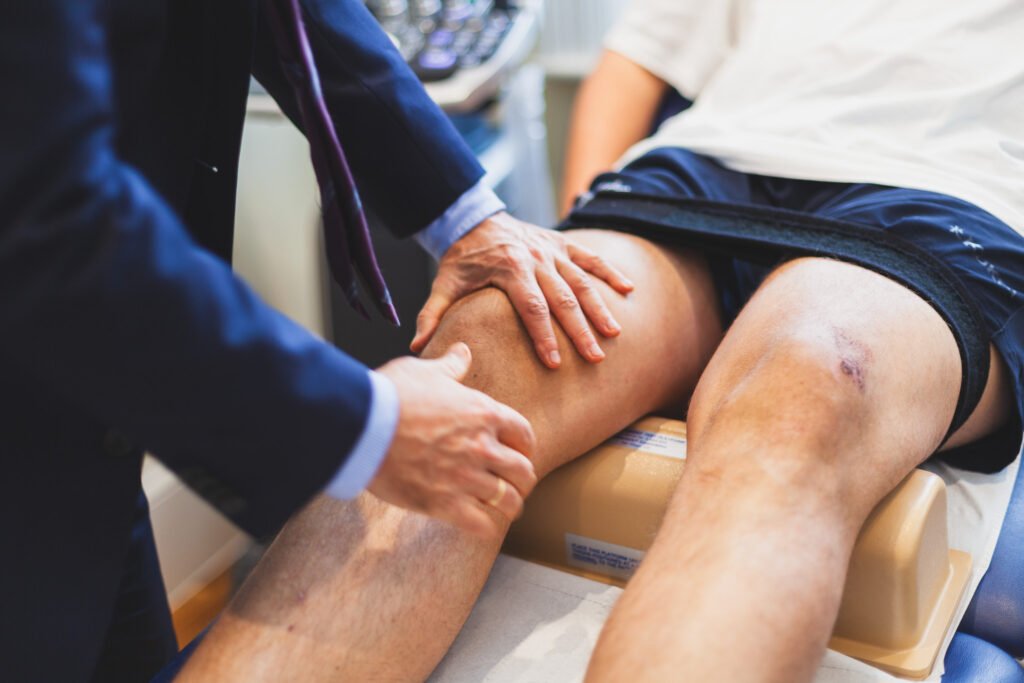
Clinicians typically begin evaluating a suspected anterior cruciate ligament tear with a detailed history, asking whether the athlete heard or felt a pop at the moment of injury and whether the knee swelled rapidly within the first few hours, both of which are common after a complete tear. Physical examination includes specific manual tests such as the Lachman test and the anterior drawer test, in which the examiner assesses how far the tibia can be pulled forward relative to the femur compared with the uninjured knee, along with the pivot shift test, which evaluates rotational instability during a simulated pivoting motion.
Magnetic resonance imaging is considered the gold standard for confirming a tear and for identifying commonly associated injuries, such as damage to the menisci or other ligaments, that can change the treatment plan. Plain radiographs are usually obtained as well, not to visualize the ligament itself, which does not appear on an X-ray, but to rule out fractures and to check for a Segond fracture, a small avulsion fracture of the lateral tibial plateau that is strongly associated with an underlying ACL tear. The combination of history, examination, and imaging allows clinicians to grade the severity of the injury and plan whether surgical reconstruction or non-surgical management is more appropriate for a given athlete.
Treatment Options and Outcomes
Treatment decisions for a torn anterior cruciate ligament depend on factors including the athlete age, activity level and sport, the presence of associated injuries to the menisci or other ligaments, and personal goals around returning to pivoting or cutting sports. Surgical reconstruction, which replaces the torn ligament with a graft taken from the patient own tissue such as the hamstring or patellar tendon, or occasionally from a donor, remains the standard recommendation for athletes who intend to return to competitive sports involving cutting and pivoting, since the native ligament generally cannot heal well enough on its own to restore reliable stability for these demands.
Non-surgical management, consisting of structured rehabilitation without reconstruction, can be appropriate for older or more sedentary individuals, or for those willing to modify their activities to avoid high-risk movements. Outcomes after reconstruction are generally favorable, with most athletes eventually returning to their sport, though reported rates of returning to the exact same level of competition are lower than commonly assumed, and the risk of re-tearing either the reconstructed ligament or the opposite knee ligament remains elevated for years afterward, particularly in younger athletes returning to high-risk pivoting sports, which is part of why rehabilitation and the eventual return-to-play decision are approached so conservatively.
Long-Term Joint Health
Beyond the immediate injury and recovery period, an anterior cruciate ligament tear carries implications for long-term knee health that extend well past return to sport. Studies following athletes for a decade or more after either surgical or non-surgical management consistently find elevated rates of post-traumatic osteoarthritis compared with uninjured peers, with the risk rising further when the meniscus was also damaged at the time of injury, since the menisci play an important role in distributing load evenly across the joint surface. This long-term risk has shifted some of the conversation around treatment away from short-term return-to-play outcomes alone and toward strategies, including meniscus preservation during surgery and sustained strength maintenance for years afterward, that may help protect joint health over an athlete lifetime, not only their current competitive season.
Key facts
- Array
Quick checkWhat movements are most commonly associated with ACL injuries?Show answer
Sudden stops, pivots, changes of direction, and landing from jumps.
Sources
- Array
Editorially reviewed by Specialty Digest Editorial TeamLast reviewed November 4, 2026Researched and drafted with AI assistanceReport an issue