Auckland, known in Maori as Tamaki Makaurau, is New Zealand’s largest city, built across a volcanic field on an isthmus between two harbours in the country’s North Island. Settled by Europeans from 1840 and briefly the colonial capital until 1865, it is today home to roughly a third of New Zealand’s population and remains the country’s commercial center even though Wellington is the capital.
Where Is Auckland Located?
Auckland sits on a narrow isthmus in New Zealand’s North Island between the Waitemata Harbour, opening onto the Pacific Ocean, and the Manukau Harbour, opening onto the Tasman Sea, making it one of the few cities in the world bordering two harbours on two different seas. The city is also built across the Auckland volcanic field, which includes around fifty volcanic cones and craters.
A Brief History of Auckland
European settlement at Auckland began in 1840, and the city briefly served as the capital of the British colony of New Zealand before the seat of government moved to Wellington in 1865. Long before European settlement, the area had been a significant site of Maori settlement, valued for its fertile volcanic soil and access to two harbours; its Maori name, Tamaki Makaurau, is often translated as “Tamaki desired by many,” reflecting centuries of contest among iwi for control of the isthmus.[1]
Growth Into New Zealand’s Largest City
Even after losing the national capital to Wellington, Auckland continued to grow and today holds roughly a third of New Zealand’s total population, making it by far the country’s largest urban area and its principal commercial and financial center.
Auckland Today
Auckland is governed by the Auckland Council, formed in 2010 by merging what had been several separate city and district councils into a single “super city” authority covering the wider metropolitan region. The city’s economy centers on finance, trade, and its port, and it is nicknamed the “City of Sails” for the exceptionally high rate of boat ownership among its residents and the popularity of the Hauraki Gulf for sailing.
The Sky Tower
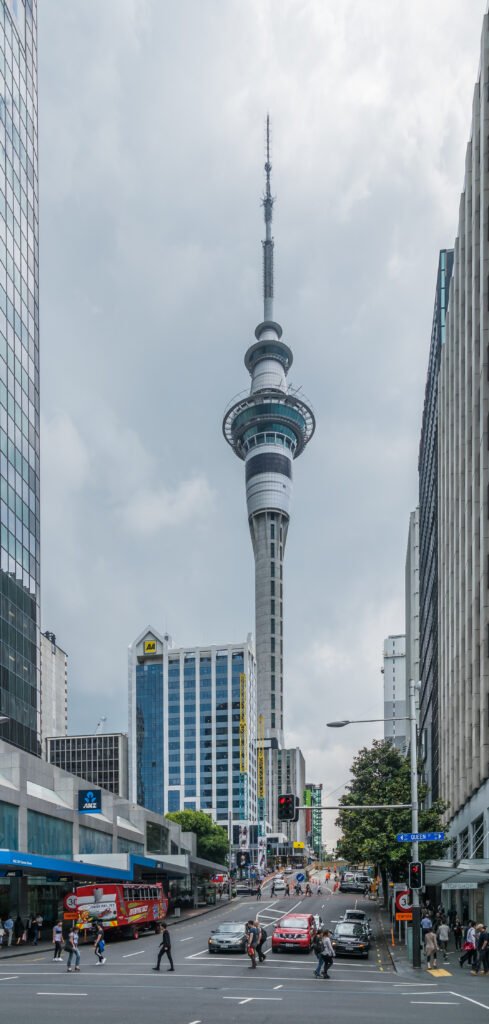
Auckland’s single most iconic landmark is the Sky Tower, a telecommunications and observation tower in the city center that opened in 1997 and stands 328 meters tall, making it the tallest freestanding structure in the Southern Hemisphere. The tower includes observation decks, a revolving restaurant, and adventure attractions such as the SkyJump and SkyWalk, and it dominates Auckland’s skyline from almost every vantage point in the city.
What Is Auckland Known For?
Auckland is known for its volcanic landscape, its two harbours and strong sailing culture, and for being New Zealand’s largest and most internationally connected city even though it is not the national capital.
Why Auckland Matters
Auckland matters as New Zealand’s commercial and demographic center, as a city shaped by an unusual volcanic and dual-harbour geography, and as a former colonial capital whose growth long outpaced the city that replaced it as the seat of government.
Key Takeaways
- Auckland, Tamaki Makaurau in Maori, is New Zealand’s largest city, home to roughly a third of the country’s population.
- European settlement began in 1840, and Auckland briefly served as the colonial capital until 1865, when Wellington took over.
- The city sits on an isthmus between two harbours, the Waitemata and Manukau, and across a volcanic field of around fifty cones.
- Auckland Council, formed in 2010, governs the wider metropolitan “super city.”
- The Sky Tower, opened in 1997, is the tallest freestanding structure in the Southern Hemisphere and Auckland’s most iconic landmark.
Sources
- New Zealand Government | “History, Culture and Heritage” | govt.nz/browse/history-culture-and-heritage
Key facts
- Auckland, Tamaki Makaurau in Maori, is New Zealand's largest city.1
- European settlement began in 1840; Auckland was the colonial capital until 1865, when Wellington took over.
- The city sits on an isthmus between the Waitemata and Manukau harbours, across a volcanic field of around fifty cones.
- Auckland Council, formed in 2010, governs the wider metropolitan area as a single authority.
- The Sky Tower, opened in 1997, is the tallest freestanding structure in the Southern Hemisphere.
Quick checkIs Auckland the capital of New Zealand?Show answer
No. Auckland was the colonial capital until 1865, but Wellington has been New Zealand's capital since then; Auckland remains the country's largest city and commercial center.
Sources
- New Zealand Government. History, Culture and Heritage. Undated (accessed Accessed 2026-10-21)
Editorially reviewed by Specialty Digest Editorial TeamLast reviewed October 21, 2026Researched and drafted with AI assistanceReport an issue