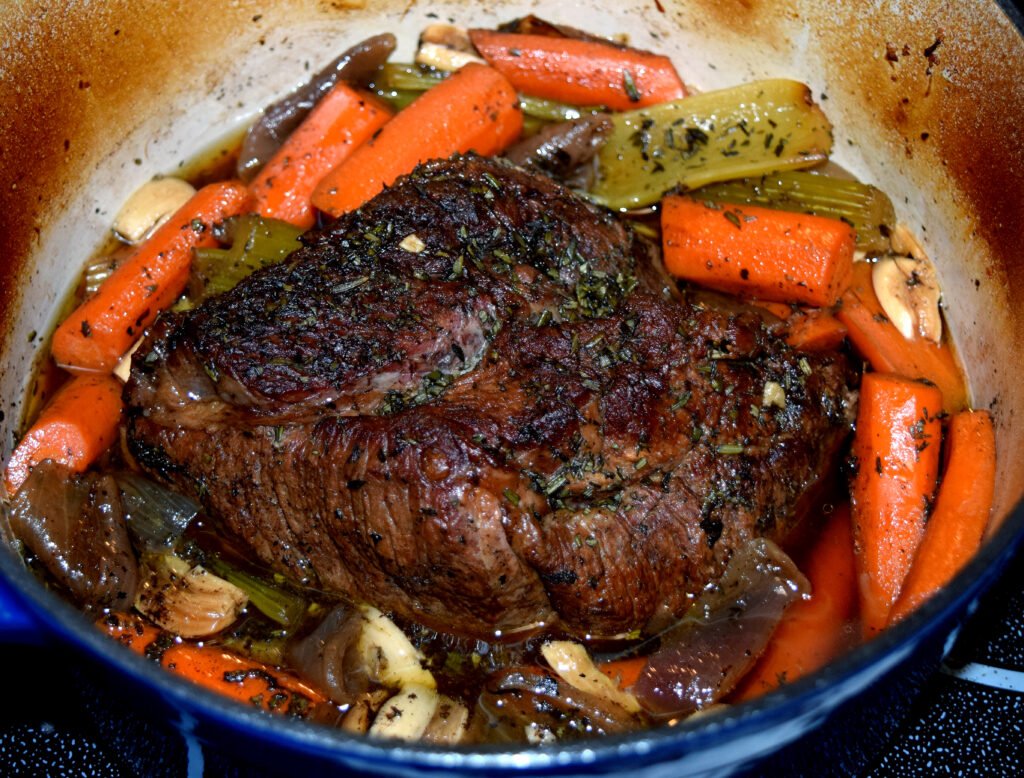
Braising is a combination cooking method that sears food at high heat and then finishes it slowly in a small amount of liquid at low temperature, typically in a covered pot. The technique is especially suited to tough cuts of meat and fibrous vegetables, since prolonged moist heat breaks down connective tissue that dry, quick cooking cannot soften.
How Braising Works
The initial sear browns the food’s exterior through the Maillard reaction, developing flavor and color that the slow-cooking stage alone cannot produce. The food then simmers partially submerged in stock, wine, or another flavorful liquid, usually at a temperature well below boiling, for an extended period that can range from one hour to most of a day depending on the cut. Collagen within tough muscle tissue gradually converts to gelatin during this slow cooking, which is what makes a braised short rib or pot roast fall-apart tender despite starting as one of the toughest cuts on the animal. The braising liquid itself becomes a built-in sauce, enriched by rendered fat, dissolved gelatin, and the aromatics cooked alongside the main ingredient.
Equipment and Setup
A heavy pot with a tight-fitting lid, often a Dutch oven, is standard, since it must hold steady, even heat for hours without scorching. Braising can proceed on the stovetop or in the oven, with oven braising generally preferred for long cooks because it surrounds the pot with consistent ambient heat rather than direct heat from below. The liquid level matters: filling the pot only partway, rather than fully submerging the food, keeps the exposed portion exposed to trapped steam while the submerged portion simmers, producing a more complex texture than full submersion would.
Classic Braised Dishes
French coq au vin braises chicken in red wine with mushrooms and lardons, while French daube uses beef, wine, and vegetables in a similarly slow-cooked style. Italian osso buco braises veal shanks, often finished with a bright gremolata to cut the richness of the dish. Beef bourguignon, another French classic, braises beef in Burgundy wine alongside carrots, onions, and mushrooms. Outside Europe, dishes like Korean galbi-jjim and Mexican birria apply the same basic sear-then-slow-simmer logic to their own regional ingredients and spicing, showing that the underlying technique recurs across cuisines that never directly influenced one another.
Braising Liquid Choices
The choice of braising liquid shapes a dish’s final character as much as the main ingredient does. Red wine braises, common in French and Italian cooking, add acidity and tannin that cut through rich, fatty cuts like short rib or oxtail. Stock-based braises, lighter and less acidic, let the main ingredient’s own flavor dominate more directly, often favored for poultry and lighter meats. Beer braises, popular in Belgian and German cooking, bring malt sweetness and bitterness that pair well with pork and beef. Some braises use little liquid at all beyond the ingredient’s own moisture and aromatics, relying mostly on trapped steam, a method sometimes called pot-roasting rather than braising, though the underlying chemistry of collagen breakdown is identical.
Vegetable Braising
While braising is most associated with tough meat, the technique applies equally well to fibrous vegetables like cabbage, fennel, leeks, and root vegetables, which soften and absorb flavor over a slow, moist cook far better than they would from quick roasting or boiling. Braised vegetable dishes are common across Mediterranean and Middle Eastern cuisines, where olive oil, tomato, and aromatic vegetables are simmered together for an extended time until completely tender, producing dishes eaten warm or at room temperature. This vegetable application shows that braising is fundamentally a method for breaking down tough plant or animal structure through time and moisture, not a technique limited to meat alone.
Make-Ahead Advantage
Braised dishes famously improve with a rest, since flavors continue melding as the dish cools and the following day’s reheating often tastes better than the meal served immediately after cooking. This quality makes braising especially practical for restaurants and home cooks alike, allowing a dish to be prepared a day or more in advance of service, with the braising liquid’s fat easily skimmed off once chilled, a practical convenience that few other cooking methods offer as reliably.
Braising Versus Related Techniques
Braising is often confused with stewing, but the two differ mainly in the proportion of liquid used and the size of the ingredient, braising typically involves larger, often whole cuts partially submerged, while stewing cuts ingredients into smaller, uniform pieces fully submerged in liquid. Pot-roasting is essentially braising applied to a large single roast, and the terms are sometimes used interchangeably depending on regional cooking vocabulary. Confit, by contrast, uses fat rather than a water-based liquid and is typically held at a lower temperature over a longer time, producing a different final texture than a classic wine or stock braise.
Choosing the Right Cut
Braising works best on cuts rich in connective tissue and collagen, such as short rib, chuck, oxtail, lamb shank, and pork shoulder, which would turn tough and chewy if cooked quickly but become tender and flavorful under slow, moist heat. Leaner, more tender cuts like filet mignon are rarely braised, since they lack the collagen that makes the technique worthwhile and would simply become dry and overcooked rather than more tender, illustrating why matching cooking method to the specific properties of a cut is a foundational culinary skill rather than an arbitrary stylistic choice.
Recognizing when a cut calls for braising rather than grilling, roasting, or searing alone is one of the clearest practical demonstrations of how classical culinary training links cooking method directly to the physical structure of the ingredient being cooked.
Key facts
- Braising combines a high-heat sear with slow, moist cooking in liquid.nCollagen in tough meat converts to gelatin during the long, slow cook.nA heavy, tightly lidded pot such as a Dutch oven is standard equipment.nCoq au vin, osso buco, and beef bourguignon are classic braised dishes.
Quick checkWhy does braising work well on tough cuts of meat?Show answer
Braising uses prolonged moist heat that converts collagen in tough connective tissue into gelatin, tenderizing cuts that dry, quick cooking cannot soften.
Sources
- Culinary Institute of America, On Food and Cooking by Harold McGee
Editorially reviewed by Specialty Digest Editorial TeamLast reviewed November 3, 2026Researched and drafted with AI assistanceReport an issue