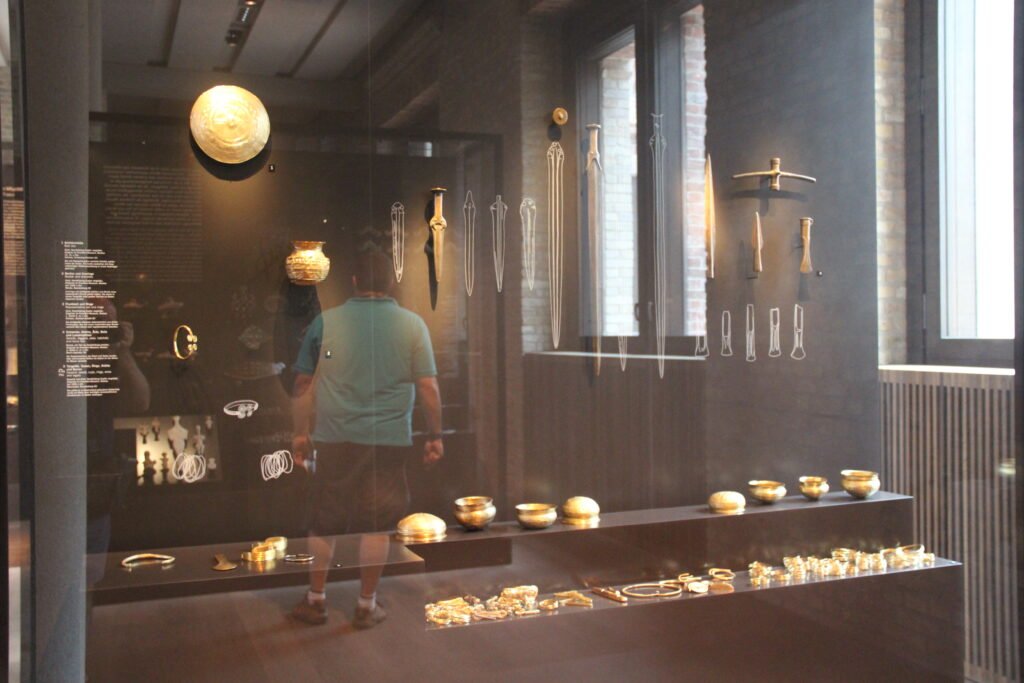
The Bronze Age is the archaeological period defined by the widespread production and use of bronze, an alloy of copper and tin, for tools, weapons, and other objects. It follows the Stone Age, when tools were made primarily from stone, bone, and wood, and precedes the Iron Age, when iron largely replaced bronze as the dominant metal for cutting edges and weaponry.
Bronze offered real advantages over the pure copper and stone tools that came before it. Alloying copper with a small amount of tin produces a harder, more durable material that holds a sharper edge and can be cast into more intricate shapes than stone allows. This technological advantage, however, came with a significant cost: tin deposits are geographically scarce and were often located far from the societies that needed them, which meant that sustaining Bronze Age technology required long-distance trade networks capable of moving tin, and sometimes copper, across considerable distances.
A Regional Patchwork, Not a Single Global Era
The Bronze Age did not begin or end at the same time everywhere, and treating it as a single worldwide period is one of the more common misunderstandings about this era. In the Near East, bronze technology developed roughly between 3300 and 1200 BCE, supporting major civilizations including Sumer, ancient Egypt, and the Hittite Empire. In the Aegean, Minoan Crete and Mycenaean Greece built sophisticated Bronze Age societies with their own palace economies and writing systems. In South Asia, the Indus Valley Civilization developed its own Bronze Age urban centers, while in East Asia, China’s Shang dynasty produced elaborately cast bronze ritual vessels. Some regions, particularly parts of Sub-Saharan Africa and the Americas, never passed through a distinct Bronze Age at all, moving in some cases directly into iron-working or developing along entirely different technological paths.
Writing and the Boundary of History
The Bronze Age is also significant because several of its major civilizations developed early writing systems, including Mesopotamian cuneiform and Egyptian hieroglyphics. Because written records allow historians to reconstruct events, laws, and beliefs directly from a society’s own documents rather than inferring them solely from physical remains, the emergence of writing is often used as a rough marker separating “prehistory,” reconstructed primarily through archaeology, from “history” in the narrower sense of a documented past. This boundary is not identical everywhere, since societies without early writing systems remain within prehistory for archaeological purposes regardless of whether they used bronze.
The Late Bronze Age Collapse
The Bronze Age in the Eastern Mediterranean ended abruptly around 1200 BCE in an episode known as the Late Bronze Age Collapse, during which several major palace-based civilizations, including Mycenaean Greece and the Hittite Empire, broke down within a relatively short span of time. Historians and archaeologists have proposed multiple contributing causes, including invasions by groups referred to in Egyptian records as the Sea Peoples, prolonged drought and crop failure, earthquakes, and the breakdown of the long-distance trade networks that bronze production depended on. No single explanation is universally accepted, and most archaeologists now favor a combination of these stresses acting together rather than any one isolated cause, since many of the affected civilizations show signs of strain on multiple fronts in the decades leading up to their collapse. The collapse remains one of the more actively debated puzzles in ancient Mediterranean archaeology, in part because it illustrates how interconnected, trade-dependent societies can prove surprisingly fragile once several supporting systems fail at once.
Bronze Age Society, Trade, and Social Hierarchy
Bronze itself helped reshape how Bronze Age societies were organized. Because raw materials for bronze had to travel long distances through networks that only centralized authorities could reliably control, access to finished bronze tools and weapons became tied to political and economic power in a way that stone tools, which almost anyone could make from locally available material, never were. This dynamic contributed to the rise of more stratified societies with distinct elite classes, specialized metalworking craftspeople, and palace or temple institutions that organized production, storage, and redistribution of goods. Bronze weapons and armor also changed warfare, giving groups with reliable access to tin and skilled bronzesmiths a significant military advantage over neighbors still relying on stone or unalloyed copper.
Archaeological evidence for these trade networks is extensive. Shipwrecks such as the Uluburun wreck off the coast of modern Turkey, dated to roughly the fourteenth century BCE, carried tons of copper and tin ingots alongside luxury goods from across the Eastern Mediterranean, Egypt, and the Near East, offering a detailed snapshot of just how interconnected Bronze Age economies had become. Similarly, tin found in Bronze Age artifacts in the Near East has been traced through isotopic analysis to sources as distant as Central Asia and possibly even Cornwall in Britain, underscoring how far these supply chains could stretch.
FAQs
What two metals combine to make bronze?
Copper and tin, alloyed together to produce a harder and more durable material than either metal alone.
Did the Bronze Age happen at the same time everywhere in the world?
No. Its timing varied enormously by region, and some societies, particularly in Sub-Saharan Africa and the Americas, never passed through a distinct Bronze Age at all.
What event is widely considered to end the Bronze Age in the Eastern Mediterranean?
The Late Bronze Age Collapse, around 1200 BCE, during which several major civilizations broke down within a relatively short period.
Why was tin scarcity significant for Bronze Age societies?
Tin deposits were geographically limited, so sustaining bronze production required long-distance trade networks capable of moving tin across considerable distances.
Key facts
- Defined by the alloying of copper and tin to produce bronze.
- Timing varied by region: roughly 3300 to 1200 BCE in the Near East.
- Ended in the Eastern Mediterranean with the Late Bronze Age Collapse around 1200 BCE.
- Some regions, including much of Sub-Saharan Africa and the Americas, never had a distinct Bronze Age.
In the news
Quick checkWhat two metals are alloyed to produce bronze, and why did Bronze Age trade networks matter?Show answer
Copper and tin, alloyed into a harder, more durable metal. Tin was geographically scarce, so sustaining bronze production required long-distance trade networks, and control over those networks shaped political power.
Sources
- Encyclopaedia Britannica, 'Bronze Age'
- British Museum, Bronze Age collections and research
- Metropolitan Museum of Art, Heilbrunn Timeline of Art History, Bronze Age
Editorially reviewed by Specialty Digest Editorial TeamLast reviewed November 2, 2026Researched and drafted with AI assistanceReport an issue