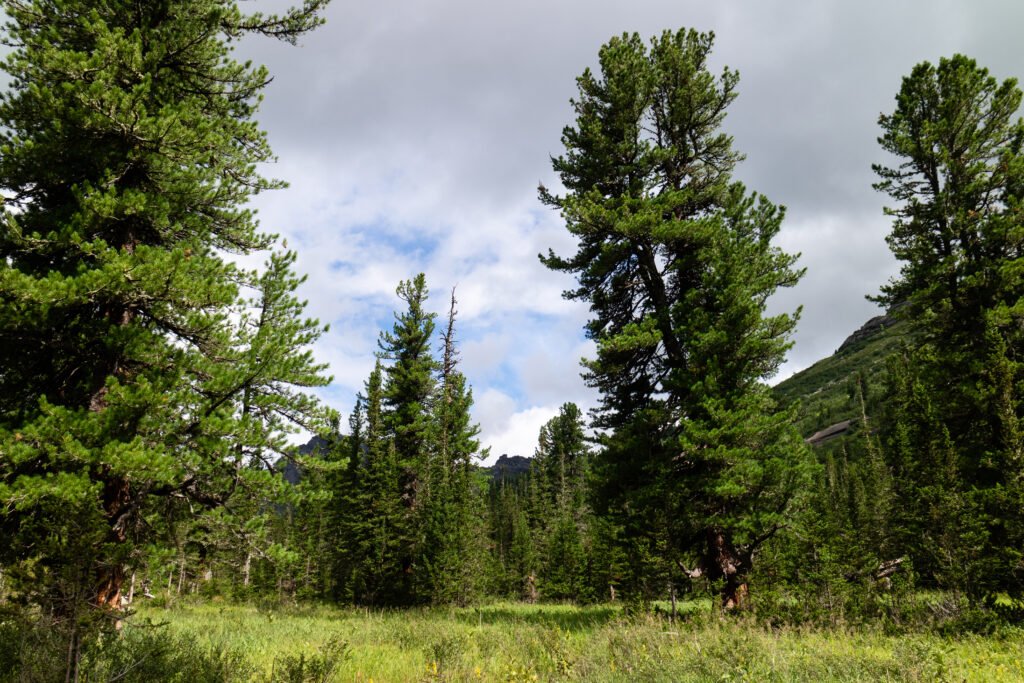
A coniferous forest is a forest ecosystem dominated by cone-bearing trees, most of which retain their needle-like leaves year-round, forming dense evergreen stands widespread across cooler regions of the Northern Hemisphere.
Evergreen Needle Adaptation
The narrow, waxy needles characteristic of most conifers minimize water loss and resist damage from heavy snow load, adaptations well suited to the cold, often dry conditions of boreal and montane climates, while retaining foliage year-round allows conifers to begin photosynthesizing immediately when conditions become favorable rather than first growing a new set of leaves each spring. This evergreen strategy proves especially advantageous in climates with short growing seasons where producing an entirely new leaf canopy annually would consume a disproportionate share of available energy and nutrients.
Major Coniferous Forest Types
The boreal forest, or taiga, forms the largest continuous coniferous forest biome, stretching across northern Canada, Scandinavia, and Russia, while montane coniferous forests occur at higher elevations in temperate regions worldwide where cooler conditions favor conifers over broadleaf species even at latitudes that would otherwise support deciduous forest at lower elevations. Pacific coastal temperate rainforests in western North America represent another distinct coniferous forest type, supporting some of the largest and oldest trees on Earth under a markedly wetter climate than typical boreal conditions.
Fire Ecology
Many coniferous forest types are strongly fire-adapted, with species like lodgepole pine producing cones that only release seed after exposure to fire heat, and periodic fire plays an essential ecological role in recycling nutrients and creating the open conditions many conifer species need to regenerate successfully. Decades of fire suppression in some coniferous forest regions has disrupted these natural fire cycles, contributing to unnaturally dense stands more vulnerable to severe, high-intensity fires when ignition eventually occurs.
Economic Importance
Coniferous forests supply the majority of the world’s softwood lumber and pulpwood, supporting major forest products industries in regions with extensive conifer forest, and the relatively fast growth and straight form of many conifer species make them particularly well-suited to plantation forestry compared with slower-growing hardwood species.
Pest and Disease Pressures
Coniferous forests face significant threats from bark beetle outbreaks and fungal pathogens, with warming temperatures in many regions allowing pest populations to expand their range and survive winters that previously limited their spread, contributing to large-scale tree mortality events that have affected millions of hectares of coniferous forest in recent decades.
Conifer Reproduction and Genetics
Conifers reproduce through cones rather than flowers, with separate male cones producing wind-dispersed pollen and female cones developing into seed-bearing structures over one or more growing seasons depending on species, a reproductive strategy that predates flowering plants by tens of millions of years and remains remarkably successful across a wide range of climates. Tree breeding programs for commercially important conifer species have developed improved genetic stock offering faster growth and greater disease resistance for plantation use.
Coniferous Forest Soil Characteristics
Needle litter decomposes more slowly than broadleaf litter due to its waxy coating and lower nutrient content, often producing more acidic forest soils beneath coniferous stands compared with deciduous forest soils, a chemical difference that shapes which understory plant species can successfully establish beneath a conifer canopy.
Conifer Plantations and Monoculture Risk
The widespread use of a small number of commercially favored conifer species in plantation forestry has created large monoculture landscapes vulnerable to pest outbreaks, prompting growing industry interest in diversifying plantation species mixes despite the added management complexity this introduces.
Boreal Forest and Global Climate Regulation
The vast boreal coniferous forest belt plays an outsized role in global climate regulation, both through enormous carbon storage in cold, slow-decomposing soils and through its influence on regional and hemispheric weather patterns, making boreal forest health a matter of global rather than purely regional concern as warming temperatures increasingly threaten this biome’s stability.
Coniferous Forest Restoration Challenges
Restoring coniferous forest after severe disturbance can prove more difficult than restoring some deciduous forest types, since certain conifer species depend on specific fire or disturbance conditions for successful regeneration, and climate-driven shifts in disturbance patterns are making it harder to predict whether historical regeneration strategies will continue working reliably going forward.
Protecting the boreal and other major coniferous forest belts from compounding climate and disturbance pressures remains one of the most consequential forest conservation priorities given their outsized role in global carbon and climate regulation.
Conifer Adaptation to Changing Fire Regimes
Some coniferous species face mismatches between their historical fire-adapted reproductive strategies and the altered fire regimes now emerging under climate change, raising concern among forest ecologists about whether certain fire-dependent conifer species can successfully regenerate under novel, more extreme fire conditions.
Understanding these shifting fire-regeneration dynamics will be essential for predicting which coniferous forest types persist successfully through the coming decades of climate change.
Looking Ahead for Coniferous Forests
Continued research into pest resistance breeding and climate-adapted planting strategies will likely determine how successfully major coniferous forest regions withstand the compounding pressures of warming temperatures, expanding pest ranges, and shifting fire regimes over coming decades.
Given how much carbon and biodiversity value these forests hold, the stakes attached to getting that research and planning right extend well beyond the forestry sector alone.
Few forest biomes face such a convergence of economic importance and climate vulnerability as the world’s coniferous forests do today.
Getting the balance right between extraction and protection will shape these landscapes for generations to come.
Their fate over the coming decades will say a great deal about how well humanity manages the broader climate challenge.
That broader stake is why coniferous forest health increasingly draws attention well beyond the forestry profession itself.
Key facts
- Needle-leaf adaptation minimizes water loss and resists snow load;Includes the boreal taiga, montane, and coastal temperate rainforest types;Many conifer species are strongly fire-adapted
Quick checkWhy do most conifers keep their needles year-round instead of shedding them seasonally?Show answer
Retaining foliage lets them begin photosynthesizing immediately when conditions improve, important in climates with short growing seasons
Sources
- Boreal and temperate forest ecology literature
Editorially reviewed by Specialty Digest Editorial TeamLast reviewed November 3, 2026Researched and drafted with AI assistanceReport an issue