Desertification is the process by which fertile land in dry, semi-dry, or seasonally dry regions becomes progressively degraded, losing the vegetation, soil quality, and water retention it needs to support agriculture and natural ecosystems, until it comes to resemble a desert. Despite the name, desertification does not mean existing deserts physically expanding their boundaries outward in a simple advancing line; instead, it describes land degradation happening in place, often in patches scattered across a dryland region, driven by a combination of climate pressures and how the land is used.
Drylands and their vulnerability
Drylands, regions where evaporation significantly exceeds rainfall over the course of a typical year, are home to more than 2 billion people worldwide and hold a notable share of the planet’s resources, including roughly 46 percent of global stored carbon and 44 percent of all cultivated agricultural systems, according to the United Nations Convention to Combat Desertification. This combination makes drylands simultaneously valuable and fragile: their soils and vegetation are adapted to limited water, but that same adaptation leaves them with little buffer against additional stress, so changes in rainfall patterns or land-use practices that a wetter region might absorb without lasting damage can push a dryland past a threshold it struggles to recover from.
Direct and indirect drivers
The United Nations Convention to Combat Desertification distinguishes between direct, climatic drivers, mainly reduced soil moisture, shifting rainfall patterns, and increased evaporation, and indirect, largely human drivers, including poverty, the technology available to farmers and herders, market pressures, and sociopolitical conditions. These indirect drivers interact in complicated ways rather than following a single clear cause-and-effect chain: poverty can push farmers toward overgrazing or overcultivation because they have no buffer to let land rest, and the resulting land degradation then deepens that same poverty, creating a self-reinforcing cycle that is often harder to break than the initial climatic stress that triggered it. Unsustainable irrigation that raises soil salinity, deforestation that removes root systems holding soil in place, and overgrazing that strips vegetation faster than it can regrow are among the most common specific practices that convert ordinary dryland stress into full desertification.
Scale of the problem
The UNCCD estimates that about 24 percent of the world’s land is actively degrading, affecting 167 countries to some degree, with roughly 12 million hectares, an area comparable in size to a country such as Benin, lost to degradation every year. Desertification and broader land degradation intersect heavily with food security, since a large share of the cultivated land most exposed to this risk sits within drylands already operating close to their limits.
Case study: Lake Chad
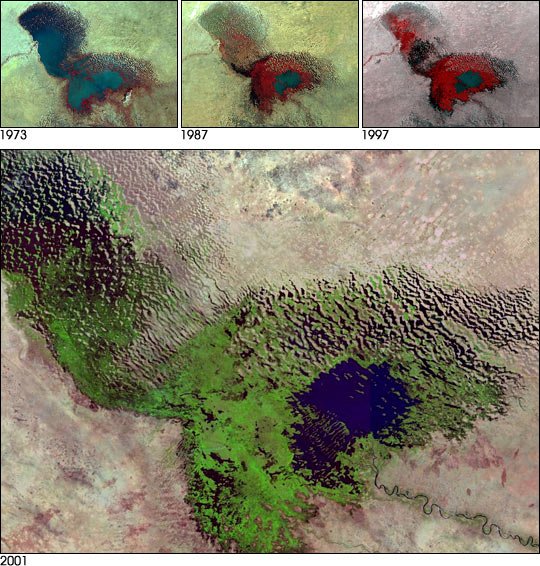
Lake Chad, bordering Chad, Cameroon, Niger, and Nigeria, has become one of the most visible examples of dryland water loss contributing to desertification pressure in its surrounding region. Satellite imagery comparing the lake’s extent in 1973 and 1997 documents a dramatic shrinkage, driven by a combination of reduced rainfall across the broader Sahel region, rising water demand for irrigation from the rivers that feed the lake, and natural climate variability. As the lake has receded, communities that depended on it for fishing, farming, and grazing have faced shrinking resources, and the resulting economic pressure has been cited as a contributing factor in regional instability, illustrating how desertification’s effects extend well beyond agriculture into broader social and security consequences.
Consequences for food and water security
Because drylands already account for a large share of the world’s cultivated land, desertification translates fairly directly into reduced food production in exactly the regions that can often least afford the loss, since many dryland farming communities have limited capacity to import food or shift to alternative livelihoods quickly. Falling groundwater and surface water availability compounds the problem, since the same degraded soils that support less vegetation are also typically worse at retaining what rainfall does occur, reducing the water available for both crops and drinking supplies. In severe cases, desertification can also act as a driver of migration, as affected households move toward cities or other regions in search of land or work that can still support them, a dynamic documented around shrinking water bodies such as Lake Chad as well as in parts of the Sahel more broadly.
Responses to desertification
Efforts to combat desertification generally focus on restoring vegetation cover, improving water management, and shifting agricultural and grazing practices toward approaches that let land recover rather than steadily depleting it. The Great Green Wall initiative across the Sahel region of Africa, which aims to restore a band of degraded land stretching across the continent through tree planting and sustainable land management, is among the most ambitious responses attempted so far, though progress has varied considerably by country, funding for the initiative has been uneven, and the project remains far from the original targets set when it was launched.
FAQs
Does desertification mean a desert is physically expanding its borders? Not exactly. Desertification describes land degradation happening within existing drylands, often in scattered patches rather than along a single advancing edge, even though the end result can resemble desert conditions spreading into previously productive land.
Can desertified land be restored? Yes, in many cases, through measures such as replanting native vegetation, improving irrigation and grazing practices, and allowing degraded land time to recover, though restoration is typically slower and more resource-intensive than the degradation process that caused the damage, since rebuilding soil structure and reestablishing vegetation cover can take years even once the underlying pressure, whether climatic or human, has eased.
Key facts
- Drylands hold about 46 percent of global stored carbon and 44 percent of cultivated systems, and are home to more than 2 billion people, per the UNCCD.
- Desertification results from both direct climatic drivers (reduced soil moisture, rainfall shifts) and indirect human drivers (poverty, land-use practices, market pressures).
- About 24 percent of the world's land is actively degrading, affecting 167 countries, with roughly 12 million hectares lost to degradation each year, per the UNCCD.
- Lake Chad shrank dramatically between 1973 and 1997, a widely cited case of dryland water loss contributing to regional desertification pressure.
- The Great Green Wall initiative across Africa's Sahel region is among the most ambitious responses attempted, through tree planting and sustainable land management.
Related concepts
Quick checkWhy does the UNCCD describe desertification's human drivers as a self-reinforcing cycle rather than a one-way cause?Show answer
Poverty can push farmers or herders toward overgrazing or overcultivation because they lack the buffer to let land rest, and the resulting land degradation then deepens that same poverty, so the climatic stress and the human response to it keep reinforcing each other rather than the damage simply flowing in one direction.
Sources
- UN Convention to Combat Desertification. Quick Facts on drylands, deserts, desertification and land degradation. 2024 (accessed 2026-11-01)
Editorially reviewed by Specialty Digest Editorial TeamLast reviewed November 1, 2026Researched and drafted with AI assistanceReport an issue