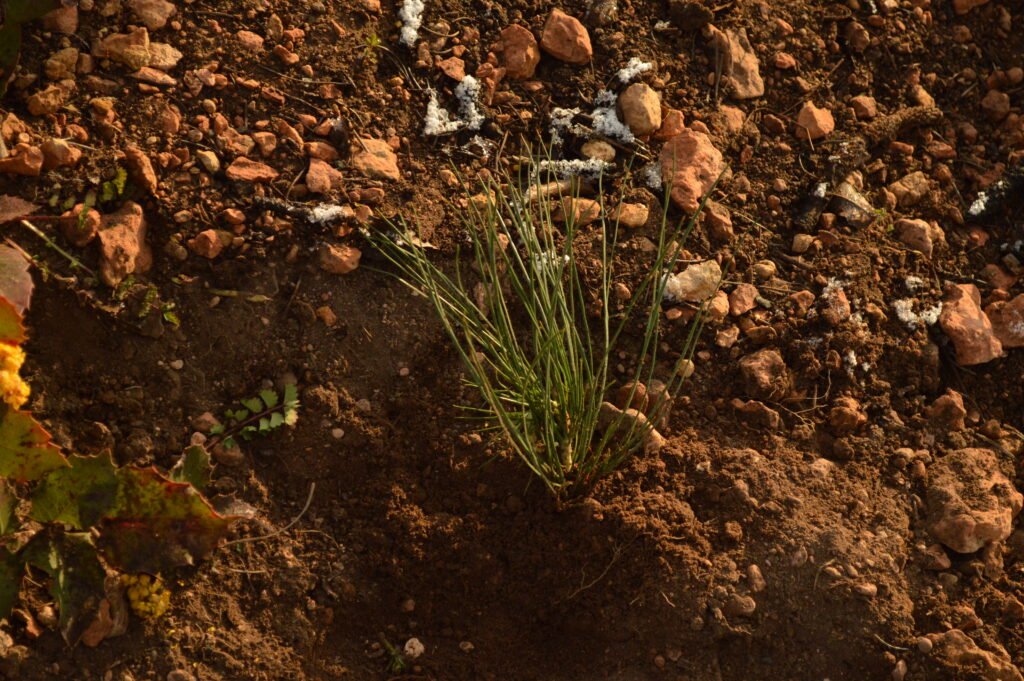
Forest succession is the gradual, predictable process by which plant and tree communities change over time following a disturbance, progressing through a series of stages until reaching a relatively stable mature forest community.
Primary and Secondary Succession
Primary succession occurs on newly exposed surfaces with no pre-existing soil or vegetation, such as land exposed after a glacier retreats or lava cools, and proceeds slowly as pioneer organisms gradually build soil and organic matter. Secondary succession, far more common in forestry contexts, occurs after a disturbance like fire, logging, or storm damage removes vegetation but leaves soil and often root systems intact, allowing recovery to proceed much faster than primary succession.
Successional Stages
A typical secondary succession sequence moves from fast-growing pioneer species such as grasses and shrubs, through early successional trees like aspen or pine that thrive in full sunlight, toward shade-tolerant hardwood species that gradually dominate as the canopy closes and understory light diminishes. Each stage changes the physical conditions of the site in ways that favor the next stage’s species while making conditions less favorable for the current stage’s species, driving the progression forward.
Climax Communities and Disturbance
Ecologists once described succession as culminating in a stable climax community that would persist indefinitely absent further disturbance, though contemporary ecology increasingly recognizes that most forests exist in a dynamic equilibrium shaped by recurring disturbances like fire, wind, insects, and disease rather than reaching a truly static final state. This updated understanding treats succession as an ongoing process continually reset at different scales across a landscape rather than a one-way march toward a fixed endpoint.
Management Applications
Foresters and land managers use knowledge of succession to predict how a site will develop after a given disturbance or management action, informing decisions about whether to intervene with planting or allow natural regeneration to proceed, and when to expect a stand to reach commercially or ecologically significant stages. Understanding succession is also essential for habitat management, since many wildlife species depend on specific successional stages, and a landscape with a mix of successional stages generally supports more biodiversity than one locked into a single stage.
Succession in Conservation Planning
Conservation planners increasingly manage landscapes to maintain a diversity of successional stages rather than letting every stand progress uniformly toward mature forest, recognizing that early successional habitat has become increasingly rare and valuable in many regions where fire suppression and reduced disturbance have allowed forests to age uniformly toward later successional stages.
Succession in Aquatic and Wetland Systems
Succession principles extend beyond upland forests to wetlands and aquatic systems, where ponds can gradually fill with sediment and organic matter, transitioning through marsh and wet meadow stages toward forested wetland over long time periods, illustrating how succession operates as a general ecological principle rather than one confined strictly to upland forest contexts. Understanding these parallel successional pathways helps land managers anticipate how a wetland or riparian area is likely to change over time absent intervention.
Human Influence on Successional Trajectories
Human activities, including fire suppression, introduction of invasive species, and altered herbivore populations, have significantly changed natural successional trajectories in many landscapes, sometimes locking an area into an unexpected intermediate stage or accelerating progression toward a different endpoint than would have occurred under purely natural conditions. Recognizing these human-altered successional pathways has become essential for restoration ecologists attempting to guide a degraded landscape back toward a more historically typical trajectory.
Succession Modeling for Land Management
Computer models that simulate successional trajectories under different management scenarios help land managers compare the long-term consequences of alternative decisions, such as allowing natural regeneration versus active planting, before committing resources to a particular management path.
Succession After Catastrophic Disturbance
Large-scale catastrophic disturbances, including severe wildfire, hurricane blowdown, or major insect outbreaks, can reset succession across vast areas simultaneously, creating landscape-scale patterns distinct from the smaller, more gradual gap-driven succession typical of undisturbed forest, and researchers continue studying how forests recover differently following these large synchronized disturbance events compared with smaller, more localized disturbances.
Succession and Invasive Species Establishment
Disturbed sites in early succession are often particularly vulnerable to invasive species establishment, since the open conditions that favor native pioneer species can equally favor aggressive non-native competitors, making early intervention against invasive establishment a priority in many restoration projects working to guide succession toward desired native plant communities.
Whether progressing gradually after a small gap or rapidly across a landscape leveled by catastrophic disturbance, succession remains the fundamental process through which forests continuously renew and reorganize themselves over time.
Succession and Long-Term Ecological Monitoring
Long-term ecological research sites that track the same forest plots across decades have proven invaluable for validating and refining successional theory, revealing that real-world succession often proceeds less predictably than classic models suggest once local variation in soil, climate, and disturbance history are fully accounted for.
Recognizing how much real-world variability shapes successional outcomes has made contemporary forest ecology considerably more nuanced than the tidy textbook sequences once used to introduce the concept.
As ecologists continue refining successional theory with better long-term data, land managers gain increasingly reliable tools for anticipating how specific disturbed sites are likely to develop in coming decades.
Understanding that complexity helps explain why no two disturbed forest sites, even seemingly similar ones, ever recover in quite the same way.
That constant renewal, however disorderly it sometimes appears up close, is precisely what keeps forests adaptable over the long run.
Patience, more than any other quality, is what succession ultimately asks of anyone trying to understand or guide it.
Key facts
- Includes primary succession on bare surfaces and faster secondary succession;Progresses through pioneer, early, and late successional stages;Shaped by recurring disturbance rather than a single fixed endpoint
Quick checkWhat is the main difference between primary and secondary succession?Show answer
Primary succession starts on bare surfaces with no soil, while secondary succession occurs where soil and often roots remain after a disturbance
Sources
- Forest ecology textbooks; U.S. Forest Service ecology resources
Editorially reviewed by Specialty Digest Editorial TeamLast reviewed November 3, 2026Researched and drafted with AI assistanceReport an issue