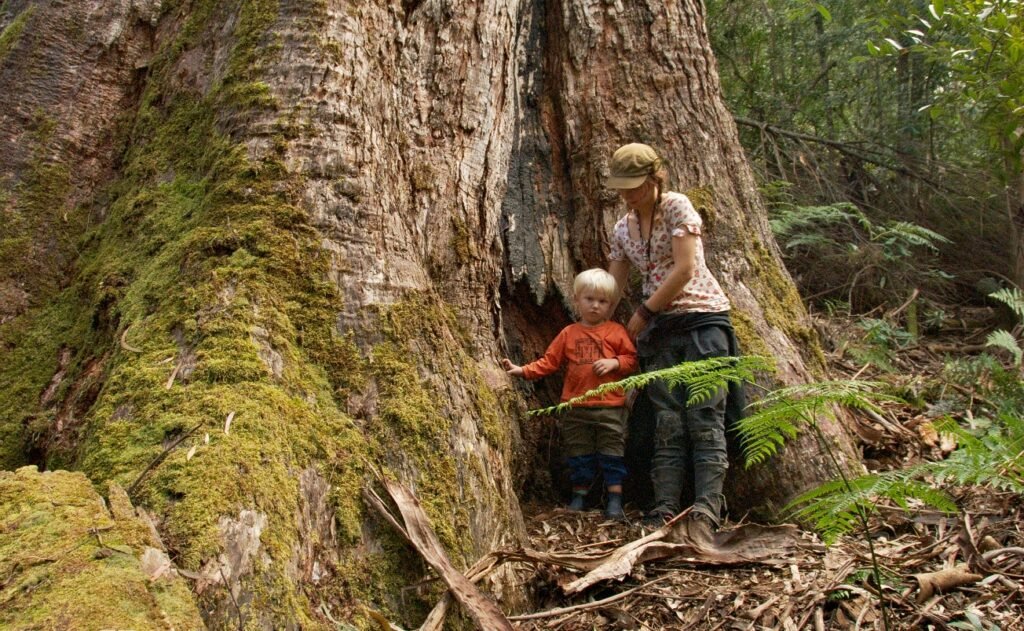
An old-growth forest is a mature forest ecosystem that has developed over a long period, typically centuries, without major human disturbance, characterized by large old trees, standing dead wood, and complex multi-layered canopy structure.
Defining Characteristics
Old-growth forests typically feature trees of exceptional size and age, a canopy with multiple distinct layers rather than a single uniform height, significant amounts of standing dead trees called snags, and large downed logs decomposing on the forest floor, all of which support biodiversity rarely found in younger managed stands. These structural features develop gradually over long periods as trees die, fall, and decompose, creating habitat niches that take decades or centuries to form naturally.
Ecological Value
The complex structure of old-growth forest supports specialized wildlife, including cavity-nesting birds, certain salamanders, and lichen species that depend specifically on old-growth conditions and rarely occur in younger forests, making old-growth stands disproportionately important for regional biodiversity despite covering a small fraction of total forested land in most regions. Old-growth forests also store substantially more carbon per hectare than young regenerating forests, both in living biomass and in accumulated dead wood and soil organic matter.
Historical Decline and Remaining Stands
Extensive historical logging across many regions, particularly during the nineteenth and early twentieth centuries, eliminated the vast majority of original old-growth forest, leaving only scattered remnant stands in areas that were difficult to access or specifically protected from harvest. Remaining old-growth stands have become focal points for conservation efforts and frequently generate significant public and political controversy when proposed for any form of commercial harvest.
Debates Over Management
Conservationists generally argue that remaining old-growth should be fully protected given how long it takes to redevelop once lost, while some forestry interests argue selective, carefully managed harvest of old-growth can be sustainable, a debate that has driven decades of litigation and policy conflict in regions with significant remaining old-growth forest. These debates often center on balancing economic value from timber against ecological and cultural values that are difficult to quantify in purely economic terms.
Defining Old-Growth in Practice
Because old-growth lacks a single universal definition, foresters and ecologists typically use a combination of criteria, including minimum stand age, tree size thresholds, and structural features like snag density, to classify a given stand, with definitions sometimes varying by forest type and region to account for differing natural growth rates and disturbance histories.
Research Value of Old-Growth Reference Stands
Scientists use remaining old-growth stands as reference benchmarks for understanding natural forest structure and function, informing restoration targets and sustainable forestry practices aimed at recreating some old-growth characteristics within managed forest landscapes even where full old-growth restoration is not feasible on commercially productive land. These reference stands provide an invaluable baseline against which the structural complexity of managed forests can be compared and evaluated.
Restoration Toward Old-Growth Characteristics
Some forest managers now deliberately apply silvicultural techniques, including variable-density thinning and retention of large trees and snags, aimed at accelerating the development of old-growth-like structural characteristics within younger managed stands, an approach sometimes called ecological forestry that seeks to blend commercial timber production with genuine progress toward old-growth structural complexity over multiple decades.
Legal Protections for Old-Growth
Several countries have enacted specific legal protections for identified old-growth stands, ranging from outright harvest bans to mandatory extended review processes before any old-growth timber sale can proceed, reflecting old-growth’s elevated conservation status compared with younger managed forest.
Cultural and Spiritual Significance
Old-growth forests hold deep cultural and spiritual significance for many indigenous peoples and local communities who have maintained traditional relationships with these forests for generations, adding a dimension to old-growth conservation debates that extends well beyond purely ecological or economic considerations into questions of cultural heritage and indigenous rights.
Old-Growth Definitions Across Forest Types
What qualifies as old-growth varies dramatically by forest type and region, since a fast-growing tropical forest may develop old-growth characteristics within a century or two while a slow-growing boreal or high-elevation forest might require several centuries to develop comparable structural complexity, meaning age thresholds used to define old-growth cannot be applied uniformly across all forest types worldwide.
As remaining old-growth continues to shrink in extent while scientific and cultural appreciation for it grows, the tension between protection and extraction seems likely to remain one of forestry’s most persistent and consequential debates.
Old-Growth and Scientific Baseline Value
Beyond their direct ecological and cultural value, remaining old-growth stands serve an irreplaceable scientific function as living baselines against which the long-term effects of human management and environmental change can be measured and understood.
Preserving what remains of these irreplaceable reference ecosystems therefore serves both conservation and scientific interests simultaneously, a rare alignment that strengthens the case for continued protection.
Visitors fortunate enough to walk through a genuine old-growth stand often describe the experience as markedly different from any managed forest, a qualitative impression that growing scientific documentation increasingly supports with hard structural and biodiversity data.
What remains of the world’s old-growth forest is, in the truest sense, irreplaceable within any human timescale.
Treating it accordingly, with patience and genuine restraint, remains the clearest path toward passing some of it on to future generations.
The choice to protect it now is, in the clearest sense available, a choice made on behalf of people not yet born.
That intergenerational weight is part of what makes old-growth conservation feel different from ordinary land use debates.
Few conservation choices offer such a direct, legible link between present action and distant future outcome.
That link is worth remembering every time an old-growth stand comes up for debate.
Key facts
- Features multi-layered canopy, snags, and downed logs;Supports specialized wildlife rarely found in younger forests;Mostly eliminated by historical logging, remnants now closely protected
Quick checkWhy do old-growth forests support more biodiversity than young managed stands?Show answer
Their complex multi-layered structure, snags, and downed wood create habitat niches that take decades or centuries to develop
Sources
- U.S. Forest Service old-growth definitions; forest ecology literature
Editorially reviewed by Specialty Digest Editorial TeamLast reviewed November 3, 2026Researched and drafted with AI assistanceReport an issue