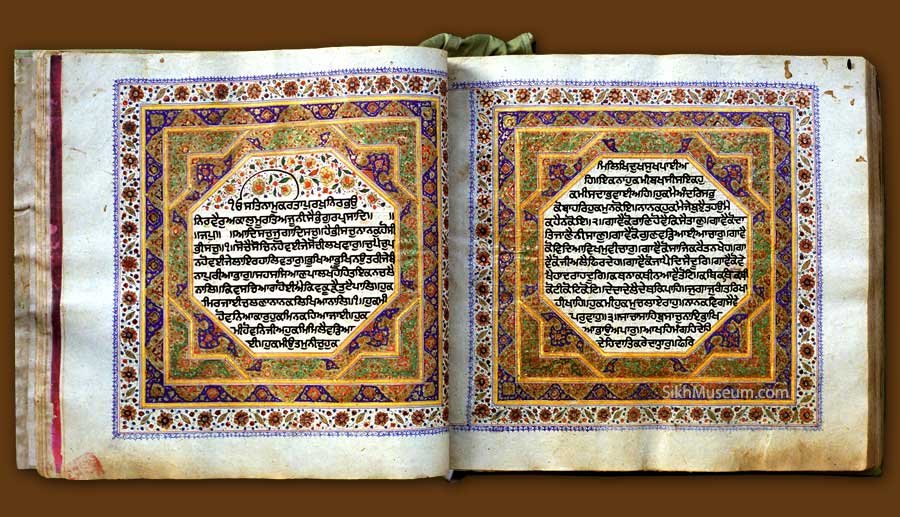
Overview
The Guru Granth Sahib is the primary scripture of Sikhism and occupies a unique position among world religious texts: it is treated not merely as a book of teaching but as the living embodiment of spiritual authority, succeeding the line of human Gurus. Sikhs approach it with the same reverence given to a living teacher.
Compilation
The core text was compiled by Guru Arjan, the fifth Sikh Guru, in 1604, drawing together hymns composed by earlier Sikh Gurus along with devotional poetry from Hindu and Muslim saints whose teachings resonated with Sikh values. A final version was prepared under the tenth Guru, Guru Gobind Singh, who added further hymns before the canon was closed.
Language and Structure
Written in the Gurmukhi script, the text incorporates several regional languages including Punjabi, Sanskrit, and Persian-influenced vocabulary, reflecting the diverse linguistic world of medieval northern India. It is organized by musical mode, or raga, with hymns grouped so they can be sung according to traditional melodic frameworks during worship.
Installation as Eternal Guru
In 1708, shortly before his death, Guru Gobind Singh declared that the line of personal Gurus would end and that the scripture itself would serve as the eternal Guru for the Sikh community going forward. This moment transformed the text from scripture into a living spiritual authority addressed directly in worship.
Role in Worship
Every Sikh gurdwara houses a copy of the Guru Granth Sahib, placed under a canopy and treated with ceremonial respect. Daily readings, continuous recitations, and the practice of taking random guidance by opening to a page are central features of Sikh devotional life centered on the text.
Role Today
The Guru Granth Sahib continues to anchor Sikh identity and practice worldwide, studied for its poetic and philosophical content as well as venerated in daily worship. Its emphasis on equality, devotion, and ethical living remains central to Sikh teaching across the global diaspora.
Authorship and Contributors
Hymns within the Guru Granth Sahib come not only from the Sikh Gurus themselves but also from a range of Hindu bhakti poets and Muslim Sufi saints whose devotional compositions were judged consistent with core Sikh teaching on divine unity and social equality. This inclusive compilation reflects a deliberate editorial choice to gather spiritually resonant material across religious boundaries rather than restricting the canon to a single communal source.
Among the non-Sikh contributors represented are figures associated with the broader North Indian bhakti devotional movement, whose poetry emphasized direct personal connection with the divine over ritual formalism. Their inclusion within Sikh scripture illustrates the historical context of religious exchange in medieval Punjab, where devotional currents from multiple traditions interacted and influenced one another across community lines.
Musical Setting
Because the text is organized by raga for musical performance, trained musicians known as ragi play a central role in Sikh worship, rendering hymns through devotional singing called kirtan. This musical dimension is considered integral to the scripture rather than incidental, since the hymns were composed with specific melodic settings in mind from the outset of their creation.
Physical Treatment
Gurdwaras observe detailed protocols for the physical care of the scripture, including ceremonial opening and closing each day, respectful transport, and a dedicated resting place when not in active use for reading or recitation. These practices express the understanding that the text itself is to be approached with the same decorum given to a living spiritual teacher present within the community.
This disciplined reverence has helped preserve both the physical text and its central place in communal Sikh identity across generations.
Few religious texts occupy quite so central and singular a place within the life of a community.
New generations continue to engage with its hymns through both traditional recitation and contemporary musical settings.
Comparative Note
Unlike many scriptural traditions that rely on a human clergy to interpret sacred text, Sikhism formal elevation of scripture itself to the status of living Guru represents a distinctive theological move, placing interpretive authority in direct communal engagement with the text rather than in an ongoing lineage of appointed religious leaders.
This arrangement continues to shape how Sikh communities understand questions of religious authority and guidance today.
Length and Content Scope
The complete text spans over 1,400 pages in its standard printed form, containing more than five thousand hymns composed across a range of poetic meters. Its sheer scope reflects contributions gathered and refined over roughly two centuries of compilation work by successive Gurus and their close associates.
Role in Ceremony
Major Sikh life events, including naming ceremonies, weddings, and funeral rites, are structured around specific readings and hymns drawn from the text, embedding scripture directly into the rhythm of communal and family life rather than confining it to separate formal worship settings alone.
Equality and Social Teaching
A consistent theme running throughout the hymns is the rejection of caste distinction and gender hierarchy in favor of direct, equal access to the divine for every person regardless of social background, a teaching that shaped distinctive Sikh institutions such as the communal kitchen found in every gurdwara.
This egalitarian message continues to shape Sikh social practice and identity in communities around the world today.
Scholarly Study
Academic interest in the text has grown steadily, with scholars examining its poetic structure, historical compilation, and theological content using methods drawn from comparative religious studies alongside traditional Sikh exegetical approaches developed within the community itself over several centuries.
This combined body of study continues to deepen understanding of its historical formation and lasting devotional significance.
It continues to reward careful and patient study by believers and scholars alike.
Key facts
- Array
Quick checkWho declared the Guru Granth Sahib the eternal Guru of Sikhism?Show answer
Guru Gobind Singh, the tenth Sikh Guru, declared it the eternal living Guru in 1708, ending the line of human Gurus.
Sources
- Array
Editorially reviewed by Specialty Digest Editorial TeamLast reviewed November 4, 2026Researched and drafted with AI assistanceReport an issue