Overview
The Talmud is the foundational document of Rabbinic Judaism, a vast compilation of legal reasoning, ethical teaching, and narrative that records centuries of rabbinic discussion. It built upon the Mishnah, an earlier codification of oral law, by gathering extensive commentary and debate known as the Gemara.
Structure
The Talmud pairs each section of the Mishnah with Gemara discussion exploring, challenging, and elaborating on its legal rulings. Rabbis across generations are quoted in dialogue with one another, often disagreeing, so that the text reads as an ongoing multigenerational argument rather than a single settled statement of law.
Two Versions
Two distinct versions survive. The Jerusalem Talmud was compiled by scholars working in the land of Israel and is generally shorter and less polished. The Babylonian Talmud, compiled later by academies in Mesopotamia, became the more authoritative and widely studied version, and references to simply the Talmud usually mean this Babylonian compilation.
Content Beyond Law
Although organized around legal categories inherited from the Mishnah, the Talmud ranges widely beyond strict law, incorporating folklore, medical and astronomical observations, biblical interpretation, ethical maxims, and extended narrative passages known as aggadah. This breadth makes it a wide-ranging record of rabbinic intellectual culture.
Study Tradition
Talmudic study developed its own distinctive methods, including the paired study practice known as chavruta, in which two students work through a passage together in dialogue. Yeshivas and seminaries worldwide continue to center their curricula on sustained, often lifelong engagement with Talmudic text and commentary.
Role Today
The Talmud remains the primary source for Jewish religious law and continues to shape rabbinic decision making on contemporary questions. Its influence extends into Jewish cultural and intellectual life broadly, and digital resources have made its extensive text more accessible to students around the world.
Structure of Argument
Talmudic passages frequently present a question of law followed by competing opinions from named rabbis, objections raised against each position, and attempts to reconcile apparent contradictions with other accepted teachings. This dialectical style, moving through claim, challenge, and response, trains readers in a distinctive mode of reasoning that prizes careful argument over simple appeal to authority, even as it ultimately seeks to establish workable legal conclusions for communal practice.
Later legal codes, most notably those compiled by Maimonides and later authorities, attempted to distill Talmudic discussion into more straightforward rulings for practical application. Even so, traditional study has generally continued to prioritize engagement with the original discursive text over reliance on condensed codes alone, valuing the reasoning process as much as the conclusions it produces for communal legal practice.
Historical Context
The Talmud took shape within rabbinic academies operating under Roman and later Persian rule, as Jewish communities sought ways to maintain religious and legal coherence following the destruction of the Second Temple and the loss of centralized priestly authority. This shift from temple-centered religion toward text-centered rabbinic Judaism represents one of the most significant transformations in the history of the Jewish tradition.
Printing and Standard Pagination
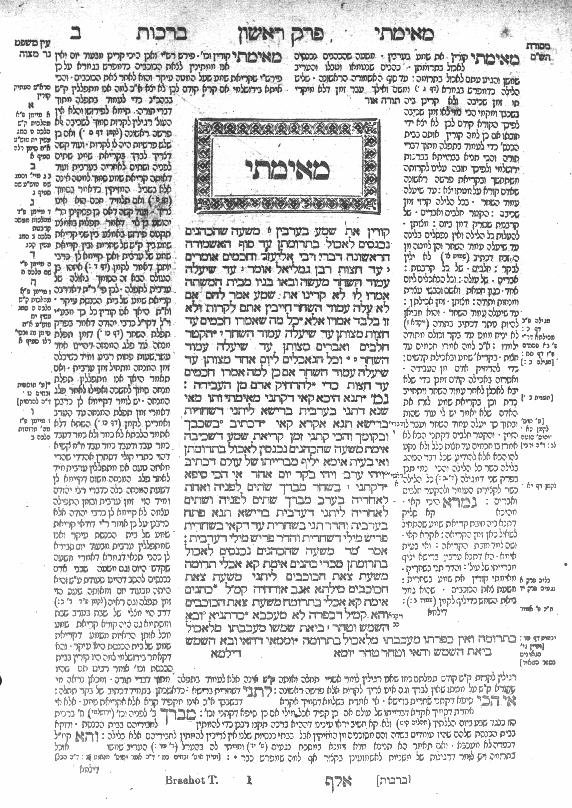
A standardized pagination system established through early printed editions in Venice continues to govern how the Talmud is cited and referenced today, allowing scholars anywhere to locate a passage by page and side regardless of which particular printed or digital edition they happen to consult for study or citation purposes.
Role of Commentary
Over the centuries following its compilation, the Talmud itself became the subject of extensive further commentary, most famously the eleventh century work of Rashi, whose line-by-line explanations appear in the margins of nearly every standard printed edition. Later medieval commentators known collectively as Tosafists added further layers of analysis, cross-referencing and sometimes challenging Rashi own interpretations and raising fresh questions of their own.
This layered commentarial tradition means that study of a single Talmudic page often involves simultaneously reading the core text alongside multiple surrounding commentaries, each in conversation with the others across different historical periods. The resulting experience of study resembles a multigenerational conversation held across centuries rather than a simple linear reading of one fixed document from beginning to end.
Educational Institutions
Talmudic study has long been organized around dedicated institutions, from medieval academies in Babylonia and later in Europe to contemporary yeshivas found in Jewish communities worldwide. These institutions developed structured curricula and distinctive pedagogical methods suited to the demanding, argument-based nature of the material being studied by students often beginning at a young age.
Influence Beyond Law
Though centered on legal reasoning, the Talmud has also shaped broader Jewish cultural attitudes toward argument, questioning, and intellectual rigor, with its distinctive back-and-forth style sometimes cited as an influence on wider patterns of Jewish scholarly and legal thought extending well beyond strictly religious contexts into fields such as law and philosophy.
Modern Accessibility
Recent decades have seen major projects aimed at making the Talmud more accessible to non-specialists, including modern Hebrew and English translations with expanded explanatory notes. These projects have broadened the base of people able to engage directly with the text, extending a tradition of study once largely confined to advanced scholars trained for many years in its specialized methods and vocabulary.
Closing Note
The Talmud remains the central text of rabbinic Judaism, continuing to shape religious law, communal practice, and intellectual culture across Jewish communities worldwide today.
Scholars, students, and lay readers alike continue to find fresh insight in its pages, a testament to the enduring depth and relevance of its wide-ranging legal and ethical discussion.
It remains, by any measure, one of the most intensively studied legal and literary texts in the whole of Jewish history.
Key facts
- Array
Quick checkWhat are the two main versions of the Talmud?Show answer
The Babylonian Talmud and the Jerusalem Talmud, named for the regions where their rabbinic academies compiled them.
Sources
- Array
Editorially reviewed by Specialty Digest Editorial TeamLast reviewed November 4, 2026Researched and drafted with AI assistanceReport an issue