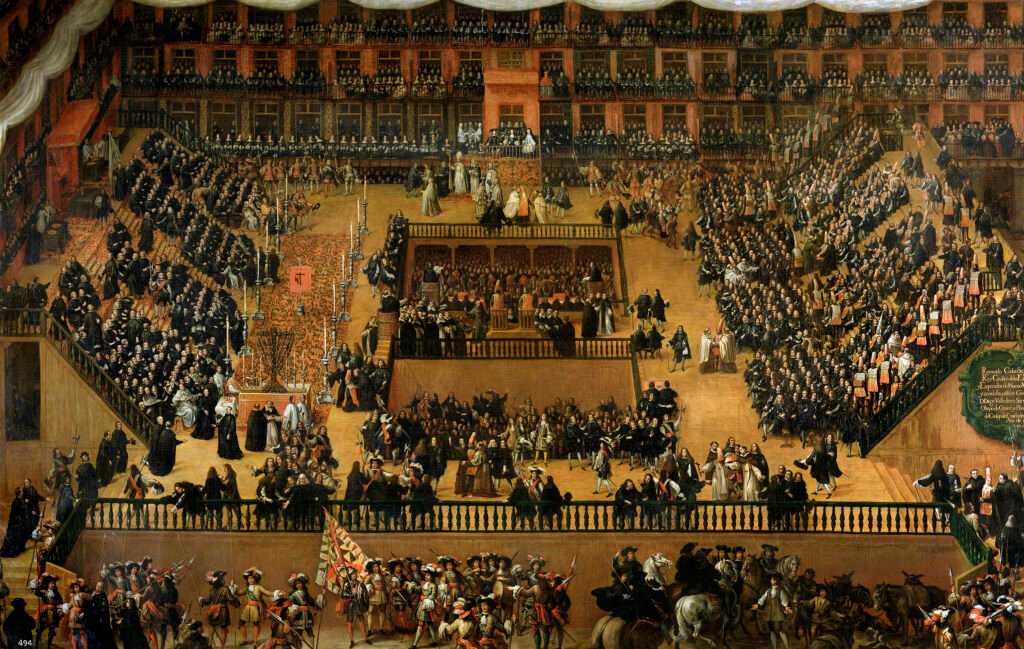
Overview
The Inquisition refers to several distinct institutions established by the Catholic Church across different periods and regions to investigate and address perceived heresy, employing formal interrogation and trial procedures that varied considerably in severity and scope depending on the specific historical and political context involved.
Medieval Origins
The medieval Inquisition emerged in the thirteenth century, developed partly in response to the spread of movements the church considered heretical, such as Catharism in southern France, establishing formal procedures for investigating accusations and determining appropriate penance or punishment for those found guilty of heretical belief.
The Spanish Inquisition
Established in 1478 under the authority of the Spanish crown rather than solely papal authority, the Spanish Inquisition became particularly associated with scrutinizing converted Jews and Muslims suspected of secretly maintaining their former religious practices, operating with considerable state backing and becoming deeply intertwined with Spanish political consolidation.
Procedures and Punishments
Inquisitorial procedures generally involved formal accusation, interrogation often including the possibility of torture under certain legal conditions, and a range of possible outcomes from acquittal through penance to, in more severe cases, execution, with procedures and severity varying considerably across different inquisitorial bodies and historical periods.
Historical Assessment
Modern historians have worked to assess inquisitorial activity with greater nuance than earlier polemical accounts, finding considerable variation in severity across time and region while also documenting genuine instances of serious abuse, wrongful conviction, and significant human suffering inflicted under inquisitorial authority.
Role Today
The Inquisition remains a significant subject of historical study and continues to serve as a reference point in broader discussions of religious persecution, due process, and the historical relationship between religious and state authority across European history.
Roman Inquisition
A separate Roman Inquisition, established in the sixteenth century partly in response to the Protestant Reformation, focused significantly on suppressing heretical teaching within Catholic territories and became notably associated with prominent cases such as the trial of Galileo Galilei over his astronomical claims.
This Roman body operated somewhat differently from the earlier medieval and Spanish inquisitions, reflecting the particular theological and political concerns of the Counter-Reformation period during which it was established and operated most actively across several Italian territories.
Legal Procedures
Inquisitorial courts developed relatively systematic legal procedures by the standards of their time, including formal record-keeping and defined categories of evidence, even though these procedures still fell considerably short of the due process protections recognized in many modern legal systems today.
Portuguese Inquisition
A related Portuguese Inquisition, established in 1536, similarly targeted converted Jews suspected of secretly maintaining their former religious practices, operating with considerable severity and contributing to significant Jewish emigration from Portuguese territories during the following centuries of its operation.
Comparative study of these various inquisitorial bodies reveals considerable variation in both severity and target populations, cautioning against treating the Inquisition as a single uniform historical phenomenon rather than several related but institutionally and historically distinct undertakings across different times and places.
Scale and Historical Estimates
Modern historians have worked to establish more reliable estimates of inquisitorial activity and its human cost, moving beyond both minimizing apologetics and exaggerated polemical claims toward carefully documented historical assessment grounded in surviving archival records from the various inquisitorial tribunals.
Comparative Religious Context
Other religious traditions have maintained their own historical mechanisms for addressing perceived heresy or deviation, though the specific institutional form of the Inquisition, with its combination of centralized ecclesiastical authority and formal judicial procedure, developed distinctively within the particular historical context of medieval and early modern Catholic Europe.
Comparative historians studying religious persecution across traditions note that the Inquisition specific institutional features, rather than its underlying impulse to police religious belief, represent its most historically distinctive characteristic relative to other documented instances of religiously motivated persecution across world history.
Closing Note
The Inquisition remains a powerful historical symbol of the dangers of unchecked religious and political authority, prompting continued scholarly reflection on due process, tolerance, and the proper relationship between church and state across many centuries since.
Archival research continues to refine understanding of its true scale, correcting both older exaggerations and more recent minimizations alike.
Final Thought
The Inquisition legacy as a cautionary historical example continues to inform how societies think about the proper limits of religious and state authority over individual conscience and belief.
Its name remains synonymous with the dangers of unchecked institutional power over individual belief.
Each newly opened archive adds further nuance to this carefully studied historical record.
Few institutions have left so lasting a mark on how later generations think about religious coercion.
Its echo persists across many debates about liberty and belief even now.
Historians, legal scholars, and theologians alike continue to study its procedures closely.
That scrutiny shows no sign of ending soon, given how much the topic still matters.
New studies of its trial records keep appearing regularly, deepening the historical record considerably further still.
Interest shows no sign of fading anytime soon among historians of religious persecution.
It remains a cornerstone topic for historians of church and state relations.
It endures as a defining chapter of religious and legal history.
Procedures varied considerably across the different inquisitorial bodies that operated in different periods and regions, but they generally relied on denunciation by neighbors or acquaintances, followed by interrogation that could include torture under defined legal limits. Confession and reconciliation with the church were preferred outcomes, since the stated purpose was correction rather than simple punishment, though unrepentant or relapsed individuals could be handed to secular authorities for execution. The Spanish Inquisition in particular became entangled with questions of ancestry, since it scrutinized converts from Judaism and Islam for signs of continued adherence to their former faiths, a concern that shaded into ethnic suspicion as much as religious doctrine. Modern historians have worked to separate the historical record from later polemical exaggerations that circulated in Protestant and Enlightenment writing, while still recognizing the real suffering inflicted on those investigated, imprisoned, or executed. Records kept by inquisitorial tribunals, ironically, now serve historians as a rich source of information about the beliefs and daily life of ordinary people who left few other written traces.
Key facts
- Array
Quick checkWhat distinguished the Spanish Inquisition from earlier medieval inquisitorial efforts?Show answer
The Spanish Inquisition, established in 1478, operated under the authority of the Spanish crown rather than solely the papacy, and became particularly associated with scrutinizing converted Jews and Muslims for perceived continued adherence to their former faiths.
Sources
- Array
Editorially reviewed by Specialty Digest Editorial TeamLast reviewed November 4, 2026Researched and drafted with AI assistanceReport an issue