In simple terms
An invasive species is an organism living outside its native range that causes ecological or economic harm in its new environment. [2] The harm is the part that matters. Without it, the species is simply non-native.
That distinction is not a technicality. Many non-native species are welcome: tomatoes and chili peppers came from South America, lettuce was first grown by the Egyptians, and cattle were brought to North America as a food source. [1] Non-native and invasive cannot be used interchangeably. [1]
How it works
The working definitions are national. In the United States, Executive Order 13112 defines an invasive species as one that is non-native to the ecosystem under consideration and whose introduction causes, or is likely to cause, economic or environmental harm or harm to human health. [1] That sets two tests: the species has to be out of place, and it has to do damage, judged against a named ecosystem rather than a whole country.
Spread is mostly human and mostly unintended, carried along with people and goods. [1] At sea, species travel in the ballast water of ocean-going ships and arrive through deliberate and accidental releases of aquaculture stock, aquarium animals and live bait. [2] Once established, an invader can compete with native organisms for limited resources, alter habitats, reduce biodiversity and drive native plants and animals to extinction. [2]
Why it matters
The bill arrives in two currencies. Invasions can cause huge economic impacts alongside fundamental disruption of coastal and Great Lakes ecosystems, which is why fisheries, utilities and farmers end up paying for an ecological problem. [2] Because most introductions ride on trade and travel, control tends to target pathways, ballast water and the pet trade among them, rather than chasing species one at a time. [1][2] It also means the label is local: a plant treasured in its homeland can be a pest a continent away.
Where you’ll see it
- Border and biosecurity checks on plants, seeds, soil and firewood [1]
- Ballast water rules for shipping and port inspections [2]
- Government species profile lists that track established and watch-list organisms [1]
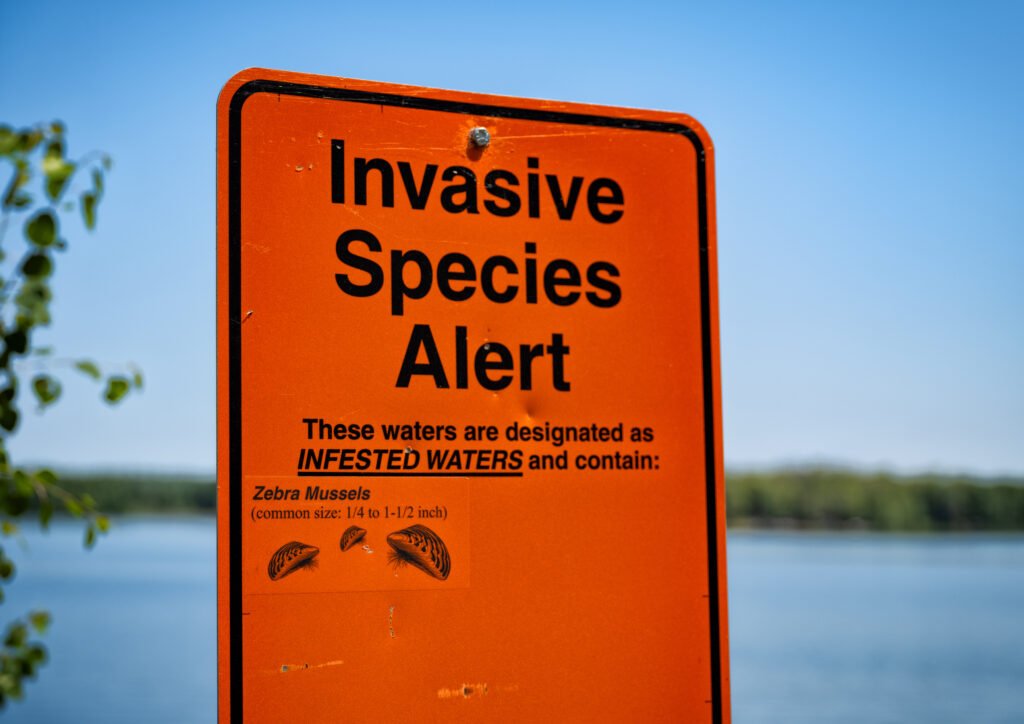
- Notices asking boaters and anglers to clean gear between water bodies
Example
A mussel carried across an ocean in ballast water settles in a lake, coats the water intake pipes of a power plant and crowds out native shellfish. That is invasive, not merely non-native.
Often confused with
Non-native, exotic and introduced species simply live outside their original range. Invasive species are the subset that cause harm, which is why most non-native species never qualify. [1]
Key facts
- Under United States Executive Order 13112, an invasive species is non-native to the ecosystem under consideration and causes or is likely to cause economic or environmental harm, or harm to human health.1
- Non-native and invasive are not interchangeable; many non-native crops and livestock are beneficial.1
- NOAA defines an invasive species as an organism that causes ecological or economic harm in a new environment where it is not native.2
- Marine invaders arrive through ship ballast water, aquaculture and aquarium releases, and discarded bait.2
- Invasive species can cause extinctions of native plants and animals, reduce biodiversity, compete for limited resources and alter habitats.2
Quick checkWhat does a non-native species have to do before it counts as invasive?Show answer
Cause, or be likely to cause, harm to the environment, the economy or human health.
Sources
- USDA National Invasive Species Information Center. What are Invasive Species?. Undated (accessed Accessed 7 October 2026)
- NOAA National Ocean Service. What is an invasive species?. Last updated 23 September 2026 (accessed Accessed 7 October 2026)
Editorially reviewed by Specialty Digest Editorial TeamLast reviewed October 7, 2026Researched and drafted with AI assistanceReport an issue