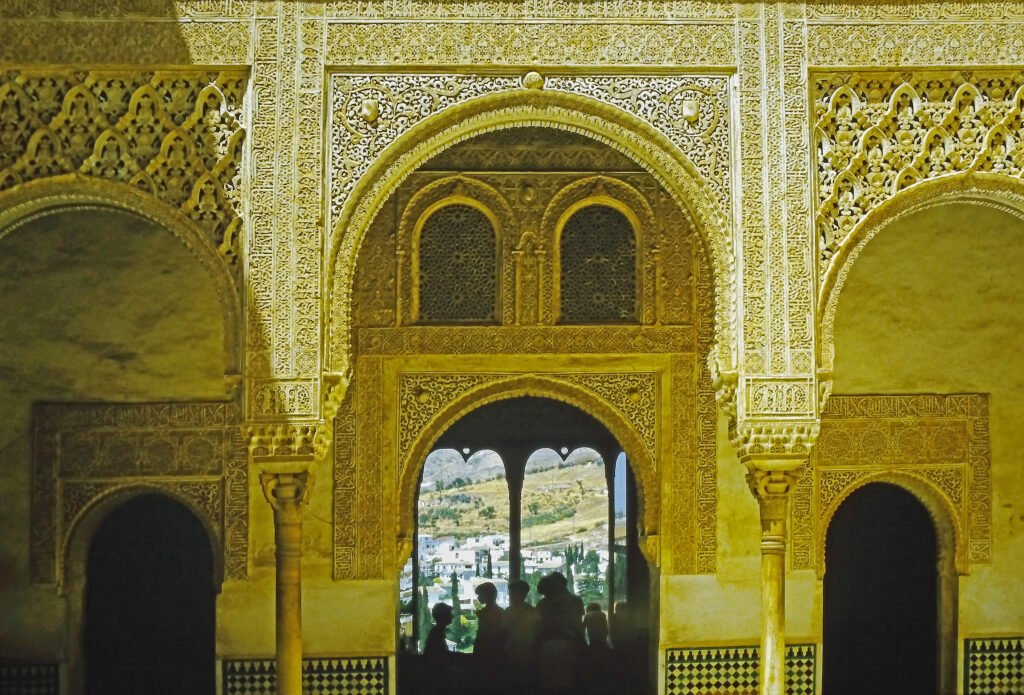
Islamic architecture refers to the building traditions that developed across the Islamic world beginning in the seventh century, encompassing mosques, palaces, tombs, and civic buildings united by a shared visual vocabulary of geometric ornament, calligraphy, and distinctive structural forms even as it took differing shapes across different regions and periods.
Core architectural elements
A mosque’s basic architectural elements typically include the mihrab, a niche set into the wall marking the direction of prayer toward Mecca, the minbar, a raised pulpit used for sermons, and the sahn, an open courtyard often used for overflow prayer and ablution. Hypostyle halls, large covered spaces supported by rows of columns, entered Islamic architecture during the Umayyad Dynasty and became a common solution for sheltering large congregations.
Decorative vocabulary
Islamic architecture is especially known for muqarnas, three-dimensional honeycomb or stalactite-like ornamental clusters applied to the undersides of domes, vaults, and arches, a technique whose origins are linked to Mesopotamia and northeastern Iran. Arabesque patterns, symmetrical geometric and floral designs often built around eight-pointed stars, appear throughout Islamic buildings alongside decorative calligraphy, which frequently frames doorways and prayer niches with passages from religious text rather than figural imagery.
Minarets and domes
Minarets, tall towers traditionally used to call worshippers to prayer, vary widely in form, from the towering Qutub Minar in India to the dramatically spiraling minaret at the Great Mosque of Samarra in Iraq, and a single mosque may have anywhere from one to six. Domes, a structural form traceable to earlier Mesopotamian architecture, entered Islamic building partly through Byzantine influence and became a defining feature of major mosques and mausoleums across the Islamic world.
Regional variations
Islamic architecture developed distinct regional personalities as it spread. Ottoman architecture in Turkey drew heavily on the example of the converted Hagia Sophia in Istanbul; Persian architecture favored the iwan, a vaulted rectangular hall open on one side, seen prominently at the Friday Mosque of Isfahan; Moorish architecture in Spain produced the intricately ornamented Alhambra; and Mughal architecture in India produced the white marble Taj Mahal with its surrounding charbagh, a four-part garden divided by water channels.
Continuity and influence
Despite this regional diversity, shared elements including the mihrab, muqarnas, and arabesque ornament continued to link mosques and palaces across vastly different climates and cultures, and Islamic architectural traditions have continued to influence contemporary mosque design and broader decorative arts well beyond the regions where they first developed.
The Great Mosque of Damascus and early examples
Among the earliest major monuments of Islamic architecture, the Great Mosque of Damascus, built in the early eighth century on the site of earlier Roman and Byzantine religious buildings, established an influential hypostyle layout that later mosques across the region would echo. The Dome of the Rock in Jerusalem, completed in the late seventh century, similarly ranks among the earliest surviving major works of Islamic religious architecture.
Palace architecture
Beyond religious buildings, Islamic architecture produced influential secular palace complexes, combining residential quarters, formal reception halls, and enclosed gardens behind fortified walls, with the Alhambra in Granada standing as one of the most celebrated surviving examples, renowned for its intricately carved stucco, tiled courtyards, and sophisticated use of water features for both cooling and decorative effect.
Mausoleum architecture
Islamic architecture also produced some of the world’s most celebrated mausoleums, structures built to house a ruler’s or saint’s tomb beneath an often domed, highly decorated chamber, with the Taj Mahal in India, completed in the mid-seventeenth century as a mausoleum for a Mughal emperor’s wife, remaining the most internationally recognized example.
Construction materials and techniques
Builders across the Islamic world adapted their techniques to locally available materials, from fired brick and glazed tilework in Persia and Central Asia to carved stone in North Africa and Spain, developing regionally distinct structural solutions, including sophisticated brick vaulting, that allowed large domed spaces to be built without the extensive use of timber or imported stone.
Modern Islamic architecture
Contemporary architects continue adapting Islamic architectural traditions to modern materials and building types, incorporating geometric ornament, mashrabiya-style perforated screens, and courtyard planning into contemporary mosques, museums, and civic buildings across the Middle East, North Africa, and beyond.
Preservation challenges
Many historic Islamic architectural monuments face ongoing preservation challenges from conflict, urban development pressure, and simple age, prompting organizations including UNESCO to designate numerous mosques, palaces, and historic urban quarters as World Heritage Sites in an effort to protect them for future generations.
Geometric pattern and mathematics
The elaborate geometric patterns found throughout Islamic architecture rely on sophisticated underlying mathematics, including tessellation and symmetry principles that craftsmen developed and refined over centuries without necessarily relying on the same formal mathematical notation modern scholars now use to analyze and describe those same patterns.
Water and gardens
Water features and formal gardens played an important architectural role across the Islamic world, providing cooling in hot climates, symbolic reference to paradise described in religious texts, and a structuring device for courtyard and palace layouts, visible prominently in the charbagh garden design associated with Mughal architecture.
Islamic architecture in daily life
Beyond grand monuments, Islamic architectural principles also shaped ordinary domestic building across much of the Islamic world, including courtyard houses designed around a private interior garden that provided light, ventilation, and family privacy within dense historic city centers.
FAQs
What is a mihrab? A mihrab is a niche set into a mosque’s wall that marks the direction of prayer toward Mecca, typically the most decoratively elaborate feature of a mosque’s interior.
What are muqarnas? Muqarnas are three-dimensional, honeycomb- or stalactite-like ornamental clusters applied to the undersides of domes, vaults, and arches, a distinctive decorative technique associated with Islamic architecture.
Key facts
- The mihrab marks the direction of prayer toward Mecca
- Muqarnas are honeycomb-like decorative clusters on domes and vaults
- Minarets call worshippers to prayer and vary widely in form
- Regional variants include Ottoman, Persian, Moorish, and Mughal architecture
Related concepts
Quick checkWhat is the purpose of a minaret?Show answer
A minaret is a tower traditionally used to call worshippers to prayer.
Sources
- Re-Thinking the Future, 10 Distinctive Elements of Islamic Architecture
- Britannica, Islamic architecture
Editorially reviewed by Specialty Digest Editorial TeamLast reviewed November 1, 2026Researched and drafted with AI assistanceReport an issue