The Renaissance was a period of renewed interest in classical Greek and Roman learning, art, and culture that began in Italy in the fourteenth century and spread across Europe over the following three centuries, profoundly reshaping painting, sculpture, architecture, science, and intellectual life. The word itself means “rebirth” in French, reflecting how later historians framed the period as a revival of classical ideals after what they characterized as the intervening medieval centuries, even though modern historians generally see more continuity between medieval and Renaissance culture than that framing originally suggested.
Origins in Italy
The Renaissance is generally traced to Florence in the fourteenth century, where wealthy merchant and banking families, most famously the Medici, used their fortunes to fund artists, architects, and scholars, creating a concentrated environment of patronage that let ambitious creative and intellectual work flourish. Florence’s prosperity, built substantially on trade and banking, combined with a cultural climate that increasingly celebrated individual human achievement and the direct study of ancient Greek and Roman texts and artifacts, a movement later called humanism, to create conditions unusually favorable for the period’s rapid artistic and intellectual developments.
Key artistic innovations
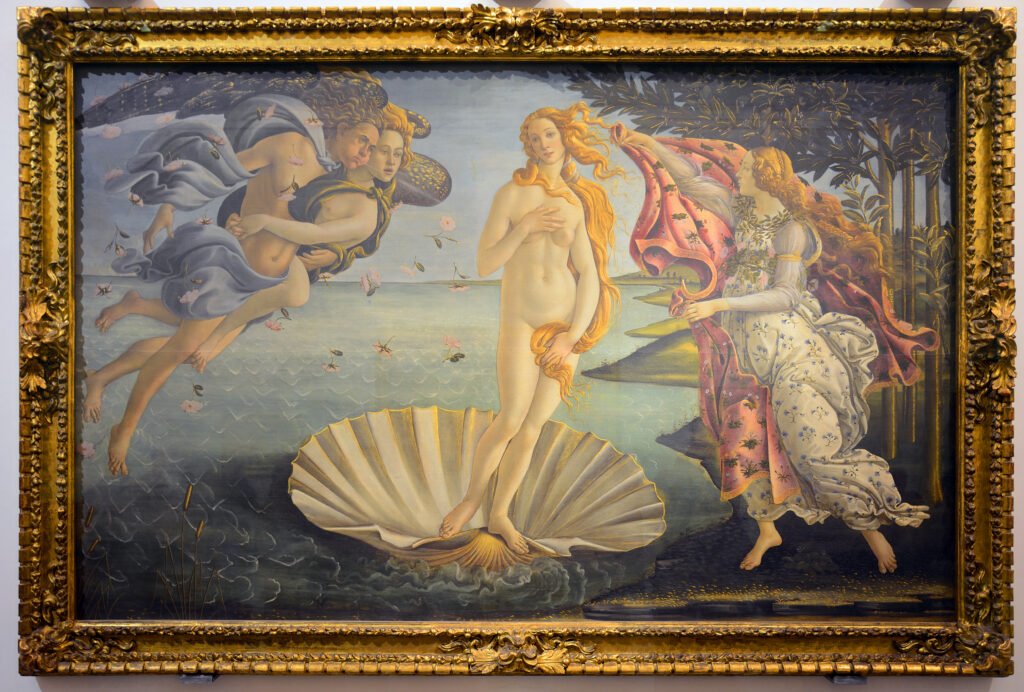
Renaissance artists developed and refined techniques that let them represent the natural world with unprecedented accuracy and emotional depth. Linear perspective, systematized by Filippo Brunelleschi in the early fifteenth century, let painters depict three-dimensional space convincingly on a flat surface. Artists also studied human anatomy directly, often through dissection, to depict the human body more accurately than medieval art typically had, and they increasingly used oil paint, which dries slowly and allows for fine blending and layering, to achieve subtler light, shadow, and skin tones than earlier tempera-based techniques generally permitted. Sandro Botticelli’s The Birth of Venus, painted in the 1480s, exemplifies the period’s revived interest in classical mythology as a subject alongside the religious themes that had dominated medieval European art.
The High Renaissance masters
The period often called the High Renaissance, roughly the late fifteenth through early sixteenth centuries, produced some of the most widely recognized figures in Western art history. Leonardo da Vinci combined technical mastery with wide-ranging scientific curiosity, applying careful observation of anatomy, light, and nature to paintings such as the Mona Lisa. Michelangelo worked across sculpture, painting, and architecture, producing the Sistine Chapel ceiling and the sculpture David among many other major works. Raphael, somewhat younger than both, synthesized elements of his predecessors’ approaches into a harmonious, idealized style exemplified by frescoes such as The School of Athens, painted for the Vatican.
Spread beyond Italy
Renaissance ideas and techniques spread northward and westward across Europe over the fifteenth and sixteenth centuries, carried by traveling artists, printed books, and increasing trade and diplomatic contact between regions. The Northern Renaissance, centered in regions including the Low Countries and Germany, developed its own distinct character, with artists such as Jan van Eyck achieving extraordinary detail and realism in oil painting somewhat independently of Italian developments, while printing, especially Johannes Gutenberg’s movable-type printing press developed in Germany around the mid-fifteenth century, dramatically accelerated the spread of both classical texts and new Renaissance ideas across the continent.
Debated causes: plague, trade, and recovery
Historians continue to debate exactly why these conditions converged in fourteenth-century Florence specifically rather than elsewhere, and the explanation is not limited to patronage and wealth alone. Some historians point to the demographic and economic disruption caused by the Black Death, the devastating plague pandemic that killed a large share of Europe’s population starting in 1347, arguing that the resulting labor shortages, land redistribution, and social disruption paradoxically created new opportunities for social and economic mobility among surviving merchant and artisan classes in the decades that followed. Others place more weight on Italy’s dense network of independent city-states, each competing for prestige and trade advantage, which encouraged rulers and wealthy families to fund visible displays of cultural achievement as a form of civic and political competition. Most historians today treat the Renaissance as the product of multiple reinforcing factors rather than any single decisive cause, cautioning against attributing the period’s flowering to one simple explanation.
Beyond art: science and thought
The Renaissance’s intellectual changes extended well beyond the visual arts. Humanist scholars emphasized direct study of classical Greek and Latin texts, often recovered or newly translated during this period, and promoted education and individual achievement in ways that gradually shifted European intellectual life away from certain medieval scholastic traditions. The period also set important groundwork for the later Scientific Revolution, as figures including Leonardo da Vinci combined artistic observation with investigations into anatomy, mechanics, and natural phenomena, while astronomers such as Nicolaus Copernicus, working in the sixteenth century, began challenging long-accepted models of the universe, developments that built on Renaissance humanism’s emphasis on direct observation and inquiry.
When and how the Renaissance ended
Historians do not point to a single clean end date for the Renaissance, since its ideas and techniques continued evolving into later styles, including Mannerism and eventually the Baroque period, rather than stopping abruptly. Most historians place the Renaissance’s latter phase in the sixteenth century, with its influence and many of its core ideas, including humanism’s emphasis on classical learning and individual achievement, persisting and evolving well into later European intellectual and artistic movements rather than disappearing at a defined boundary.
FAQs
Why did the Renaissance begin in Florence specifically? A combination of concentrated merchant and banking wealth, especially from families like the Medici, patronage funding for artists and scholars, and a cultural climate increasingly interested in classical learning and individual achievement created conditions in Florence that were unusually favorable for the period’s rapid developments.
Is the Renaissance considered a single unified movement across all of Europe? Not exactly; while shared interests in classical learning and new artistic techniques spread widely, different regions, such as Italy and the Northern Renaissance in the Low Countries and Germany, developed somewhat independent characteristics and timelines rather than following one identical pattern.
Key facts
- Began in Florence in the 14th century, funded heavily by Medici patronage
- High Renaissance masters: Leonardo da Vinci, Michelangelo, Raphael
- Linear perspective and oil painting technique matured during this period
- Spread north via the Northern Renaissance and Gutenberg's printing press
Related concepts
Quick checkWhy did the Renaissance begin in Florence specifically?Show answer
Concentrated merchant/banking wealth (notably the Medici), artistic patronage, and a humanist cultural climate combined favorably there.
Sources
- Smarthistory. Early applications of linear perspective. https://smarthistory.org/early-applications-of-linear-perspective
Editorially reviewed by Specialty Digest Editorial TeamLast reviewed November 1, 2026Researched and drafted with AI assistanceReport an issue