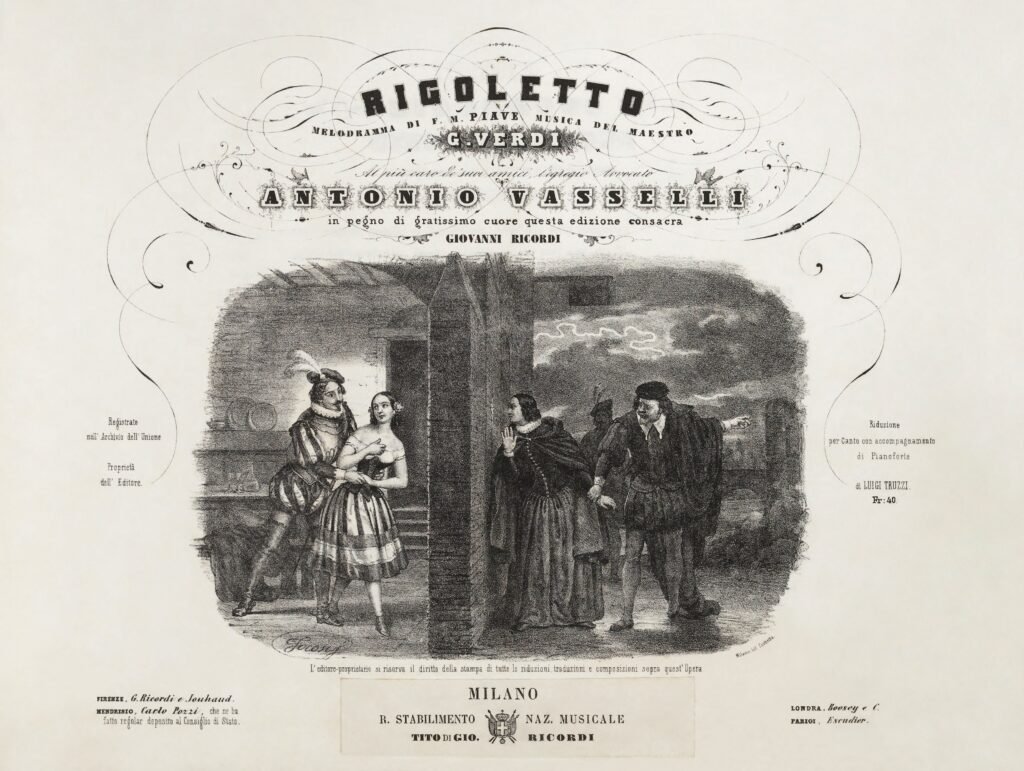
A libretto is the text, including both the words to be sung and any accompanying stage directions, written for an opera, operetta, oratorio, cantata, or musical, distinct from both a simple plot summary and the composer’s musical score that ultimately sets that text to music.
Libretto versus score
Although a printed score contains the libretto’s words set beneath the music, a separately printed libretto edition does not always match the score exactly, since composers frequently repeat words or short phrases musically in ways a plain printed libretto would not; Giacomo Puccini’s opera Turandot, for instance, repeats the closing line of a famous aria within the score even though the words appear only once in a simple printed text.
Famous librettist-composer partnerships
Certain librettist-composer partnerships have become especially celebrated in opera history. Lorenzo Da Ponte wrote the libretti for three of Wolfgang Amadeus Mozart’s most celebrated operas, including Don Giovanni, while Arrigo Boito, himself a composer of two operas, wrote influential libretti for Giuseppe Verdi’s late operas as well as for composer Amilcare Ponchielli. In English-language theater, librettist W. S. Gilbert’s long partnership with composer Arthur Sullivan produced a string of enduringly popular comic operas performed regularly to this day.
Adapting existing works
Librettists frequently adapt an opera or musical’s text from an already-existing play or novel rather than writing an entirely original story. Well-known examples include Oklahoma!, adapted from Lynn Riggs’s play Green Grow the Lilacs; My Fair Lady, adapted from George Bernard Shaw’s Pygmalion; Oliver!, adapted from Charles Dickens’s novel Oliver Twist; and Alban Berg’s opera Wozzeck, adapted from Georg Buchner’s unfinished play Woyzeck. Claude Debussy’s opera Pelleas et Melisande, based on a play by Maurice Maeterlinck, has become considerably more widely performed today than the original play that inspired it, illustrating how thoroughly a well-set libretto can eventually eclipse its own literary source.
The librettist’s limited recognition
Despite writing the actual words audiences hear sung, librettists have historically received far less public recognition than the composers whose music carries those words, with most operagoers readily able to name an opera’s composer while remaining unaware of who wrote its text, a lasting imbalance that has only partly eased as scholars and opera companies have worked to credit librettists more prominently in recent decades.
Writing for the voice
Writing an effective libretto requires skills distinct from writing an ordinary play or novel, since a librettist must shape dialogue and verse that will be sung, often repeated, and sometimes stretched or compressed by a composer’s musical setting, requiring close collaboration between librettist and composer to ensure the finished words serve the music as effectively as the drama.
The libretto’s dramatic structure
A libretto must balance dramatic storytelling with the practical demands of musical setting, typically alternating between recitative-like passages that advance plot quickly and more static, musically elaborate passages, such as arias and ensembles, where the drama pauses to let a composer develop a scene’s emotional content at length.
Translating libretti
Because operas are frequently performed internationally in their original language, many opera houses provide translated surtitles projected above the stage so audiences can follow a libretto’s meaning without requiring a fully sung translation, a practice that became standard at major opera houses only in the later twentieth century, after earlier eras more often simply translated and re-sang the entire libretto into the local language.
Collaborative revision
Librettos frequently went through extensive revision during an opera’s composition, with composers requesting specific textual changes to fit a musical idea already in progress, meaning a finished libretto often reflects close, sometimes contentious, back-and-forth collaboration between librettist and composer rather than a text the composer simply received complete and set to music without alteration.
Musicals and the modern libretto
In musical theater, the libretto, sometimes called simply the book, is often credited separately from both the songwriting lyricist and the composer, reflecting the same underlying division between spoken or sung dramatic text and musical setting that has defined opera’s libretto tradition for centuries.
Notable self-written libretti
Although most operas rely on a separate librettist, some composers wrote their own libretti, most famously Richard Wagner, who insisted on writing the full texts for all of his mature operas himself, treating text and music as a single unified creative act rather than two separable contributions from different artists.
Studying libretti today
Opera scholars and performers continue studying libretti as literary texts in their own right, analyzing how a librettist’s specific word choices, pacing, and dramatic structure shaped the finished opera, work that has helped gradually raise librettists’ standing as significant creative contributors rather than mere support staff for a composer’s music.
Librettists as literary figures
Some librettists achieved significant literary reputations independent of their opera work, and modern scholarship increasingly treats major libretti, including Da Ponte’s work for Mozart, as sophisticated literary texts worth studying on their own terms rather than simply as functional scaffolding beneath a composer’s score.
FAQs
What is the difference between a libretto and a musical score? A libretto is the written text and stage directions for an opera or musical, while the score is the composer’s musical setting of that text, and a separately printed libretto does not always match the score exactly since composers often repeat words musically.
Why do so few people know who wrote a famous opera’s libretto? Composers have historically received far more public recognition than librettists, even though the librettist wrote the actual words being sung, a long-standing imbalance that opera scholars and companies have only partly corrected in recent decades.
Key facts
- Italian for 'booklet'; distinct from the musical score
- Lorenzo Da Ponte wrote libretti for three major Mozart operas
- Many libretti adapt existing plays or novels, such as My Fair Lady from Pygmalion
- Librettists have historically received far less recognition than composers
Related concepts
Quick checkWhat is a libretto?Show answer
A libretto is the text, including sung words and stage directions, written for an opera, operetta, oratorio, or musical.
Sources
- Wikipedia, Libretto
Editorially reviewed by Specialty Digest Editorial TeamLast reviewed November 1, 2026Researched and drafted with AI assistanceReport an issue