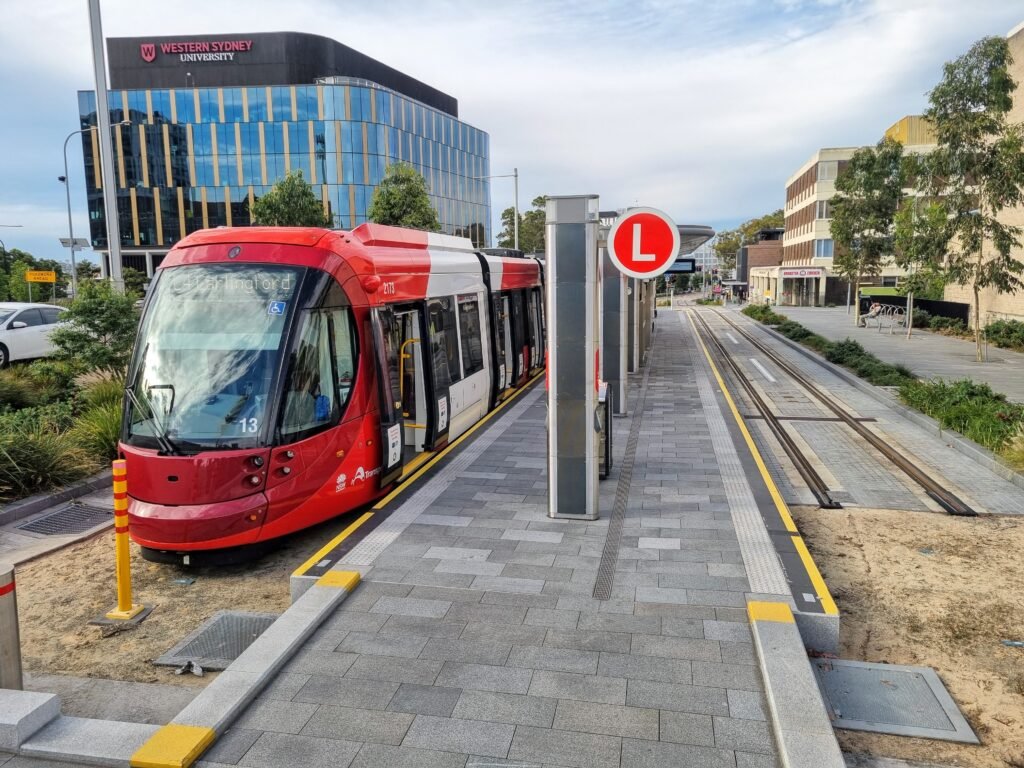
Positioning Between Bus and Subway
Light rail transit occupies a middle position in the hierarchy of urban transit modes, offering higher capacity and generally smoother, faster service than buses while typically costing less to build than a fully grade-separated heavy rail subway. Light rail vehicles are usually narrower and lighter than subway cars, allowing them to negotiate tighter curves and, in many systems, run at street level through city centers before transitioning to dedicated rights-of-way in outer areas, a flexibility that has made light rail attractive to mid-sized cities that need more capacity than buses provide but cannot justify full subway construction costs.
Revival After Mid-Century Decline
Many cities around the world built extensive streetcar networks in the late nineteenth and early twentieth centuries, only to dismantle most of them by the mid-twentieth century as automobile ownership expanded and transit investment shifted toward buses and highways. Starting in the 1970s and accelerating through subsequent decades, a wave of light rail revival swept through North America, Europe, and elsewhere, as cities sought a transit option that offered more capacity and permanence than buses while being more affordable and faster to build than subway expansion, often using light rail investment to anchor broader urban redevelopment along the new line.
Operating Environment Trade-offs
Running light rail at street level, mixed with other traffic and pedestrians, keeps construction costs down and integrates the system visibly into the urban fabric, but it also exposes trains to the same congestion and traffic signal delays that slow buses, limiting the speed advantage light rail can achieve over bus alternatives on heavily trafficked corridors. Cities seeking faster, more reliable light rail service increasingly invest in dedicated lanes, signal priority, and grade separation at the busiest intersections, effectively borrowing design principles from bus rapid transit and heavy rail to strengthen the parts of a light rail line most prone to delay.
Vehicle Technology and Low-Floor Design
Modern light rail vehicles have largely shifted to low-floor designs that eliminate steps between the platform and the vehicle interior, improving accessibility for wheelchair users, parents with strollers, and elderly riders while also speeding up boarding and alighting at every stop. This shift required substantial engineering changes to accommodate motors, wheels, and other mechanical components that traditionally occupied the space beneath a high-floor vehicle, and has become close to a universal standard for new light rail orders in North America and Europe over the past two decades.
Many systems also run longer multi-car trains during peak periods and shorter single-car trains during off-peak hours, allowing operators to match capacity to demand without running needlessly long and costly trains when ridership is light, a flexibility that gives light rail an operating efficiency advantage over fixed-length subway trains in some contexts.
Interaction with Freight and Emergency Vehicles
Light rail lines that share street-level right-of-way must carefully coordinate with freight delivery access, emergency vehicle routes, and parking regulations along the corridor, since conflicts between a scheduled rail line and the everyday demands of an active commercial street can create friction that purely rail-dedicated corridors never encounter. Cities have addressed this through time-restricted loading zones, dedicated turn lanes for cross traffic, and close coordination with fire and emergency services to ensure response routes remain clear even where rail tracks occupy part of the roadway.
Noise and vibration mitigation, including resilient rail fasteners and, in some cases, embedded track in a continuous concrete slab, has also become standard practice for light rail built near residential buildings, reflecting lessons learned from early systems that generated noise complaints significant enough to affect political support for further expansion.
Fare integration between light rail and connecting bus or regional rail services, through unified smart card systems, has also proven important for maximizing light rail ridership by removing payment friction at transfer points.
Modern Streetcar Revivals
Distinct from full light rail, a parallel revival of modern streetcar lines, generally running entirely in mixed traffic without the dedicated lanes or signal priority that distinguish higher-performing light rail, has occurred in numerous North American cities since the 2000s, often justified primarily by their economic development and placemaking benefits rather than pure transportation capacity or speed. Critics have noted that streetcars built without any traffic priority can run slower than walking over short distances once mixed-traffic delays are included, prompting debate within the transit planning field about whether such projects should be classified alongside true light rail or treated as a distinct, lower-performing mode with different and more limited transportation goals.
Comparing Construction Costs Across Cities
Light rail construction costs per mile vary enormously across different cities and countries, shaped by factors including labor costs, the extent of underground or elevated sections required, utility relocation needs, and local procurement and permitting processes, making direct cost comparisons between projects in different regions an unreliable guide without careful adjustment for these underlying differences. Transit planners increasingly caution against assuming a light rail line in one city will cost proportionally the same per mile as a similar-looking line built elsewhere, given how significantly local conditions can swing total project cost.
Procurement of light rail vehicles typically involves lead times of several years from order to delivery, a planning constraint that transit agencies must factor into expansion timelines well before construction even begins.
Depot and maintenance yard siting for new light rail lines often requires significant land assembly, a planning hurdle that can be as politically contentious as the passenger-facing route itself.
Platform-level boarding further speeds dwell time at each stop along a route.
Key facts
- Array
Quick checkHow does light rail differ from a heavy rail subway system?Show answer
Light rail uses lighter vehicles, can share street-level right-of-way with other traffic, and generally costs less to build than a fully separated subway.
Sources
- Array
Editorially reviewed by Specialty Digest Editorial TeamLast reviewed November 4, 2026Researched and drafted with AI assistanceReport an issue