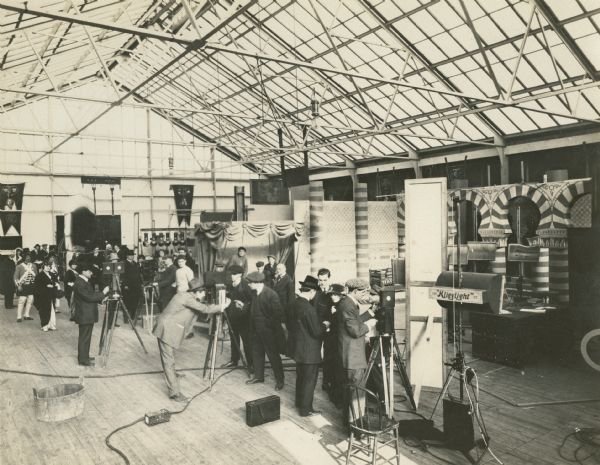
Mise-en-scene is a French term, literally meaning ‘placing on stage,’ used in film studies to describe everything that appears in front of the camera and how those elements are arranged to shape a scene’s mood and meaning. It covers set design, costume, lighting, the positioning and movement of actors, and the overall composition of the frame, treating these choices as a coherent visual language rather than incidental background detail.
n
From theatre to film criticism
n
The term originates in theatre, where it described the staging of a play, and was later adopted by film critics to analyze a director’s visual style independent of editing. French critics associated with the influential magazine Cahiers du Cinema used mise-en-scene analysis in the 1950s as part of auteur theory, which argued that a director’s personal vision could be identified through consistent choices in how scenes were staged and filmed, not only through the story being told.
n
Elements of mise-en-scene
n
Analysts typically break mise-en-scene into several components: set design and the props visible within a scene; costume, makeup, and hairstyles, which can signal a character’s traits or a historical period; lighting, whose direction and intensity shape mood and draw attention to particular elements; and composition, meaning how actors and objects are positioned and move within the frame. Critic Ed Sikov has argued that mise-en-scene treats every visible detail as meaningful, including conspicuous absences, such as a deliberately bare wall.
n
Mise-en-scene versus montage
n
Mise-en-scene is often discussed in contrast to montage, a different approach to film storytelling that relies on the rhythm and juxtaposition of editing between shots rather than what is arranged within a single shot. Directors who favor mise-en-scene often use long takes and deep focus, a technique that keeps multiple planes of a shot in sharp focus simultaneously, as seen in Orson Welles and cinematographer Gregg Toland’s work on Citizen Kane, allowing a viewer’s eye to move through a densely staged frame rather than having the director’s editing do that work.
n
Why mise-en-scene matters to directors
n
Because mise-en-scene lets a director communicate character, power dynamics, and atmosphere without relying on dialogue or editing, it is one of the primary tools used to analyze a filmmaker’s personal visual signature across multiple films. A director’s consistent use of particular color palettes, framing choices, or blocking patterns is often cited by critics as evidence of a distinctive directorial style, separate from whichever story a given film happens to tell.
n
Directors known for mise-en-scene
n
Certain directors are especially closely associated with distinctive, highly controlled mise-en-scene. Stanley Kubrick became known for meticulously symmetrical compositions and carefully centered framing across very different films, while director Wes Anderson has built a widely recognized visual signature from flat, frontal staging, pastel color palettes, and obsessively arranged props and sets, demonstrating how consistent mise-en-scene choices can become as recognizable as a director’s choice of subject matter.
n
Realist versus expressive staging
n
Mise-en-scene can lean toward realism or toward exaggeration, depending on a film’s goals. Italian Neorealist filmmakers of the 1940s favored unglamorous location shooting and naturalistic staging to emphasize authenticity, while German Expressionist cinema of the 1920s, such as The Cabinet of Dr. Caligari, used deliberately distorted, nightmarish sets and jagged shadows to externalize a character’s inner psychological state, showing how far mise-en-scene can stretch between documentary-like restraint and deliberately unreal visual exaggeration.
n
Color as a mise-en-scene tool
n
Color is one of the most deliberate mise-en-scene choices available to a director, used to reinforce mood, distinguish characters, or signal a shift in a story’s tone; a film might restrict most of its palette to muted, desaturated tones and then introduce a single saturated color to draw a viewer’s eye to an object or character that carries particular narrative weight. Production designers and directors typically plan a film’s color strategy well before shooting begins, coordinating set dressing, costume, and lighting so that color choices remain consistent across every scene.
n
Because mise-en-scene depends on decisions made well before the camera rolls, close collaboration between a director, production designer, cinematographer, and costume designer is essential, and disagreements among these roles about how a scene should look are among the most consequential creative conflicts that can arise during a film’s preparation.
n
Film students and critics often study a single scene’s mise-en-scene frame by frame to understand how these staging choices guide a viewer’s attention and emotional response, treating the frame itself as a text worth reading as closely as a film’s dialogue or plot.
n
Streaming platforms and the rise of high-resolution home displays have also raised the stakes for mise-en-scene, since fine detail in costume, set dressing, and lighting that might once have gone unnoticed on an older television is now far more visible to audiences watching on large, high-definition screens.
n
Even a film with a modest budget can use mise-en-scene thoughtfully, since the discipline depends far more on deliberate choices about existing space, light, and props than on expensive effects or elaborate sets.
n
This is part of why mise-en-scene remains one of the most frequently taught concepts in introductory film studies courses, since it rewards close attention regardless of a given film’s budget or production scale.
n
FAQs
n
Who first applied mise-en-scene to film criticism? The concept was adopted from theatrical staging by French film critics, especially those writing for Cahiers du Cinema in the 1950s, as part of a broader framework called auteur theory.
n
Is mise-en-scene only about the visual look of a film? Mostly, yes; it specifically concerns what is placed and arranged in front of the camera, which distinguishes it from other filmmaking tools such as editing, sound design, and camera movement, even though all of these elements work together in a finished film.
Key facts
- French for 'placing on stage', adapted from theatrical staging
- Popularized in film criticism by Cahiers du Cinema writers in the 1950s as part of auteur theory
- Contrasted with montage, which relies on editing rather than in-frame staging
- Citizen Kane's deep-focus cinematography is a classic mise-en-scene example
Related concepts
Quick checkWhat does mise-en-scene mean and where does the term come from?Show answer
It means 'placing on stage' in French, originating in theatre before being adopted by film critics to describe everything arranged in front of the camera.
Sources
- Wikipedia, Mise-en-scene
- No Film School, What is Mise en Scene?
- Open Oklahoma State University textbook, Mise en scene chapter
Editorially reviewed by Specialty Digest Editorial TeamLast reviewed November 1, 2026Researched and drafted with AI assistanceReport an issue