User interface design is the practice of designing the visual and interactive elements, including buttons, menus, icons, and screen layouts, through which a person operates a digital system such as a computer, website, or mobile app. Good interface design aims to make a system’s functions clear and predictable, so that people can accomplish tasks without needing to understand how the underlying software actually works.
n
Origins at Xerox PARC
n
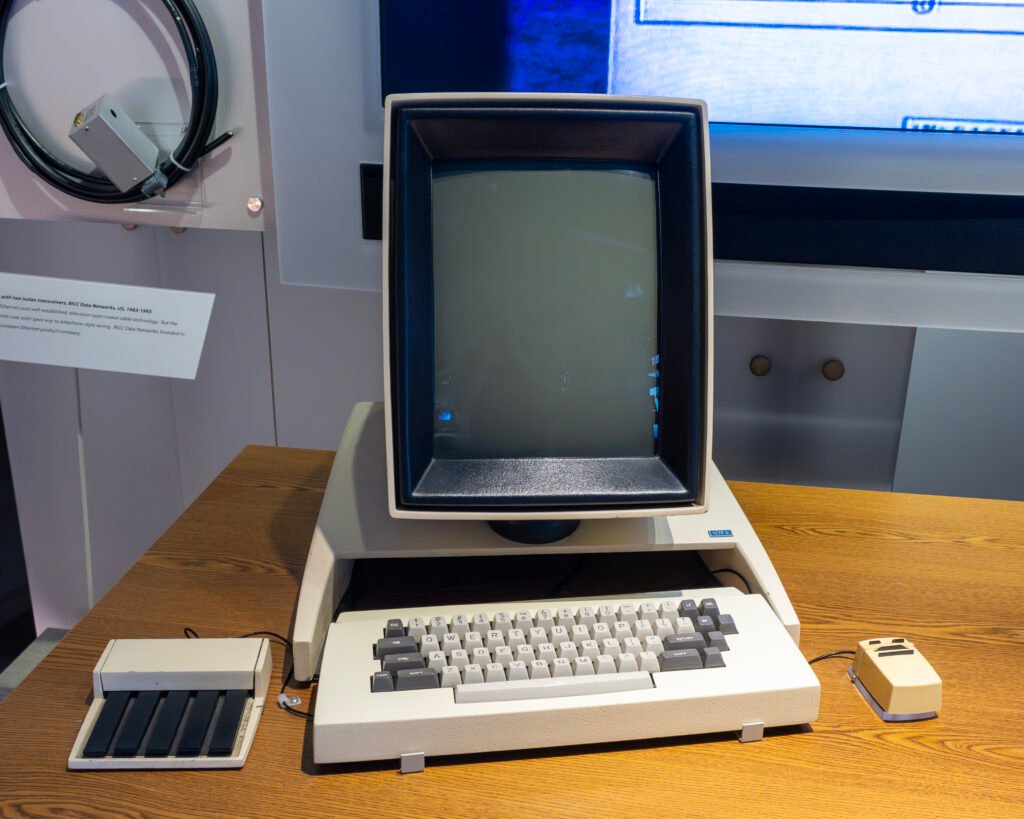
The modern graphical user interface traces back to the Xerox Alto, a research computer built at Xerox’s Palo Alto Research Center starting in 1973. The Alto used a bitmapped display and a mouse, and its Smalltalk programming environment supported overlapping windows, establishing the basic visual vocabulary, icons, windows, and a pointer, that would come to define graphical computing, even though Xerox itself largely failed to turn the Alto into a commercial product.
n
Apple’s adoption of the GUI
n
In 1979, Apple co-founder Steve Jobs toured Xerox PARC and came away convinced that a graphical interface represented the future of personal computing. Apple’s Lisa computer, released in 1983, and the far more influential Macintosh, released in 1984, brought a graphical, mouse-driven interface to a mass consumer audience for the first time, popularizing what designers often call the WIMP model, for windows, icons, menus, and a pointer.
n
The GUI spreads to Windows
n
Microsoft released Windows 1.0 in 1985, bringing a similar graphical interface to the much larger base of IBM-compatible personal computers. Steve Jobs later accused Microsoft of copying Apple’s interface, to which Bill Gates reportedly replied that both companies had drawn on a shared, wealthy neighbor named Xerox, a response that also weakened Apple’s subsequent legal case against Microsoft over the look of its interface.
n
From desktop to mobile and web
n
Interface design expanded dramatically with the growth of the web through the 1990s and then with touchscreen smartphones, especially after Apple’s iPhone launched in 2007 and replaced the mouse pointer with direct finger input. Designers had to rethink established conventions for much smaller screens and touch-based interaction, giving rise to responsive design practices that adapt a single interface to many different screen sizes.
n
Core principles and UI versus UX
n
Interface designers generally work by a consistent set of principles, including visual consistency across a product, clear feedback after a user’s action, visible affordances that signal what can be interacted with, and a clear hierarchy that draws attention to the most important elements first. User interface design is often discussed alongside user experience, or UX, design, which focuses more broadly on how a person navigates and feels about an entire product rather than the specific visual controls on screen; the two fields overlap substantially but are not identical.
n
An earlier precursor: the Mother of All Demos
n
Before the Xerox Alto, engineer Douglas Engelbart gave a landmark 1968 public demonstration, later nicknamed the ‘Mother of All Demos,’ showcasing a computer mouse, hypertext links, and collaborative real-time editing years ahead of their eventual mainstream adoption. Engelbart’s work is widely credited as a direct influence on the Xerox PARC researchers who built the Alto a few years later, making him an important precursor to graphical interface design even though his own system did not yet use a fully graphical, window-based interface.
n
Skeuomorphism and the shift to flat design
n
Interface design has also gone through distinct stylistic phases. Early smartphone interfaces, including Apple’s iOS before 2013, often used skeuomorphism, a design approach that made on-screen buttons and icons resemble real-world textures and objects, such as a notepad app styled to look like torn yellow paper, to help users intuitively understand unfamiliar touchscreen interactions. Apple’s iOS 7, released in 2013, marked a widely noted industry shift toward flat design, which stripped away these realistic textures in favor of simpler shapes, flat colors, and clean typography, a stylistic direction most major interface design systems have followed since.
n
Accessibility in interface design
n
Modern interface design also has to account for accessibility, ensuring that people with visual, motor, hearing, or cognitive disabilities can still use a digital product effectively. The Web Content Accessibility Guidelines, maintained by the World Wide Web Consortium, provide widely adopted standards covering issues such as sufficient color contrast, keyboard navigability, and compatibility with screen readers, and many governments now require digital products, especially public-facing or government websites, to meet specific accessibility conformance levels.
n
User testing, in which designers observe real people attempting to complete tasks with a prototype interface, has also become a standard part of the interface design process, since problems that seem minor to a designer familiar with a product often turn out to confuse first-time users in practice.
n
Design systems, reusable libraries of interface components, colors, and typography rules shared across a product or an entire company, have also become standard practice, letting large design and engineering teams maintain visual and functional consistency across many different screens and features without redesigning each one from scratch.
n
As voice assistants, wearable devices, and augmented reality headsets have grown more common, interface designers have also had to extend these same core principles, consistency, feedback, and clear hierarchy, into contexts that go well beyond the traditional screen-and-pointer model the field originally grew up around.
n
FAQs
n
Who invented the graphical user interface? No single person invented it; it emerged from research at Xerox PARC in the early 1970s, led by a team working on the Alto computer, before Apple and later Microsoft popularized it commercially.
n
Is UI design the same as UX design? No; UI design focuses specifically on a product’s visual and interactive controls, while UX design focuses more broadly on a person’s overall experience and satisfaction using a product, though the two disciplines are closely linked and often practiced together.
Key facts
- The graphical user interface originated at Xerox PARC with the Alto computer (1973)
- Apple's Macintosh (1984) brought the GUI to a mass consumer audience
- Microsoft released Windows 1.0 with a similar graphical interface in 1985
- The 2007 iPhone shifted interface design toward touchscreen interaction
Related concepts
Quick checkWhat research lab originated the graphical user interface?Show answer
Xerox's Palo Alto Research Center (PARC), with the Alto computer starting in 1973.
Sources
- apple-history.com, Graphical User Interface (GUI)
- NoGood, What is Graphical User Interface (GUI) Design?
- Wikipedia, History of the graphical user interface
Editorially reviewed by Specialty Digest Editorial TeamLast reviewed November 1, 2026Researched and drafted with AI assistanceReport an issue